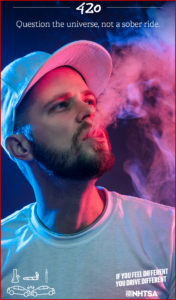
Click for more information.
Marijuana laws are changing constantly across the country. One thing that hasn’t changed. Impaired driving. Is still illegal. Thursday, 20 April 2023, marks the unofficial marijuana “holiday.” So odds are there will be an increase in marijuana use, says the U.S. Department of Transportation’s National Highway Traffic Safety Administration.
“High, stoned, wasted, zonked – doesn’t matter what term you use, if you’re impaired, don’t get behind the wheel of a vehicle,” suggests AutoInformed. “We are asking our readers to use judgement, obey the law, and above all make safe choices before your drive any type of vehicle.”
In 2019, 49% of drivers who were killed in crashes and were tested for drugs, tested positive. Therefore, If You Feel Different, You Drive Different. If you think being high won’t affect your driving, think again. It has been proven that marijuana can slow reaction times, impair cognitive performance, and make it more difficult for drivers to keep a steady position in their lane.
Those who plan to use marijuana on 4/20 – or any time – should not drive. If you find yourself drug-impaired and stranded with your vehicle, give your keys to a sober driver who can safely drive you home or to your next stop. Remind your friends to never get in the vehicle with an impaired driver. If you have a friend who is about to drive while high, take the keys away and help them get home safely. Don’t worry about offending someone – you could save their or someone else’s life.

About Ken Zino
Ken Zino, editor and publisher of AutoInformed, is a versatile auto industry participant with global experience spanning decades in print and broadcast journalism, as well as social media. He has automobile testing, marketing, public relations and communications experience. He is past president of The International Motor Press Assn, the Detroit Press Club, founding member and first President of the Automotive Press Assn. He is a member of APA, IMPA and the Midwest Automotive Press Assn.
He also brings an historical perspective while citing their contemporary relevance of the work of legendary auto writers such as Ken Purdy, Jim Dunne or Jerry Flint, or writers such as Red Smith, Mark Twain, Thomas Jefferson – all to bring perspective to a chaotic automotive universe.
Above all, decades after he first drove a car, Zino still revels in the sound of the exhaust as the throttle is blipped during a downshift and the driver’s rush that occurs when the entry, apex and exit points of a turn are smoothly and swiftly crossed. It’s the beginning of a perfect lap.
AutoInformed has an editorial philosophy that loves transportation machines of all kinds while promoting critical thinking about the future use of cars and trucks.
Zino builds AutoInformed from his background in automotive journalism starting at Hearst Publishing in New York City on Motor and MotorTech Magazines and car testing where he reviewed hundreds of vehicles in his decade-long stint as the Detroit Bureau Chief of Road & Track magazine. Zino has also worked in Europe, and Asia – now the largest automotive market in the world with China at its center.









Tucked into the sprawling bipartisan infrastructure law passed in 2021 is a congressional mandate for the National Highway Traffic Safety Administration (NHTSA) to require every new passenger vehicle to be equipped with a system that prevents an alcohol-impaired driver from operating it.
The law is a huge victory for advocates, led by victims of impaired driving and Mothers Against Drunk Driving, but plenty of safety rules have withered on the vine despite legislative action. It’s the job of federal agencies to flesh out Congress’ intentions, and they sometimes deviate from them.
In this case, NHTSA must complete several large tasks before issuing a final regulation. The agency will need to research the breadth of potential technologies before determining what tests and criteria to use to evaluate manufacturer compliance. It’s also expected to come up with a cost estimate for equipping the fleet and compare that with the total societal cost of illegal impaired driving ($296 billion in 2019 by NHTSA’s own calculation). Finally, it must publish a proposed regulation, weigh public comments and make revisions as needed. The process doesn’t lend itself to shortcuts, which is why it’s crucial that the agency proceed without delay.
The technology itself is closer to being ready than most people realize. But because few consumers would pay extra to equip their vehicle with an impaired driving prevention system, automakers have had little incentive to bring it to market. A regulatory requirement would push it over the finish line.
One system already being tried out in fleets was developed by the Driver Alcohol Detection System for Safety (DADSS) project, a partnership between NHTSA and the auto industry. The DADSS breath-based system is in some ways similar to ignition interlocks that are often installed by court order on the vehicles of people convicted of driving while intoxicated. However, unlike those interlocks, the passive system doesn’t require the driver to blow into a tube or take any special action; it simply analyzes the driver’s exhalations from normal breathing and prevents the vehicle from moving if it determines the driver has had too much to drink. The consortium is also working on a touch-based system that would analyze the driver’s skin.
David Zuby is Executive Vice President and Chief Research Officer, IIHS – AutoCrat