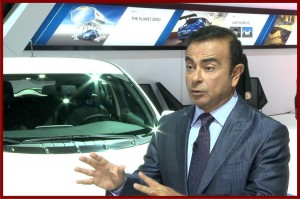
Ghosn’s Leaf EV sales predictions have thus far failed to materialize costing shareholders billions.
The Renault-Nissan Alliance claimed record synergies, jargon for cost cuts or cost avoidance and a soft number at best – of €2.69 billion (~$3.44 million) in 2012, up from €1.75 billion during 2011.
Only new savings – not cumulative ones – are taken into account every year. As a result, the Alliance that was established in 1999 when Nissan was facing bankruptcy, arguably now has the longest-lasting cross-cultural partnership in the auto industry. Paris-based Renault and Yokohama, Japan-based Nissan, which together sell one in 10 cars worldwide sold 8.1 million cars in nearly 200 countries in 2012.
“Synergies and greater economies of scale allow Renault and Nissan to compete in an elite tier of the world’s top automakers globally,” said Christian Mardrus, Renault-Nissan Alliance Managing Director for Logistics and the Office of the CEO. “We expect to generate even more synergies going forward, particularly in emerging markets such as Brazil, Russia, India and China.”
In a release, the Alliance claimed that as in previous years, the major contributors to cost reductions by business unit in 2012 were purchasing (€851 million), powertrain (709 million euros) and vehicle engineering (€546 million).
One area that it clearly did not help was product planning, where both companies clearly missed hybrid vehicles by more than a decade, and are thus far conducting a very costly multi-billion Euro bet on electric vehicles with sales far lagging initial predictions of 20% of volume by the end of the century. Carlos Ghosn, the CEO, continues to defend the investment saying that it is just a little ahead of the sales curve.
Synergies increasingly come from traditional automaking tasks in Asia and emerging markets such as Russia, where the two manufacture both vehicles and powertrains together at the same plants.
The Alliance’s plant in Chennai, India, for example, is home to the biggest platform-sharing project within the Alliance. The plant, which has an annual production capacity of 400,000 units, produces both Renault and Nissan vehicles for export and the local market.
In Russia, the Alliance builds cars together with Avtovaz, Russia’s largest automaker, at the same facility in Togliatti. Last year, the Alliance gained a controlling interest in the maker of the much-derided Lada brand through a joint venture with state-owned Russian Technologies.
In South Korea, Nissan will start building the next-generation Rogue at the Renault Samsung Busan plant next year. Last year, the Alliance claimed significant cost improvements to the manufacturing process before the start of production of the sport utility vehicle. The improvements will increase production of the Nissan Rogue and will boost efficiency throughout the plant.
Since 2009, the Renault Nissan Purchasing Organization – the largest common Alliance organization, has handled all buying. Thanks to the 8-million-unit scale of the Alliance, it can negotiate better pricing than small companies could negotiate individually.
Powertrain synergies are derived from the co-development and exchange of engines and gearboxes. Thanks to their historical centers of excellence, Renault specializes in diesel and down-sized gasoline engines and manual transmissions, while Nissan specializes in natural aspirated gasoline engines and automatic transmissions.
Vehicle engineering synergies are mainly derived from shared platforms and common parts.