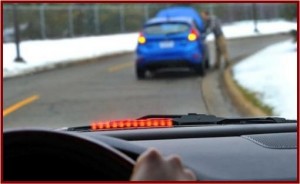
The red LED lights along the windshield base on the driver's side advise of danger ahead.
The U.S. Department of Transportation is testing consumer acceptance of so called connected vehicles – cars, trucks and buses with the ability to automatically talk to each other and with traffic lights and railroad crossings, among other advanced features. A National Highway Traffic Safety Administration (NHTSA) report found that connected vehicle technology has the potential to address 81% of all unimpaired driver related crashes, but there is little research in the area and no real world safety data.
In a release today, DOT said it is beginning Driver Acceptance Clinics to test new safety capabilities for Connected Vehicles. These driver clinics will explore how real drivers react to this new technology in urban, suburban, and rural communities across the U.S.
The clinics are part of a taxpayer cymbalta financed DOT research program to make vehicles safer through the use of wireless communication technology. DOT’s Research and Innovative Technology Administration (RITA) and National Highway Traffic Safety Administration (NHTSA) have partnered with the Crash Avoidance Metrics Partnership (CAMP) to lead these six driver clinics.
The first will be in August in Brooklyn, MI, followed by Minneapolis in September, Orlando in October, Blacksburg, VA, in November, Dallas in December, and San Francisco in January 2012.
In each community, about 100 local drivers will test 24 cars equipped with Dedicated Short Range Communications wireless safety technology in controlled locations or racetracks.
“We need to continue to research vehicle-to-vehicle technology, but these systems show a great amount of promise. We could be on the brink of making a real cultural change in terms of preventing crashes altogether,” said NHTSA Administrator David Strickland.








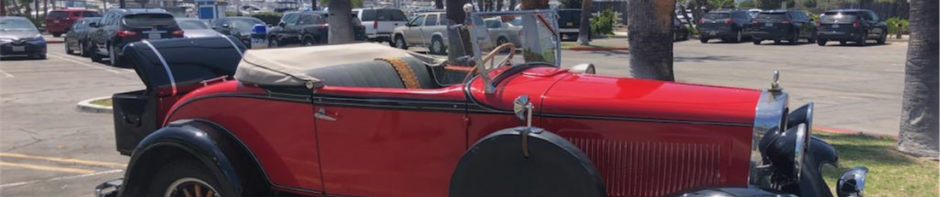
Circa 1958, GM tested a “wired” highway in a competition for a research contract from the Federal Highway Administration. The contract went to some other company (non-automotive, of course) but nothing came of it and GM abandoned the effort.
The idea was to imbed a wire which the vehicle would communicate with for steering, braking, etc., providing worry- and accident-free driving whether long distance or simple commute.
“There is Nothing New Under The Sun.”– Ecclesiastices, if only I could spell it.