Click to Enlarge.
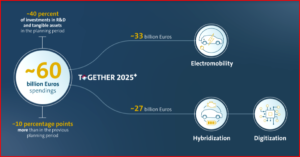
The Volkswagen Group has revealed its investment plan for 2020 to 2024*. The Group plans to spend nearly €60 billion on hybridization, electric mobility and digitalization in the next five years. This is slightly more than 40% of the company’s investments in property, plant and equipment and all research and development costs during the period. Compared with the Group’s last Planning Round, it’s an increase of around 10%. The Group intends to invest around €33 billion of this in electric mobility. (Drinking the Electrolyte? Audi Plans to Sell 800K EVs in 2025)
“We are resolutely pressing ahead with the transformation of the Volkswagen Group and focusing our investments on the future of mobility. This is part of our systematic and consequent implementation of the Group’s strategy,” said Hans Dieter Pötsch, Chairman of the Supervisory Board of the Volkswagen Group.
During Planning Round 68, the long-term plan for the next 10 years was also modified. Through 2029, the Group plans to introduce up to 75 all-electric models to the market along with about 60 hybrid vehicles. The number of projected e-vehicles will rise to about 26 million, largely due to the addition of a year to the planning period to include 2029. Volkswagen is also planning to sell nearly 6 million hybrid vehicles by 2029. (Volkswagen ID.R Sets New EV Record on The Nürburgring)
About 20 million of the e-vehicles planned through 2029 will be based on the Group’s Modular Electric Drive Matrix (MEB). Most of the remaining 6 million vehicles will be based on the High-Performance Platform (PPE). E-vehicles are scheduled to be made outside Germany by the company’s plants in Mlada Boleslav, Chattanooga, Foshan and Anting. Others will be produced by German plants in Zwickau, Emden, Hannover, Zuffenhausen and Dresden. Plans maxalt for the Emden site were confirmed, according to which production of the electric A-SUV (ID.Next) should start in 2022.
A camouflaged version of the ID.Next was presented at this year’s Internationale Automobil-Ausstellung (IAA). A decision about a planned multi-brand plant is scheduled to be made by the end of the year. (Volkswagen Breaks Ground on Expanded US EV Production, VW Group Electric Shuffle – Emden, Hanover to build EVs)
* The Chinese joint ventures are not included in the consolidated group and are excluded from the planning. These joint ventures finance investments in plants and products from their own resources.

About Ken Zino
Ken Zino, editor and publisher of AutoInformed, is a versatile auto industry participant with global experience spanning decades in print and broadcast journalism, as well as social media. He has automobile testing, marketing, public relations and communications experience. He is past president of The International Motor Press Assn, the Detroit Press Club, founding member and first President of the Automotive Press Assn. He is a member of APA, IMPA and the Midwest Automotive Press Assn.
He also brings an historical perspective while citing their contemporary relevance of the work of legendary auto writers such as Ken Purdy, Jim Dunne or Jerry Flint, or writers such as Red Smith, Mark Twain, Thomas Jefferson – all to bring perspective to a chaotic automotive universe.
Above all, decades after he first drove a car, Zino still revels in the sound of the exhaust as the throttle is blipped during a downshift and the driver’s rush that occurs when the entry, apex and exit points of a turn are smoothly and swiftly crossed. It’s the beginning of a perfect lap.
AutoInformed has an editorial philosophy that loves transportation machines of all kinds while promoting critical thinking about the future use of cars and trucks.
Zino builds AutoInformed from his background in automotive journalism starting at Hearst Publishing in New York City on Motor and MotorTech Magazines and car testing where he reviewed hundreds of vehicles in his decade-long stint as the Detroit Bureau Chief of Road & Track magazine. Zino has also worked in Europe, and Asia – now the largest automotive market in the world with China at its center.







Volkswagen Group Debuts Investment Plan for 2020-2024
Click to Enlarge.
The Volkswagen Group has revealed its investment plan for 2020 to 2024*. The Group plans to spend nearly €60 billion on hybridization, electric mobility and digitalization in the next five years. This is slightly more than 40% of the company’s investments in property, plant and equipment and all research and development costs during the period. Compared with the Group’s last Planning Round, it’s an increase of around 10%. The Group intends to invest around €33 billion of this in electric mobility. (Drinking the Electrolyte? Audi Plans to Sell 800K EVs in 2025)
“We are resolutely pressing ahead with the transformation of the Volkswagen Group and focusing our investments on the future of mobility. This is part of our systematic and consequent implementation of the Group’s strategy,” said Hans Dieter Pötsch, Chairman of the Supervisory Board of the Volkswagen Group.
During Planning Round 68, the long-term plan for the next 10 years was also modified. Through 2029, the Group plans to introduce up to 75 all-electric models to the market along with about 60 hybrid vehicles. The number of projected e-vehicles will rise to about 26 million, largely due to the addition of a year to the planning period to include 2029. Volkswagen is also planning to sell nearly 6 million hybrid vehicles by 2029. (Volkswagen ID.R Sets New EV Record on The Nürburgring)
About 20 million of the e-vehicles planned through 2029 will be based on the Group’s Modular Electric Drive Matrix (MEB). Most of the remaining 6 million vehicles will be based on the High-Performance Platform (PPE). E-vehicles are scheduled to be made outside Germany by the company’s plants in Mlada Boleslav, Chattanooga, Foshan and Anting. Others will be produced by German plants in Zwickau, Emden, Hannover, Zuffenhausen and Dresden. Plans maxalt for the Emden site were confirmed, according to which production of the electric A-SUV (ID.Next) should start in 2022.
A camouflaged version of the ID.Next was presented at this year’s Internationale Automobil-Ausstellung (IAA). A decision about a planned multi-brand plant is scheduled to be made by the end of the year. (Volkswagen Breaks Ground on Expanded US EV Production, VW Group Electric Shuffle – Emden, Hanover to build EVs)
* The Chinese joint ventures are not included in the consolidated group and are excluded from the planning. These joint ventures finance investments in plants and products from their own resources.
About Ken Zino
Ken Zino, editor and publisher of AutoInformed, is a versatile auto industry participant with global experience spanning decades in print and broadcast journalism, as well as social media. He has automobile testing, marketing, public relations and communications experience. He is past president of The International Motor Press Assn, the Detroit Press Club, founding member and first President of the Automotive Press Assn. He is a member of APA, IMPA and the Midwest Automotive Press Assn. He also brings an historical perspective while citing their contemporary relevance of the work of legendary auto writers such as Ken Purdy, Jim Dunne or Jerry Flint, or writers such as Red Smith, Mark Twain, Thomas Jefferson – all to bring perspective to a chaotic automotive universe. Above all, decades after he first drove a car, Zino still revels in the sound of the exhaust as the throttle is blipped during a downshift and the driver’s rush that occurs when the entry, apex and exit points of a turn are smoothly and swiftly crossed. It’s the beginning of a perfect lap. AutoInformed has an editorial philosophy that loves transportation machines of all kinds while promoting critical thinking about the future use of cars and trucks. Zino builds AutoInformed from his background in automotive journalism starting at Hearst Publishing in New York City on Motor and MotorTech Magazines and car testing where he reviewed hundreds of vehicles in his decade-long stint as the Detroit Bureau Chief of Road & Track magazine. Zino has also worked in Europe, and Asia – now the largest automotive market in the world with China at its center.