
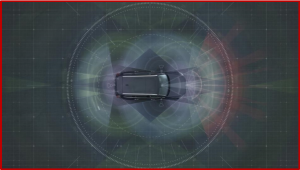
As a part of its autonomous driving project Volvo will use self-driving XC90s in real traffic – with ordinary people driving or riding along as the car drives. Exact positioning and a complete 360° view of the car’s surroundings by radars, cameras and laser sensors are used. A network of computers processes the data, generating a real-time map of moving and stationary objects in the environment.
Volvo Cars claims it will place 100 autonomous driving XC90 crossovers in the hands of customers on selected roads around Gothenburg by 2017. The public pilot is part of a plan to achieve a crash-free future. The highly autonomous car project requires the collaboration of legislators, transport authorities, a major city and a vehicle manufacturer.
Volvo’s web presentation of the autonomous driving project this morning had technical problems with an invalid embed code, thereby demonstrating how complex the computer programing is for even relatively well-known technologies. Also cyber security and privacy issues will need to be resolved.
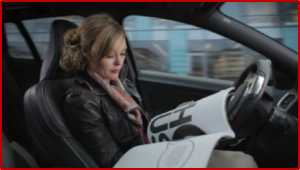
If perfected, autonomous driving allows for more efficient time-management behind the wheel.
Volvo appears to be in a unique position here, although virtually all automakers are working on autonomous driving vehicles. Safety systems, such as lane departure warnings, automatic braking, and intelligent cruise control are already in production. More integration with follow in the coming years as automakers link various systems together.
“Taking the exciting step to a public pilot, with the ambition to enable ordinary people to sit behind the wheel in normal traffic on public roads, has never been done before,” said Dr. Peter Mertens, Senior Vice President Research and Development of Volvo Car Group.
Volvo will start the recruiting process during 2016 but it has not decided on the method to pick drivers. However, there are some prerequisites, for instance that the customers need to live and/or work along the AD route around Gothenburg.
Volvo claims it has designed a complete production-viable autonomous driving system via a complex network of sensors, cloud-based positioning systems and intelligent braking and steering technologies. An autopilot system is designed to be reliable enough to allow the car to take over every aspect of driving in autonomous mode. The technology advances a crucial step beyond the automotive systems demonstrated so far, since it includes fault-tolerant systems.
The autonomous driving radar system used is quite complex. It includes seven radar sensors. The so-called Drive Me XC90s have one radar sensor looking forward, 4 corner radars monitoring the close range around the vehicle and two long range radars monitoring the rear and parallel lanes. The latter radars are primarily for lane changing.
A high definition 3D digital map is the tool used to provide the XC90 with information about the surroundings, altitude, road curvature, number of lanes, geometry of tunnels, guard rails, signs, exits, and so forth. The position geometry is in many cases at centimeter level.
A GPS system is one part of the positioning control that is enhanced by a combination of a 3-degrees of freedom accelerometer and a 3-degrees of freedom gyro. By matching the 360-degree image created by the multitude of sensors with the map image, the car will get the information about its position in relation to the surroundings.
The challenge is to design an autonomous driving autopilot that is robust for traffic scenarios as well as for technical faults that may occur. It cannot be expected that the driver is ready to intervene in a critical situation. Initially, the cars will drive autonomously on selected roads with suitable conditions, for example without oncoming traffic, cyclists and pedestrians.
“It is relatively easy to build and demonstrate a self-driving concept vehicle, but if you want to create an impact in the real world, you have to design and produce a complete system that will be safe, robust and affordable for ordinary customers,” says Dr. Erik Coelingh, Technical Specialist at Volvo Cars.
Autonomous Driving vehicles will have black boxes logging information while in autonomous driving mode. With this data Volvo will be able to understand what has happened. It will also be important to understand what has happened to make sure an incident or accident will not happen again.
“Making this complex autonomous driving system 99% reliable is not good enough. You need to get much closer to 100% before you can let self-driving cars mix with other road users in real-life traffic,” says Coelingh. “Here, we have a similar approach to that of the aircraft industry. Our fail-operational architecture includes backup systems that will ensure that Autopilot will continue to function safely also if an element of the system were to become disabled.”
For example, the probability of a brake system failure is very small, but a self-driving vehicle needs a second independent system to brake the vehicle to a stop, as it is unlikely that the driver will be prepared to press the brake pedal.
When autonomous driving is no longer available – due to exceptional weather conditions, technical malfunction or the end of the route has been reached, the driver is prompted by the system to take over again. If the driver is incapacitated for any reason and does not take over in time, the car will bring itself to a safe place to stop.
The Drive Me project is a collaboration between Volvo Cars, The City of Gothenburg, The Swedish Transport Administration (The Governmental body with the responsibility for infrastructure), The Swedish Transport Agency (In charge of the legal landscape of traffic environment, drivers and vehicles) and Lindholmen Science Park.