
Porosity can cost two to three times as much as traditional asphalt, require vacuuming or cleaning, and might not be suitable for high traffic areas or cold weather climates.
Porous asphalt pavement has been around for years, but its strength and durability have now been improved by the use of high-performance materials and improved engineering practices. As a result, more projects are underway, including one planned in the Adirondack Mountains.
During the past construction season, dozens of porous pavement projects, public and private, were installed throughout the United States. Boosters note that an early porous road built during the 1970s at Walden Pond, Massachusetts is still functioning.
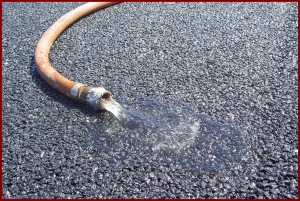
Porous asphalt pavement is made of one or more layers of “open-graded” asphalt mix placed atop a stone reservoir of large, single-size crushed stone. “Open-graded” means that the stone is sized to create voids throughout the structure that allow water to filter through quickly. Porosity can cost two to three times as much as traditional asphalt, require vacuuming or cleaning, and might not be suitable for high traffic areas or cold weather climates.
Proponents point out the cost analysis depends on whether you factor storm water treatment and holding pond costs and the environmental damage that the runoff causes, which isn’t paid for by property developers in the classic marketplace failure of the commons.
In the proposed Adirondack project, porous asphalt pavement for Beach Road on the south end of Lake George will be installed during next Spring. The construction is significant, at least in the view of the Asphalt Pavement Alliance, because Beach Road will be the heaviest-traveled roadway in New York – 5,800 vehicles daily – to use porous asphalt pavement.
Lake George has a pollution problem because storm water is the largest source of contaminants entering the lake, and Beach Road serves an area of intense development that exacerbated the environmental problem.
One notable street project took place in Buffalo, New York this year when the city unveiled the first of seven planned residential streets to be converted to porous asphalt pavement to relieve flooding in North Buffalo.
Another proven success of the environmental and economic advantages of porous asphalt occurred in Pringle Creek in Salem, Oregon. Pringle Creek is a good example of the emerging trend of so-called low-environmental-impact communities that use green building designs, landscaping and roads and parking lots made of porous asphalt to filter and store storm water and allow it to percolate back into the ground rather than add to the loads on drainage systems that flow into creeks and rivers.
During last January’s large storm that flooded roads and rivers in the Salem area, Pringle Creek had no flooding. Environmentalists claim that not only did the community’s green storm water system protect the environment, but also it saved residents from thousands or millions of dollars in storm damage.
“Porous asphalt pavement is an important flood relief tool,” said Mike Kvach, Executive Director for the Asphalt Pavement Alliance. “You can reduce or eliminate storm water infrastructure such as detention basins and storm sewer outlets. On top of the cost savings, porous pavements actually improve the water quality of the outflow.”








Great topic, however the comment about porous asphalt maybe not being appropriate for cold weather climates is a bit off. Porous asphalt has been performing well for many years in regions of the United States that experience very cold temperatures. From the northeast and through the midwest porous asphalt pavements have proven their ability to perform very well in these freeze-thaw climates. Minnesota and Iowa are states which have some really cold winters, and have successfully applied the use of porous asphalt pavements for parking lots and residential streets. The University of New Hampshire Stormwater Center was been studying the issue for a few years now and has found that porous asphalt does better than denser pavements with snow and ice because the water drains through and doesn’t freeze on top of the pavement.
The important difference porous asphalt has with the cold is that traditional sanding regimens are not recommended as it may cause the pavement to clog. Light plowing and using salt to remove snow and ice is all that is needed to keep the pavement clear. The University of New Hampshire also found that porous asphalt pavements require much less salt to keep it clear and that’s good for the environment.
Regarding heavy loads, Open Graded Friction Courses have been used for some time now to reduce water spray on highways carrying heavy truck traffic. The weight of the race cars is not the real issue as is the lateral stress applied to the surface of the pavement. The appropriate selection of engineered materials can compensate for this type of dynamic loading. (The writer works for an asphalt industry trade organization. – editor)
Pity that. . . but what a goal to aspire to, eh?
Yup, and even if race tracks have runoff, think of the very real benefits across the U.S.A. on the environment.
I wonder how that porous asphalt does with fluids other than water, say on the starting line of a dragstrip (which might get torn up from the torque transfer) or on a road course where wicking away fluids quickly could reduce accidents.
Its great weakness is heavy loads, which thus far precludes racing applications.