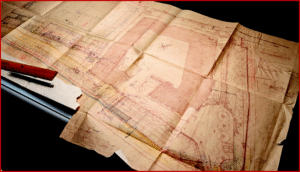
Click to enlarge.
In 1937, the first sketch for the Porsche factory in Stuttgart-Zuffenhausen was drawn up.*
“In the 1930s, the Porsche engineering office at Kronenstrasse 24 developed into an innovative actor in the automotive industry. However, the garages at the Porsche villa on Feuerbacher Weg were still being used to develop the first customer-commissioned vehicles. So in 1937, they decided to build a new factory in Zuffenhausen. Ferry Porsche acquired the land from the Wolff entrepreneur family, and architect Richard Pfob was responsible for the design,” said Matthias Kriegel, writing in the Porsche magazine Christophorus 416.
“At the heart of the site would be a three-story brick building, with parks and sports facilities off to the side. Dated 20 November 1937, the plan for ‘Landscaping and Employee Sports Facilities’ envisioned an athletic facility with a 100-meter track, high jump and long jump area, shot put and discus throw facility, swimming pool, and sunbathing area for employee recreation, located to the left of the factory and bordered by trees. It also called for gravel areas, terraces, benches, and garden beds for vegetables and berries. But it was ultimately just the new factory that was built. On 26 June 1938, 176 employees moved from downtown to Zuffenhausen. Known today as Plant 1, the building became the headquarters of the company known as Dr. Ing. h.c. F. Porsche KG.
“But because of the war, the company had to move to Gmünd, Austria, where it produced the first 52 models of the 356. With the factory occupied by the Allies upon Porsche’s return to Stuttgart, engine assembly and production were relocated to Reutter Plant II across the street. In return, Reutter was commissioned to build the bodies. The first Porsche 356 was ultimately built in Zuffenhausen 75 years ago – completed on 6April 1950. By the end of production in 1965, the sports car manufacturer had produced ~78,000 vehicles there.
“Due to the US military administration’s delay in handing over Plant 1, Plant 2 began operating in 1952, designed by Stuttgart architect Rolf Gutbrod. Today’s Plant 3 was acquired in 1960. It housed the sales and customer service departments, the central spare parts warehouse, and vehicle delivery. In 1963, Porsche acquired Karosseriewerk Reutter and doubled the staff to around 2000 employees. Initially referred to as the 901, the first 911 was built in the same year.
“The 911 proved to be a huge success and the range of models grew steadily in the 1970s. Plant 5 was built for highly flexible body construction in the 1980s. A distinctive feature to this day, the conveyor bridge passes over Schwieberdinger Strasse, providing direct access to final assembly in Plant 2. The 2010s saw the next transformation, with the all-electric Taycan going into production in 2019. New facilities included a body shop, a paint shop, an assembly building, and another conveyor bridge. The location has evolved into a production center that not only combines high tech and craftsmanship, but also unites the benefits of series production and the exclusivity of customized one-off vehicles.
“The engineering office has developed into a multinational company, and the first sketch into a production site measuring more than 600,000 square meters in size,” said Kriegel.
*AutoInformed on

About Ken Zino
Ken Zino, editor and publisher of AutoInformed, is a versatile auto industry participant with global experience spanning decades in print and broadcast journalism, as well as social media. He has automobile testing, marketing, public relations and communications experience. He is past president of The International Motor Press Assn, the Detroit Press Club, founding member and first President of the Automotive Press Assn. He is a member of APA, IMPA and the Midwest Automotive Press Assn.
He also brings an historical perspective while citing their contemporary relevance of the work of legendary auto writers such as Ken Purdy, Jim Dunne or Jerry Flint, or writers such as Red Smith, Mark Twain, Thomas Jefferson – all to bring perspective to a chaotic automotive universe.
Above all, decades after he first drove a car, Zino still revels in the sound of the exhaust as the throttle is blipped during a downshift and the driver’s rush that occurs when the entry, apex and exit points of a turn are smoothly and swiftly crossed. It’s the beginning of a perfect lap.
AutoInformed has an editorial philosophy that loves transportation machines of all kinds while promoting critical thinking about the future use of cars and trucks.
Zino builds AutoInformed from his background in automotive journalism starting at Hearst Publishing in New York City on Motor and MotorTech Magazines and car testing where he reviewed hundreds of vehicles in his decade-long stint as the Detroit Bureau Chief of Road & Track magazine. Zino has also worked in Europe, and Asia – now the largest automotive market in the world with China at its center.







Milestones – Porsche Factory in Stuttgart-Zuffenhausen
Click to enlarge.
In 1937, the first sketch for the Porsche factory in Stuttgart-Zuffenhausen was drawn up.*
“In the 1930s, the Porsche engineering office at Kronenstrasse 24 developed into an innovative actor in the automotive industry. However, the garages at the Porsche villa on Feuerbacher Weg were still being used to develop the first customer-commissioned vehicles. So in 1937, they decided to build a new factory in Zuffenhausen. Ferry Porsche acquired the land from the Wolff entrepreneur family, and architect Richard Pfob was responsible for the design,” said Matthias Kriegel, writing in the Porsche magazine Christophorus 416.
“At the heart of the site would be a three-story brick building, with parks and sports facilities off to the side. Dated 20 November 1937, the plan for ‘Landscaping and Employee Sports Facilities’ envisioned an athletic facility with a 100-meter track, high jump and long jump area, shot put and discus throw facility, swimming pool, and sunbathing area for employee recreation, located to the left of the factory and bordered by trees. It also called for gravel areas, terraces, benches, and garden beds for vegetables and berries. But it was ultimately just the new factory that was built. On 26 June 1938, 176 employees moved from downtown to Zuffenhausen. Known today as Plant 1, the building became the headquarters of the company known as Dr. Ing. h.c. F. Porsche KG.
“But because of the war, the company had to move to Gmünd, Austria, where it produced the first 52 models of the 356. With the factory occupied by the Allies upon Porsche’s return to Stuttgart, engine assembly and production were relocated to Reutter Plant II across the street. In return, Reutter was commissioned to build the bodies. The first Porsche 356 was ultimately built in Zuffenhausen 75 years ago – completed on 6April 1950. By the end of production in 1965, the sports car manufacturer had produced ~78,000 vehicles there.
“Due to the US military administration’s delay in handing over Plant 1, Plant 2 began operating in 1952, designed by Stuttgart architect Rolf Gutbrod. Today’s Plant 3 was acquired in 1960. It housed the sales and customer service departments, the central spare parts warehouse, and vehicle delivery. In 1963, Porsche acquired Karosseriewerk Reutter and doubled the staff to around 2000 employees. Initially referred to as the 901, the first 911 was built in the same year.
“The 911 proved to be a huge success and the range of models grew steadily in the 1970s. Plant 5 was built for highly flexible body construction in the 1980s. A distinctive feature to this day, the conveyor bridge passes over Schwieberdinger Strasse, providing direct access to final assembly in Plant 2. The 2010s saw the next transformation, with the all-electric Taycan going into production in 2019. New facilities included a body shop, a paint shop, an assembly building, and another conveyor bridge. The location has evolved into a production center that not only combines high tech and craftsmanship, but also unites the benefits of series production and the exclusivity of customized one-off vehicles.
“The engineering office has developed into a multinational company, and the first sketch into a production site measuring more than 600,000 square meters in size,” said Kriegel.
*AutoInformed on
About Ken Zino
Ken Zino, editor and publisher of AutoInformed, is a versatile auto industry participant with global experience spanning decades in print and broadcast journalism, as well as social media. He has automobile testing, marketing, public relations and communications experience. He is past president of The International Motor Press Assn, the Detroit Press Club, founding member and first President of the Automotive Press Assn. He is a member of APA, IMPA and the Midwest Automotive Press Assn. He also brings an historical perspective while citing their contemporary relevance of the work of legendary auto writers such as Ken Purdy, Jim Dunne or Jerry Flint, or writers such as Red Smith, Mark Twain, Thomas Jefferson – all to bring perspective to a chaotic automotive universe. Above all, decades after he first drove a car, Zino still revels in the sound of the exhaust as the throttle is blipped during a downshift and the driver’s rush that occurs when the entry, apex and exit points of a turn are smoothly and swiftly crossed. It’s the beginning of a perfect lap. AutoInformed has an editorial philosophy that loves transportation machines of all kinds while promoting critical thinking about the future use of cars and trucks. Zino builds AutoInformed from his background in automotive journalism starting at Hearst Publishing in New York City on Motor and MotorTech Magazines and car testing where he reviewed hundreds of vehicles in his decade-long stint as the Detroit Bureau Chief of Road & Track magazine. Zino has also worked in Europe, and Asia – now the largest automotive market in the world with China at its center.