Starting with 2011 models, NHTSA introduced tougher tests and more rigorous requirements for its five-star ratings.
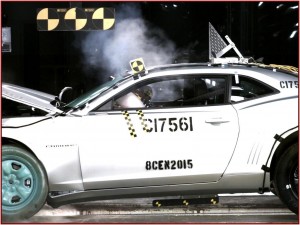
The 2012 Chevrolet Camaro Coupe is the first vehicle to receive the highest possible five-star score in every individual safety ratings segment from the National Highway Traffic Safety Administration, according to a Chevrolet news release.
Yes, but many of the vehicles sold in the U.S. have not been tested since the safety ratings were revised last year. That evidently won’t stop carefully written press releases though. What’s needed here is a level playing field, one that won’t be slanted by automotive marketers until all cars are tested so the federal government safety program isn’t used to pick winners by p.r departments selectively presenting incomplete data.
Starting with 2011 models, NHTSA introduced tougher tests and more rigorous requirements for its five-star safety ratings that provide more information about safety feature performance and crash-avoidance technologies. Safety ratings changes include a new side barrier test and a new side pole test simulating a 20-mph side-impact crash into a 10-inch-diameter pole or tree at a 75-degree angle just behind the A-pillar on the driver’s side. New overall safety ratings, which combine the results from the various tests, are now provided.
The Camaro Coupe under NHTSA’s current New Car Assessment Program – NCAP – performed well enough to receive five stars in each individual rating category. Camaro also received five stars in the combined categories leading to the top overall vehicle score.
The 2012 Ford Mustang received four stars in frontal and side impact tests, so it did not get NHTSA accolades. The 2012 Dodge Challenger has not been tested under the new system. The 2012 Honda Accord sedan – the coupe wasn’t tested – is also rated five-stars across the board. It seems unlikely that the Accord coupe wouldn’t achieve the same top ratings.








The NHTSA crash tests–and those by copycats like IIHS, though to be fair, it is the other way around, NHTSA copying IIHS–are invariably misleading because they are idealized at certain prescribed speeds and “perfect” crash dynamics. One consequence is that manufacturers have to design test-beaters (20 mph pole impact behind the A pillar? What about in front of it?).
Another is, as Ken points out, that various interested parties from manufacturers to bureaucrats have something to crow about. But they are not demonstrated to be related to the real-world crash data that NHTSA itself has now collected for years. Maybe the safety’s there, maybe it isn’t.
A corollary is that all the air bags that can be mounted inside a mini-car won’t help it from being crushed by a much heavier vehicle, even though the mini-car tests well in a lab test.
One big shell game, though maybe there is no other way for either bureaucrats or auto companies to handle the issue.
And either way, you can bet a plaintiff’s lawyer will claim that a manufacturer was negligent because its car didn’t live up to the NHTSA crash tests in a real world crash with resulting injuries.
On the other hand, the fairly widespread installation now of black box Electronic Data Recorders has meant bullet-proof lie detectors, eliminating a lot of previously fallacious litigation–you know, “I was only going 20” or “Of course I was wearing my seat belt.”