
When the Lexus ISC is equipped with the optional “Intuitive Park Assist,” roof operation stops if an obstacle is detected that might interfere .
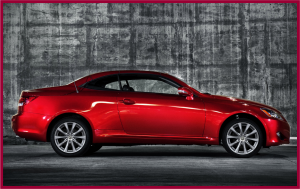
Lexus is now offering a hardtop convertible ISC (the C for coupe) with a claimed 20 seconds needed to lower the three-panel aluminum roof after the driver pushes the button.
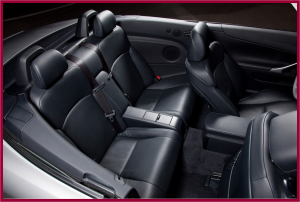
This is theoretically a four-seat car, and when there are no rear passengers, visibility is improved by lowering the rear headrests using a lever located on the front of the rear console. With the top up, the trunk offers storage for two golf bags, or one golf bag with the top lowered. Let us be real, this is a two-seat car for all im-practical purposes. Just bring money, the 2014 ISC starts at $48,000, the entry point for competing BMW 3-Series and Infiniti G37 hardtop convertibles.
Two versions of the IS coupe are offered, the 250C is powered by a 204 horsepower (185 lb.-ft. of torque at 4800 rpm) 2.5-liter V6 engine and a 350C with a 306 horsepower (277 lb.-ft. of torque at 4800 rpm) 3.5-liter V6. Both models come with a six-speed automatic transmission – no 8-speed even though an 8-speed is used on the big motor IS sedan – and steering-wheel-mounted paddle shifters. (I hate paddle shifters, and you can still get a true 6-speed manual or 8-speed automatic in the BMW 3-Series.) BMW this year, as mentioned, added a 3-Series with a retractable hardtop, a body style Lexus pioneered in the luxury segment with the SC 430 before the turn of the century.
Both of the Lexus engines are high-strung V6s with their double overhead camshafts, 4-valves per cylinder and continuously variable intake and exhaust timing. This makes the IS quick – under 6 seconds to 60 mph for the 3.5 V6, about 8 seconds for the 2.5 V6. The optional F Sport package is mostly show with its 18-inch wheels, different interior trim and aerodynamic cladding. Additional F Sport add-ons include 19-inch forged alloy wheels, suspension and brake upgrades, as well as revised intake and exhaust systems.
Test drive show that the IS is not just straight line fast. The heavily revised 2014 model Lexus has an all-new multi-link rear suspension, a revised front suspension and electric steering derived from the GS sedan adopted to the smaller car. Perhaps more important are increases in the use of sophisticated steel alloys, laser-screw welding and structural adhesives that made higher chassis rigidity possible, one of the long standing strengths of German automakers. The overall initial impression the IS provides is one of a high-quality Japanese car that is responsive and easily driven, maybe too easily driven for enthusiasts.
Herein starts the electronic controls debate. The standard Vehicle Dynamics Integrated Management System (VDIM) directs the electronic throttle control system and governs all of the vehicle’s dynamic handling systems – the Anti-lock Braking System (ABS), Brake Assist (BA), Vehicle Stability Control (VSC) and Traction Control (TRAC) – employing them to make corrections while helping provide higher dynamic capability irrespective of what the driver is doing or wants to be doing, however ham-fisted.
Unlike earlier automotive computerized systems, the latest ones cover far more driving situations, are slickly integrated and now even predictive, instead of reactive. The upshot is an electronic car that is capable of driving at the limits all of the time. These systems are capable of producing faster lap times than professional racing drivers can without them. The IS system is a rollicking demonstration that Lexis is on top of the state of this emerging dark electronic art.
A nicely done expensive toy.
When the ISC is equipped with the optional Intuitive Park Assist (IPA), roof operation will stop if an obstacle that might interfere with operation is detected behind the car. The driver gets an audible warning, and a warning light illuminates in the instrument panel. Here’s a newer electronic application that is controversy free.







