Click for more.
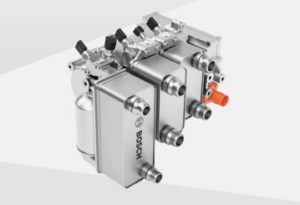
The problem as posited is the variety of powertrains that are offered by global automakers. The problem is they all must provide what used to be known as HVAC [Heating, Ventilation and Air Conditioning for some vehicle components and its occupants. The system is apparently not in broad use in the U.S. at the moment, but the possibilities of cost-lowering mass production and part number consolidation are compelling. – AutoCrat]
“Gasoline engines, diesel engines, a variety of hybrids and fully electric vehicles are all on the road, with no clear winner. Each needs a different approach to heating and cooling, from a simple setup with a traditional engine to complex heat pumps in electric vehicles. The challenge is building one system architecture that scales across all of them without starting from scratch,” according to a social media post by German auto component supplier Bosch.*
“Refrigerants are changing, too. In Europe, a proposed PFAS restriction could affect today’s widely used automotive refrigerant. Natural refrigerant alternatives could potentially be approved for certain automotive applications in the United States, but broader adoption involves additional technical and safety considerations. Automakers must navigate evolving regulatory requirements and technology choices while managing their own multi-year development cycles.
“Bosch’s answer is scalable integration. Instead of separate pumps, valves and compressors linked by hoses, clamps and wiring, the parts come together in one compact module. Fewer connections mean fewer chances for leaks, higher quality and lower cost.”
*[Dana Nicgorski, Director of Thermal Systems Engineering, and Stephen Zukowski, Director of Thermal Systems Engineering Applications – AutoCrat.]

About Ken Zino
Ken Zino, editor and publisher of AutoInformed, is a versatile auto industry participant with global experience spanning decades in print and broadcast journalism, as well as social media. He has automobile testing, marketing, public relations and communications experience. He is past president of The International Motor Press Assn, the Detroit Press Club, founding member and first President of the Automotive Press Assn. He is a member of APA, IMPA and the Midwest Automotive Press Assn.
He also brings an historical perspective while citing their contemporary relevance of the work of legendary auto writers such as Ken Purdy, Jim Dunne or Jerry Flint, or writers such as Red Smith, Mark Twain, Thomas Jefferson – all to bring perspective to a chaotic automotive universe.
Above all, decades after he first drove a car, Zino still revels in the sound of the exhaust as the throttle is blipped during a downshift and the driver’s rush that occurs when the entry, apex and exit points of a turn are smoothly and swiftly crossed. It’s the beginning of a perfect lap.
AutoInformed has an editorial philosophy that loves transportation machines of all kinds while promoting critical thinking about the future use of cars and trucks.
Zino builds AutoInformed from his background in automotive journalism starting at Hearst Publishing in New York City on Motor and MotorTech Magazines and car testing where he reviewed hundreds of vehicles in his decade-long stint as the Detroit Bureau Chief of Road & Track magazine. Zino has also worked in Europe, and Asia – now the largest automotive market in the world with China at its center.







Bosch – Modular Heating, Cooling for All Engine Types
Click for more.
The problem as posited is the variety of powertrains that are offered by global automakers. The problem is they all must provide what used to be known as HVAC [Heating, Ventilation and Air Conditioning for some vehicle components and its occupants. The system is apparently not in broad use in the U.S. at the moment, but the possibilities of cost-lowering mass production and part number consolidation are compelling. – AutoCrat]
“Gasoline engines, diesel engines, a variety of hybrids and fully electric vehicles are all on the road, with no clear winner. Each needs a different approach to heating and cooling, from a simple setup with a traditional engine to complex heat pumps in electric vehicles. The challenge is building one system architecture that scales across all of them without starting from scratch,” according to a social media post by German auto component supplier Bosch.*
“Refrigerants are changing, too. In Europe, a proposed PFAS restriction could affect today’s widely used automotive refrigerant. Natural refrigerant alternatives could potentially be approved for certain automotive applications in the United States, but broader adoption involves additional technical and safety considerations. Automakers must navigate evolving regulatory requirements and technology choices while managing their own multi-year development cycles.
“Bosch’s answer is scalable integration. Instead of separate pumps, valves and compressors linked by hoses, clamps and wiring, the parts come together in one compact module. Fewer connections mean fewer chances for leaks, higher quality and lower cost.”
*[Dana Nicgorski, Director of Thermal Systems Engineering, and Stephen Zukowski, Director of Thermal Systems Engineering Applications – AutoCrat.]
About Ken Zino
Ken Zino, editor and publisher of AutoInformed, is a versatile auto industry participant with global experience spanning decades in print and broadcast journalism, as well as social media. He has automobile testing, marketing, public relations and communications experience. He is past president of The International Motor Press Assn, the Detroit Press Club, founding member and first President of the Automotive Press Assn. He is a member of APA, IMPA and the Midwest Automotive Press Assn. He also brings an historical perspective while citing their contemporary relevance of the work of legendary auto writers such as Ken Purdy, Jim Dunne or Jerry Flint, or writers such as Red Smith, Mark Twain, Thomas Jefferson – all to bring perspective to a chaotic automotive universe. Above all, decades after he first drove a car, Zino still revels in the sound of the exhaust as the throttle is blipped during a downshift and the driver’s rush that occurs when the entry, apex and exit points of a turn are smoothly and swiftly crossed. It’s the beginning of a perfect lap. AutoInformed has an editorial philosophy that loves transportation machines of all kinds while promoting critical thinking about the future use of cars and trucks. Zino builds AutoInformed from his background in automotive journalism starting at Hearst Publishing in New York City on Motor and MotorTech Magazines and car testing where he reviewed hundreds of vehicles in his decade-long stint as the Detroit Bureau Chief of Road & Track magazine. Zino has also worked in Europe, and Asia – now the largest automotive market in the world with China at its center.