Click for more.
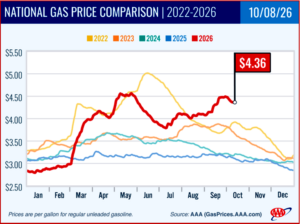
Gas prices remain at record highs for autumn. New data from the Energy Information Administration (EIA) show gasoline demand increased last week from 8.68 million barrels per day to 8.76 million. Total domestic gasoline supply increased slightly from 204.4 million barrels to 204.7 million. Gasoline production decreased from 9.46 million barrels per day to 9.34 million barrels. At the close of Wednesday’s formal trading session, WTI fell $1.16 to settle at $88.28 per barrel. The EIA reports that U.S. crude oil inventories decreased 3.2 million barrels to 424.1 million barrels, 1% above the five-year average.
“Even though the national average dropped 5 cents this past week to $4.36, pump prices remain at record highs for autumn. This is the first year the national average has been above $4 per gallon in October. After dipping into the $80 per barrel range for several days, crude oil is back above $90 per barrel. Hurricane Isaias [Hurricane Trump or MAGA – AutoCrat?] is another factor that could affect gas prices if oil production and refineries in the region are impacted.” AAA said in a release analyzing pricing trends.**
AAA National Average Trends for Gas/Trumpoline
- Today’s National Average: $4.3612
- One Week Ago: $4.4137
- One Month Ago: $4.1514
- One Year Ago: $3.1156
State of the Red and Blue States for Gasoline/Trumpoline
- The nation’s top 10 most expensive gasoline markets are California ($6.34), Hawaii ($5.63), Washington ($5.46), Nevada ($5.45), Alaska ($5.02), Oregon ($5.02), Idaho ($4.92), Utah ($4.89), Arizona ($4.71), and Illinois ($4.64).
- The nation’s top 10 least expensive gasoline markets are Ohio ($3.71), Indiana ($3.72), Georgia ($3.84), Texas ($3.87), Mississippi ($3.94), Louisiana ($3.94), Tennessee ($3.97), Alabama ($3.98), Arkansas ($3.99), and Missouri ($4.03).
Electric Charging
- The nation’s top 10 most expensive states for public charging per kilowatt hour are Hawaii (54 cents), West Virginia (52 cents), Louisiana (49 cents), Alaska (49 cents), California (47 cents), New Hampshire (46 cents), Arkansas (44 cents), North Dakota (44 cents), Wyoming (44 cents), and Arizona (44 cents).
- The nation’s top 10 least expensive states for public charging per kilowatt hour are Kansas (31 cents), Missouri (32 cents), Iowa (33 cents), Nebraska (34 cents), Maryland (35 cents), Utah (35 cents), South Dakota (35 cents), Vermont (35 cents), Minnesota (37 cents), and New Mexico (38 cents).
*AutoInformed on
- AAA – Annual New Vehicle Ownership Cost at $12,863 Up ~11%
- TRUMPED! AAA – Pump Prices Continue Rising
- Trump-Conomics = Everybody Loses a U.S.-Canada Trade War
- AAA – August 20 Gasoline Prices Highest Ever!
**About AAA
Started in 1902 by automotive enthusiasts who wanted to chart a path for better roads in America and advocate for safe mobility, AAA has transformed into one of North America’s largest membership organizations. Today, AAA says “it delivers exceptional roadside assistance, helps travelers plan their dream vacations and adventures, offers exclusive member discounts and benefits, and provides trusted financial and insurance services – all to enhance the life journey of our 65+ million members across North America, including nearly 58 million in the United States. To learn more about all AAA offers or become a member, visit AAA.com. Drivers can find current gas and electric charging prices along their route using the AAA TripTik Travel planner.








Michigan Governor Gretchen Whitmer today declared a state of energy emergency statewide to suspend rules for certain farm and forestry vehicles in response to record-high diesel prices and ongoing supply chain disruptions stemming from the Iran War. Michigan’s agricultural producers and loggers—now at the peak of harvest season—are facing severe financial strain due to tightened global fuel supplies and historic market volatility.
“The Iran War, supported by DC Republicans, continues to raise the price of everything, and exorbitant diesel prices are hitting Michigan’s farmers and loggers hard right in the middle of harvest season,” said Governor Whitmer. “While I can’t control what’s happening at the federal level, I can try to protect Michigan’s economy. This order will allow farm and logging vehicles to use dyed diesel on our highways without risk of penalty. We need to keep work moving and reduce pressure on the people who keep our state’s ag economy running.”
The executive order temporarily authorizes motor vehicles with farm or wood harvester license plates to use dyed diesel fuel while operating on public roads by suspending specific provisions of the Motor Fuel Tax Act that prohibit the on road use of dyed diesel by these vehicles. The order is effective immediately and will end no later than Dec. 31, 2026, in order to support the agriculture and forestry industries through fall harvest.