
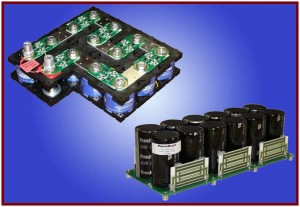
Many applications can benefit from ultracapacitors, since they can provide short power pulses.
While the sun comes up and the sun goes down, there is very little new under the sun. That’s one conclusion that can be reached from a new report by Pike Research that claims worldwide sales of ultracapacitors will grow tenfold from $28 million in 2011 to $284 million by 2016, with cumulative revenue of $901 million during that period.
General Electric engineers have been exploring this energy storage device, which is similar to a battery, since the 1950s. The most popular application for ultracapacitors will be in stop-start vehicles, according to Pike. However, ultracapacitors have been tested only in pilot projects in electric buses and fuel cell vehicles.
Ultracapacitors are not being used commercially in large numbers in other transportation market applications. Nonetheless, Pike Research forecasts that ultracapacitors will bring global revenues in the stop-start vehicles of $355.5 million by 2020.
Other “early-stage applications” for ultracapacitors also include grid-scale energy storage and wind turbines.
“Ultracapacitors are viewed as too expensive for most energy storage applications, and the technology is commonly viewed as not sufficiently mature for transportation applications,” says Pike senior analyst John Gartner.
“That said, ultracapacitors are showing great promise in several niche applications, most notably the burgeoning market for stop-start vehicles.”
Gartner claims that ultracapacitors’ greatest advantages over the primary competition, batteries, are superior cycle life and power density.
A report by the U.S. taxpayer-funded National Renewable Energy Laboratory (NREL) last year claimed that many applications can benefit from ultracapacitors, since they can provide short power pulses. Ultracapacitors can also – in theory – be primary energy devices for power assist during acceleration and hill climbing, as well as for recovery of braking energy – all critical to the efficiency ratings of hybrid and electric vehicles.
Furthermore, using an ultracapacitor in conjunction with a battery combines the power performance of the battery with the greater energy storage capability of the ultracapacitor. An ultracapacitor system can in theory extend the life of a battery, save on replacement and maintenance costs, and enable a battery to be downsized, according to NREL.
At the same time, ultracapacitors can increase available energy by providing high peak power whenever necessary.
Large Zino caveat here: the combination of ultracapacitors and batteries requires additional DC/DC power electronics, which would increase the cost of the vehicle using them.