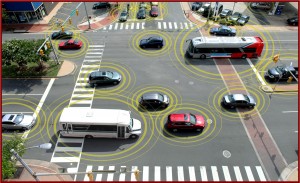
V2V allows vehicles to send and receive from each other information such as location, speed, direction of travel. V2I shares data about traffic signal phase, road attributes and surface conditions. This has the potential to mitigate traffic collisions and congestion. They can be integrated with active safety features, such as forward collision warning and side blind zone alert, already available on production cars. Crucial is also infrastructure-to-vehicle (I2V) interface between infrastructure-related objects and technologies. It’s a complex problem in execution.
In the latest twist on the bumpy road to autonomous vehicles, Continental has entered into a “collaborative evaluation partnership” with 3M to assess the infrastructure-to-vehicle (I2V) interface between infrastructure-related objects and technologies. This includes pavement markings, conspicuity film, signs and other landmarks on or near the roadways as well as vehicle-related technologies. In short, many milestones that need to be safely and repeatedly passed if and/or when vehicles are to become more autonomous.
By Continental’s admission, and an awareness of the enormity of the task that is becoming more collective admitted among previously unbridled automaker promoters, “current infrastructure is lacking some aspects of consistency, uniformity, performance specifications, and maintenance standards that are important for the industry to optimize the perception and localization capabilities of automated vehicles…
“While it is clear that infrastructure optimized solutions are not possible in the short term, our long-term goal is to find a more balanced solution,” Continental said.
The immediate hope is to help increase road safety while continuing to work toward automated driving solutions. As to when or if they appear remains a growing debate among makers and policy pundits.
Continental and 3M will “collaboratively evaluate the infrastructure and vehicle interface” in: localization and correction services using clear environmental landmarks for locating a vehicle on a high-definition map; identification and classification of objects in urban roadway environments including urban cross-walks, signalized intersections and other stationary and moving objects to improve safety; improved awareness of objects in and around work zones and the status of the work zones; and enhanced object detection using sensor fusion detectable infrastructure-related objects.

About Ken Zino
Ken Zino, editor and publisher of AutoInformed, is a versatile auto industry participant with global experience spanning decades in print and broadcast journalism, as well as social media. He has automobile testing, marketing, public relations and communications experience. He is past president of The International Motor Press Assn, the Detroit Press Club, founding member and first President of the Automotive Press Assn. He is a member of APA, IMPA and the Midwest Automotive Press Assn.
He also brings an historical perspective while citing their contemporary relevance of the work of legendary auto writers such as Ken Purdy, Jim Dunne or Jerry Flint, or writers such as Red Smith, Mark Twain, Thomas Jefferson – all to bring perspective to a chaotic automotive universe.
Above all, decades after he first drove a car, Zino still revels in the sound of the exhaust as the throttle is blipped during a downshift and the driver’s rush that occurs when the entry, apex and exit points of a turn are smoothly and swiftly crossed. It’s the beginning of a perfect lap.
AutoInformed has an editorial philosophy that loves transportation machines of all kinds while promoting critical thinking about the future use of cars and trucks.
Zino builds AutoInformed from his background in automotive journalism starting at Hearst Publishing in New York City on Motor and MotorTech Magazines and car testing where he reviewed hundreds of vehicles in his decade-long stint as the Detroit Bureau Chief of Road & Track magazine. Zino has also worked in Europe, and Asia – now the largest automotive market in the world with China at its center.







Continental, 3M to Develop Intelligent Infrastructure Technology
V2V allows vehicles to send and receive from each other information such as location, speed, direction of travel. V2I shares data about traffic signal phase, road attributes and surface conditions. This has the potential to mitigate traffic collisions and congestion. They can be integrated with active safety features, such as forward collision warning and side blind zone alert, already available on production cars. Crucial is also infrastructure-to-vehicle (I2V) interface between infrastructure-related objects and technologies. It’s a complex problem in execution.
In the latest twist on the bumpy road to autonomous vehicles, Continental has entered into a “collaborative evaluation partnership” with 3M to assess the infrastructure-to-vehicle (I2V) interface between infrastructure-related objects and technologies. This includes pavement markings, conspicuity film, signs and other landmarks on or near the roadways as well as vehicle-related technologies. In short, many milestones that need to be safely and repeatedly passed if and/or when vehicles are to become more autonomous.
By Continental’s admission, and an awareness of the enormity of the task that is becoming more collective admitted among previously unbridled automaker promoters, “current infrastructure is lacking some aspects of consistency, uniformity, performance specifications, and maintenance standards that are important for the industry to optimize the perception and localization capabilities of automated vehicles…
“While it is clear that infrastructure optimized solutions are not possible in the short term, our long-term goal is to find a more balanced solution,” Continental said.
The immediate hope is to help increase road safety while continuing to work toward automated driving solutions. As to when or if they appear remains a growing debate among makers and policy pundits.
Continental and 3M will “collaboratively evaluate the infrastructure and vehicle interface” in: localization and correction services using clear environmental landmarks for locating a vehicle on a high-definition map; identification and classification of objects in urban roadway environments including urban cross-walks, signalized intersections and other stationary and moving objects to improve safety; improved awareness of objects in and around work zones and the status of the work zones; and enhanced object detection using sensor fusion detectable infrastructure-related objects.
About Ken Zino
Ken Zino, editor and publisher of AutoInformed, is a versatile auto industry participant with global experience spanning decades in print and broadcast journalism, as well as social media. He has automobile testing, marketing, public relations and communications experience. He is past president of The International Motor Press Assn, the Detroit Press Club, founding member and first President of the Automotive Press Assn. He is a member of APA, IMPA and the Midwest Automotive Press Assn. He also brings an historical perspective while citing their contemporary relevance of the work of legendary auto writers such as Ken Purdy, Jim Dunne or Jerry Flint, or writers such as Red Smith, Mark Twain, Thomas Jefferson – all to bring perspective to a chaotic automotive universe. Above all, decades after he first drove a car, Zino still revels in the sound of the exhaust as the throttle is blipped during a downshift and the driver’s rush that occurs when the entry, apex and exit points of a turn are smoothly and swiftly crossed. It’s the beginning of a perfect lap. AutoInformed has an editorial philosophy that loves transportation machines of all kinds while promoting critical thinking about the future use of cars and trucks. Zino builds AutoInformed from his background in automotive journalism starting at Hearst Publishing in New York City on Motor and MotorTech Magazines and car testing where he reviewed hundreds of vehicles in his decade-long stint as the Detroit Bureau Chief of Road & Track magazine. Zino has also worked in Europe, and Asia – now the largest automotive market in the world with China at its center.