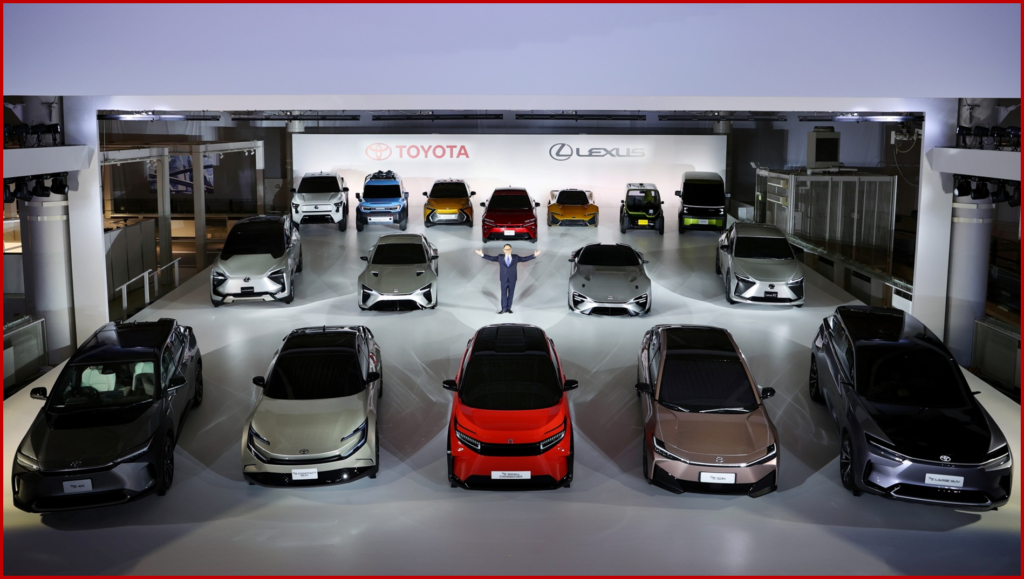
Toyota plans to invest ~$70 billion globally in electrified vehicles.
Toyota President Akio Toyoda announced today in Japan that the company will roll out 30 Battery Electric Vehicles and is anticipating sales of 3.5 million BEVs globally by 2030. The Lexus brand aims to have BEVs account for 100% of total sales in Europe, North America, and China by 2030, which given the current regulatory pace is the price of survival for all major automakers. Toyota Motor overall will offer a full lineup of battery EVs in the passenger and commercial segments. (EU Gets Tougher on Climate Change – Wants All EVs by 2035; Climate Change Car Wars – GM to Reach 100% Renewable Energy in 2025)
This is a sweeping claim, emulating GM’s breakthrough EV announcement in January, is by a giant company that sells more than 100 models of engine-only vehicles, hybrid electric vehicles, plug-in hybrid electric vehicles, and fuel cell electric vehicles in more than 170 countries and regions under the Toyota brand. The Lexus brand has more than 30 models of engine-only vehicles, hybrid electric vehicles, and plug-in hybrid electric vehicles in more than 90 countries and regions. (Environmental About Face – General Motors Ditching Internal Combustion Engines by 2035. Carbon Neutral by 2040?)
Toyota plans to invest ~$70 billion globally in electrified vehicles including HEVs, PHEVs, FCEVs and BEVs. Of that amount, approximately $35 billion will be invested in BEVs starting in 2022 through 2030. In North America, Toyota has, arguably, been the industry leader in electrified vehicles for 21 years. In 1997, Toyota launched Prius, the world’s first mass-production hybrid electric vehicle. Development of battery EVs had started before that in 1992 with the Electric Vehicle Development Division that brought he RAV4 EV to the market in 1996. During the past 26 years, Toyota has invested ~1 trillion yen and produced more than 19 million batteries.
To-date, ~85% of Toyota’s electrified vehicles sold in North America are Toyota-branded models. Keeping pace with the changing tastes of luxury consumers, by 2030, Lexus aims to have a full line of BEVs in all vehicle segments. (SEC Starts Task Force on Climate Change Investment Risks)
“I believe that achieving carbon neutrality means realizing a world in which all people living on this planet continue to live happily,” Toyoda said. “We want to help realize such a world. This has been and will continue to be Toyota’s wish and our mission as a global company. For that challenge, we need to reduce CO2 emissions as much as possible, as soon as possible.”

About Ken Zino
Ken Zino, editor and publisher of AutoInformed, is a versatile auto industry participant with global experience spanning decades in print and broadcast journalism, as well as social media. He has automobile testing, marketing, public relations and communications experience. He is past president of The International Motor Press Assn, the Detroit Press Club, founding member and first President of the Automotive Press Assn. He is a member of APA, IMPA and the Midwest Automotive Press Assn.
He also brings an historical perspective while citing their contemporary relevance of the work of legendary auto writers such as Ken Purdy, Jim Dunne or Jerry Flint, or writers such as Red Smith, Mark Twain, Thomas Jefferson – all to bring perspective to a chaotic automotive universe.
Above all, decades after he first drove a car, Zino still revels in the sound of the exhaust as the throttle is blipped during a downshift and the driver’s rush that occurs when the entry, apex and exit points of a turn are smoothly and swiftly crossed. It’s the beginning of a perfect lap.
AutoInformed has an editorial philosophy that loves transportation machines of all kinds while promoting critical thinking about the future use of cars and trucks.
Zino builds AutoInformed from his background in automotive journalism starting at Hearst Publishing in New York City on Motor and MotorTech Magazines and car testing where he reviewed hundreds of vehicles in his decade-long stint as the Detroit Bureau Chief of Road & Track magazine. Zino has also worked in Europe, and Asia – now the largest automotive market in the world with China at its center.







Toyota – Annual Global Sales of 3.5Mn Battery EVs by 2030
Toyota plans to invest ~$70 billion globally in electrified vehicles.
Toyota President Akio Toyoda announced today in Japan that the company will roll out 30 Battery Electric Vehicles and is anticipating sales of 3.5 million BEVs globally by 2030. The Lexus brand aims to have BEVs account for 100% of total sales in Europe, North America, and China by 2030, which given the current regulatory pace is the price of survival for all major automakers. Toyota Motor overall will offer a full lineup of battery EVs in the passenger and commercial segments. (EU Gets Tougher on Climate Change – Wants All EVs by 2035; Climate Change Car Wars – GM to Reach 100% Renewable Energy in 2025)
This is a sweeping claim, emulating GM’s breakthrough EV announcement in January, is by a giant company that sells more than 100 models of engine-only vehicles, hybrid electric vehicles, plug-in hybrid electric vehicles, and fuel cell electric vehicles in more than 170 countries and regions under the Toyota brand. The Lexus brand has more than 30 models of engine-only vehicles, hybrid electric vehicles, and plug-in hybrid electric vehicles in more than 90 countries and regions. (Environmental About Face – General Motors Ditching Internal Combustion Engines by 2035. Carbon Neutral by 2040?)
Toyota plans to invest ~$70 billion globally in electrified vehicles including HEVs, PHEVs, FCEVs and BEVs. Of that amount, approximately $35 billion will be invested in BEVs starting in 2022 through 2030. In North America, Toyota has, arguably, been the industry leader in electrified vehicles for 21 years. In 1997, Toyota launched Prius, the world’s first mass-production hybrid electric vehicle. Development of battery EVs had started before that in 1992 with the Electric Vehicle Development Division that brought he RAV4 EV to the market in 1996. During the past 26 years, Toyota has invested ~1 trillion yen and produced more than 19 million batteries.
To-date, ~85% of Toyota’s electrified vehicles sold in North America are Toyota-branded models. Keeping pace with the changing tastes of luxury consumers, by 2030, Lexus aims to have a full line of BEVs in all vehicle segments. (SEC Starts Task Force on Climate Change Investment Risks)
“I believe that achieving carbon neutrality means realizing a world in which all people living on this planet continue to live happily,” Toyoda said. “We want to help realize such a world. This has been and will continue to be Toyota’s wish and our mission as a global company. For that challenge, we need to reduce CO2 emissions as much as possible, as soon as possible.”
About Ken Zino
Ken Zino, editor and publisher of AutoInformed, is a versatile auto industry participant with global experience spanning decades in print and broadcast journalism, as well as social media. He has automobile testing, marketing, public relations and communications experience. He is past president of The International Motor Press Assn, the Detroit Press Club, founding member and first President of the Automotive Press Assn. He is a member of APA, IMPA and the Midwest Automotive Press Assn. He also brings an historical perspective while citing their contemporary relevance of the work of legendary auto writers such as Ken Purdy, Jim Dunne or Jerry Flint, or writers such as Red Smith, Mark Twain, Thomas Jefferson – all to bring perspective to a chaotic automotive universe. Above all, decades after he first drove a car, Zino still revels in the sound of the exhaust as the throttle is blipped during a downshift and the driver’s rush that occurs when the entry, apex and exit points of a turn are smoothly and swiftly crossed. It’s the beginning of a perfect lap. AutoInformed has an editorial philosophy that loves transportation machines of all kinds while promoting critical thinking about the future use of cars and trucks. Zino builds AutoInformed from his background in automotive journalism starting at Hearst Publishing in New York City on Motor and MotorTech Magazines and car testing where he reviewed hundreds of vehicles in his decade-long stint as the Detroit Bureau Chief of Road & Track magazine. Zino has also worked in Europe, and Asia – now the largest automotive market in the world with China at its center.