Click for more information.
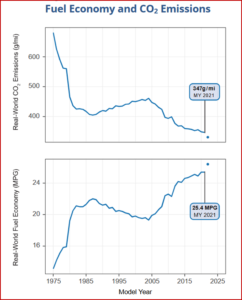
The US Environmental Protection Agency (EPA) has released its annual Automotive Trends Report, which shows that for model year (MY) 2021, vehicle fuel economy remained at an all-time high of 25.4 miles per gallon (mpg), and new vehicle real-world carbon dioxide (CO2) emissions decreased to a record low of 347 grams per mile (g/mi). The report also shows all 14 large automotive manufacturers achieved compliance with the Light-duty Greenhouse Gas (GHG) standards through at least MY2020.
The latest welcome gains in fuel economy and cleaner air started back during the Obama Administration. Despite fierce opposition against the Obama Administration, and during the Republican interregnum, better fuel economy and cleaner air continued to progress during the Biden Administration, which also faced opposition from the pollution of the false claims of Republican climate change disputers. CO2 levels have reached 420 parts per million. This is the highest for three million years or more. Worse, CO2 is increasing ~100 times faster than it did at the close of the last ice age. There is no dispute in the validity of the science. Neither is there a dispute about the fossil fuel industries’ financing of Republicans.
In December 2021, EPA finalized revised light-duty GHG standards for model years 2023-2026 and in March 2022 NHTSA subsequently published revised fuel economy standards for model years 2024-2026. In March 2022, EPA also restored California’s waiver to enforce greenhouse gas standards for cars and light trucks.
“Today’s report demonstrates the significant progress we’ve made to ensure clean air for all as automakers continue to innovate and utilize more advanced technologies to cut pollution,” said EPA Administrator Michael S. Regan. “Working together across the public and private sector, we can deliver on EPA’s mission to protect public health, especially our most vulnerable populations, and advance President Biden’s ambitious agenda to combat the climate crisis.”
Report Spotlights
- For MY 2021, vehicle fuel economy remained at an all-time high of 25.4 miles per gallon (mpg), and new vehicle real-world carbon dioxide (CO2) emissions decreased to a record low of 347 grams per mile (g/mi).
- All vehicle types are at record low CO2 emissions;
- However, the market shift away from cars and towards sport utility vehicles and pickups offset some of the fleet-wide benefits.
- Since MY 2004, average fuel economy in the U.S. has increased by 32%, or 6.1 mpg.
- The average estimated real-world CO2 emission rate for all new vehicles fell by 2 g/mi to 347 g/mi, the lowest ever reported.
- Since MY 2004, CO2 emissions have decreased 25%, or by 114 g/mi. Over that time, CO2 emissions have been reduced in 14 of the past 17 years.
Without question advancements in technology and government regulations are prodding industry to reach these carbon reduction achievements. In model year 2021, hybrid vehicles reached a new high of 9% of all production. These vehicles can use a larger battery to recapture braking energy and provide power when necessary, allowing for a smaller, more efficiently operated engine.
Combining electric vehicles (EVs), plug-in hybrid electric vehicles (PHEVs), and fuel cell vehicles (FCVs), sales increased to 4% of nationwide production in MY 2021.
EPA said that the annual report is part of EPA’s commitment to provide the public with information about new light-duty vehicle GHG emissions, fuel economy, technology data, and auto manufacturers’ performance in meeting the agency’s GHG emissions standards.








“The bottom line is fleetwide fuel economy didn’t improve. That’s bad news for drivers at the pump and for the climate.
“Some models got more efficient, but with the automakers marketing large SUVs so heavily, they’re taking up more and more market share. The manufacturers are canceling out all the efficiency progress as they sell more large vehicles. And it’s completely allowed under the federal rules.
“There’s another problem, too: Nearly all automakers used emissions credits from earlier years in the program to undershoot this year’s fuel economy target.
“The EPA is going to need to learn from the lack of progress here and tackle the relentless upsizing of vehicles and rampant use of credits in its next standards.”
Avi Mersky is senior transportation researcher, at the American Council for an Energy-Efficient Economy