Click for more Cap and Trade.
The California Air Resources Board (CARB) said today that in its shift away from polluting fuel sources, clean fuels are replacing more than 50% of the diesel used in the state during Q1 of 2023. The awakened Low Carbon Fuel Standard (LCFS), a regulation requiring fuel producers to reduce the carbon intensity of fuel sold in the state, is largely responsible for the shift by encouraging the use and production of cleaner alternatives.
“As technological advances put a zero-emissions future within reach, the use of cleaner fuels offers an essential tool to reduce pollution now,” said CARB Executive Officer, Dr. Steven Cliff. “A 50% reduction in diesel means cleaner air, healthier communities and a commitment to reaching carbon neutrality in California by 2045.”
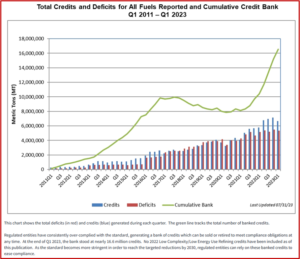
Compliance with the LCFS began in 2011. The program is designed to lower the carbon intensity in fuels by assessing each step in their production, from extraction to combustion. If a fuel has a carbon intensity above that baseline it generates a deficit for the producer. If the intensity is below the baseline it can generate credits which may then be sold to a producer who has a deficit.
Carbon intensity for the LCFS program is measured through lifecycle analysis of a fuel. The LCFS is one of several programs developed under AB 32 (the 2006 Global Warming Solutions Act) to cut California’s emissions of climate warming greenhouse gas. Other programs include Cap-and-Trade, which establishes a declining limit to emissions allowed in the state by requiring industry to pay for pollution produced.
Newer regulations such as Advanced Clean Trucks and Advanced Clean Fleets put in place a phased-in transition to sell and implement clean truck technology in California, in line with Governor Gavin Newsom’s Executive Order calling for all heavy-duty vehicles traveling in the state to be zero emissions by 2045. In July, CARB announced the Clean Truck Partnership with the nation’s leading truck manufacturers, including the Engine and Truck Manufacturers Association and its member companies, and Ford Motor Company, which advances the development of zero-emissions truck technology, adding further momentum to the shift to cleaner transportation fuels.
The LCFS program helped to replace nearly two billion gallons of regular diesel fuel in 2022 with a combination of cleaner fuels, including renewable diesel, biodiesel, electricity, and hydrogen. Since compliance began, the program has helped to replace more than 8.6 billion gallons of diesel.
AutoInformed on

About Ken Zino
Ken Zino, editor and publisher of AutoInformed, is a versatile auto industry participant with global experience spanning decades in print and broadcast journalism, as well as social media. He has automobile testing, marketing, public relations and communications experience. He is past president of The International Motor Press Assn, the Detroit Press Club, founding member and first President of the Automotive Press Assn. He is a member of APA, IMPA and the Midwest Automotive Press Assn.
He also brings an historical perspective while citing their contemporary relevance of the work of legendary auto writers such as Ken Purdy, Jim Dunne or Jerry Flint, or writers such as Red Smith, Mark Twain, Thomas Jefferson – all to bring perspective to a chaotic automotive universe.
Above all, decades after he first drove a car, Zino still revels in the sound of the exhaust as the throttle is blipped during a downshift and the driver’s rush that occurs when the entry, apex and exit points of a turn are smoothly and swiftly crossed. It’s the beginning of a perfect lap.
AutoInformed has an editorial philosophy that loves transportation machines of all kinds while promoting critical thinking about the future use of cars and trucks.
Zino builds AutoInformed from his background in automotive journalism starting at Hearst Publishing in New York City on Motor and MotorTech Magazines and car testing where he reviewed hundreds of vehicles in his decade-long stint as the Detroit Bureau Chief of Road & Track magazine. Zino has also worked in Europe, and Asia – now the largest automotive market in the world with China at its center.







Half of California Diesel Fuel Is Replaced By Clean Fuels
Click for more Cap and Trade.
The California Air Resources Board (CARB) said today that in its shift away from polluting fuel sources, clean fuels are replacing more than 50% of the diesel used in the state during Q1 of 2023. The awakened Low Carbon Fuel Standard (LCFS), a regulation requiring fuel producers to reduce the carbon intensity of fuel sold in the state, is largely responsible for the shift by encouraging the use and production of cleaner alternatives.
“As technological advances put a zero-emissions future within reach, the use of cleaner fuels offers an essential tool to reduce pollution now,” said CARB Executive Officer, Dr. Steven Cliff. “A 50% reduction in diesel means cleaner air, healthier communities and a commitment to reaching carbon neutrality in California by 2045.”
Compliance with the LCFS began in 2011. The program is designed to lower the carbon intensity in fuels by assessing each step in their production, from extraction to combustion. If a fuel has a carbon intensity above that baseline it generates a deficit for the producer. If the intensity is below the baseline it can generate credits which may then be sold to a producer who has a deficit.
Carbon intensity for the LCFS program is measured through lifecycle analysis of a fuel. The LCFS is one of several programs developed under AB 32 (the 2006 Global Warming Solutions Act) to cut California’s emissions of climate warming greenhouse gas. Other programs include Cap-and-Trade, which establishes a declining limit to emissions allowed in the state by requiring industry to pay for pollution produced.
Newer regulations such as Advanced Clean Trucks and Advanced Clean Fleets put in place a phased-in transition to sell and implement clean truck technology in California, in line with Governor Gavin Newsom’s Executive Order calling for all heavy-duty vehicles traveling in the state to be zero emissions by 2045. In July, CARB announced the Clean Truck Partnership with the nation’s leading truck manufacturers, including the Engine and Truck Manufacturers Association and its member companies, and Ford Motor Company, which advances the development of zero-emissions truck technology, adding further momentum to the shift to cleaner transportation fuels.
The LCFS program helped to replace nearly two billion gallons of regular diesel fuel in 2022 with a combination of cleaner fuels, including renewable diesel, biodiesel, electricity, and hydrogen. Since compliance began, the program has helped to replace more than 8.6 billion gallons of diesel.
AutoInformed on
About Ken Zino
Ken Zino, editor and publisher of AutoInformed, is a versatile auto industry participant with global experience spanning decades in print and broadcast journalism, as well as social media. He has automobile testing, marketing, public relations and communications experience. He is past president of The International Motor Press Assn, the Detroit Press Club, founding member and first President of the Automotive Press Assn. He is a member of APA, IMPA and the Midwest Automotive Press Assn. He also brings an historical perspective while citing their contemporary relevance of the work of legendary auto writers such as Ken Purdy, Jim Dunne or Jerry Flint, or writers such as Red Smith, Mark Twain, Thomas Jefferson – all to bring perspective to a chaotic automotive universe. Above all, decades after he first drove a car, Zino still revels in the sound of the exhaust as the throttle is blipped during a downshift and the driver’s rush that occurs when the entry, apex and exit points of a turn are smoothly and swiftly crossed. It’s the beginning of a perfect lap. AutoInformed has an editorial philosophy that loves transportation machines of all kinds while promoting critical thinking about the future use of cars and trucks. Zino builds AutoInformed from his background in automotive journalism starting at Hearst Publishing in New York City on Motor and MotorTech Magazines and car testing where he reviewed hundreds of vehicles in his decade-long stint as the Detroit Bureau Chief of Road & Track magazine. Zino has also worked in Europe, and Asia – now the largest automotive market in the world with China at its center.