Click for more hydrogen.
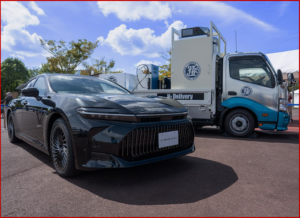
Toyota continues to take steps toward its goal to promote and move to a hydrogen-powered society. The latest example was spotted at Motegi raceway at a Super Taikyu race where a hydrogen refueling truck was in use.
“When we were first approached, the project only entailed the hydrogen module. However, from the perspective of JAF’s operations, we informed Toyota that running out of fuel was a relatively rare problem, while the most common issues are tire-related, “said General Manager Koso Takeda, JAF Road Service Division. “From there, the conversation turned to creating an all-in-one vehicle with the equipment to carry out JAF tasks. Before the day was out, people from Toyota visited our offices to measure sizes, and proceeded to build it.”
The JAF fleet has van-type service vehicles, which cannot tow and are intended for light jobs such as battery failures or key lock-ins. They carry various items for these tasks, such as air tanks, gasoline, and diesel fuel cans. As part of its roadside services, JAF annually assists some 50,000 vehicles stranded without fuel, including 700 battery electric vehicles (BEVs) that have run out of charge and around 20 cars needing a hydrogen top-up.
The newly premiered road service vehicle was jointly developed to ensure that in a hydrogen society with more FCEVs on the road, running out of hydrogen could be handled like other fuels rather than requiring cars to be towed.
Chief Engineer Hirofumi Ota of the CV Company, which handles Toyota’s commercial vehicles, on the reasons for revealing the road service vehicle at this Super Taikyu event:
“At the front of the cargo bed sit four light Mirai hydrogen tanks, part of our efforts in transporting hydrogen. The top box is fitted with a safety control mechanism, which is just about ready for commercial release. This box has a dry-cell-like structure that facilitates hydrogen delivery. We loaded these onto the truck and, working with JAF, built a configuration that allows the hydrogen to be easily transported in packs (as modules).
“In terms of using hydrogen, we saw Super Taikyu as an opportunity to address potential concerns and create an environment that facilitates energy use by simplifying transportation. The vehicle carries modules that integrate multiple resin hydrogen tanks, used in the Mirai with a high degree of safety, with various safety devices to monitor operating conditions automatically. With their large capacity, these modules make storing and transporting hydrogen safer and more efficient. As such, they were developed with the aim of boosting hydrogen energy use in seaports, mountainous regions, and other areas where refueling is difficult,” said Hirofumi Ota.
This is still a Concept Prototype
“However, I feel the vehicle’s current size will present challenges in servicing passenger cars, and we will gradually have to make it smaller,” said Takeda of JAF Road Service.

About Ken Zino
Ken Zino, editor and publisher of AutoInformed, is a versatile auto industry participant with global experience spanning decades in print and broadcast journalism, as well as social media. He has automobile testing, marketing, public relations and communications experience. He is past president of The International Motor Press Assn, the Detroit Press Club, founding member and first President of the Automotive Press Assn. He is a member of APA, IMPA and the Midwest Automotive Press Assn.
He also brings an historical perspective while citing their contemporary relevance of the work of legendary auto writers such as Ken Purdy, Jim Dunne or Jerry Flint, or writers such as Red Smith, Mark Twain, Thomas Jefferson – all to bring perspective to a chaotic automotive universe.
Above all, decades after he first drove a car, Zino still revels in the sound of the exhaust as the throttle is blipped during a downshift and the driver’s rush that occurs when the entry, apex and exit points of a turn are smoothly and swiftly crossed. It’s the beginning of a perfect lap.
AutoInformed has an editorial philosophy that loves transportation machines of all kinds while promoting critical thinking about the future use of cars and trucks.
Zino builds AutoInformed from his background in automotive journalism starting at Hearst Publishing in New York City on Motor and MotorTech Magazines and car testing where he reviewed hundreds of vehicles in his decade-long stint as the Detroit Bureau Chief of Road & Track magazine. Zino has also worked in Europe, and Asia – now the largest automotive market in the world with China at its center.








Toyota Hydrogen Road Service Vehicle at Motegi
Click for more hydrogen.
Toyota continues to take steps toward its goal to promote and move to a hydrogen-powered society. The latest example was spotted at Motegi raceway at a Super Taikyu race where a hydrogen refueling truck was in use.
“When we were first approached, the project only entailed the hydrogen module. However, from the perspective of JAF’s operations, we informed Toyota that running out of fuel was a relatively rare problem, while the most common issues are tire-related, “said General Manager Koso Takeda, JAF Road Service Division. “From there, the conversation turned to creating an all-in-one vehicle with the equipment to carry out JAF tasks. Before the day was out, people from Toyota visited our offices to measure sizes, and proceeded to build it.”
The JAF fleet has van-type service vehicles, which cannot tow and are intended for light jobs such as battery failures or key lock-ins. They carry various items for these tasks, such as air tanks, gasoline, and diesel fuel cans. As part of its roadside services, JAF annually assists some 50,000 vehicles stranded without fuel, including 700 battery electric vehicles (BEVs) that have run out of charge and around 20 cars needing a hydrogen top-up.
The newly premiered road service vehicle was jointly developed to ensure that in a hydrogen society with more FCEVs on the road, running out of hydrogen could be handled like other fuels rather than requiring cars to be towed.
Chief Engineer Hirofumi Ota of the CV Company, which handles Toyota’s commercial vehicles, on the reasons for revealing the road service vehicle at this Super Taikyu event:
“At the front of the cargo bed sit four light Mirai hydrogen tanks, part of our efforts in transporting hydrogen. The top box is fitted with a safety control mechanism, which is just about ready for commercial release. This box has a dry-cell-like structure that facilitates hydrogen delivery. We loaded these onto the truck and, working with JAF, built a configuration that allows the hydrogen to be easily transported in packs (as modules).
“In terms of using hydrogen, we saw Super Taikyu as an opportunity to address potential concerns and create an environment that facilitates energy use by simplifying transportation. The vehicle carries modules that integrate multiple resin hydrogen tanks, used in the Mirai with a high degree of safety, with various safety devices to monitor operating conditions automatically. With their large capacity, these modules make storing and transporting hydrogen safer and more efficient. As such, they were developed with the aim of boosting hydrogen energy use in seaports, mountainous regions, and other areas where refueling is difficult,” said Hirofumi Ota.
This is still a Concept Prototype
“However, I feel the vehicle’s current size will present challenges in servicing passenger cars, and we will gradually have to make it smaller,” said Takeda of JAF Road Service.
About Ken Zino
Ken Zino, editor and publisher of AutoInformed, is a versatile auto industry participant with global experience spanning decades in print and broadcast journalism, as well as social media. He has automobile testing, marketing, public relations and communications experience. He is past president of The International Motor Press Assn, the Detroit Press Club, founding member and first President of the Automotive Press Assn. He is a member of APA, IMPA and the Midwest Automotive Press Assn. He also brings an historical perspective while citing their contemporary relevance of the work of legendary auto writers such as Ken Purdy, Jim Dunne or Jerry Flint, or writers such as Red Smith, Mark Twain, Thomas Jefferson – all to bring perspective to a chaotic automotive universe. Above all, decades after he first drove a car, Zino still revels in the sound of the exhaust as the throttle is blipped during a downshift and the driver’s rush that occurs when the entry, apex and exit points of a turn are smoothly and swiftly crossed. It’s the beginning of a perfect lap. AutoInformed has an editorial philosophy that loves transportation machines of all kinds while promoting critical thinking about the future use of cars and trucks. Zino builds AutoInformed from his background in automotive journalism starting at Hearst Publishing in New York City on Motor and MotorTech Magazines and car testing where he reviewed hundreds of vehicles in his decade-long stint as the Detroit Bureau Chief of Road & Track magazine. Zino has also worked in Europe, and Asia – now the largest automotive market in the world with China at its center.