Click for more.
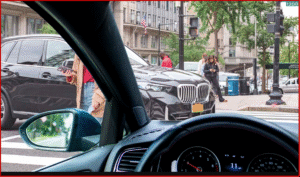
A recent study led by researchers from the U.S. Department of Transportation’s Volpe Center is the first to use the new method that the non-profit Insurance Institute for Highway Safety (IIHS)* developed for measuring a driver’s direct area of vision around a vehicle. Through multiple redesign cycles from 1997 to 2023, forward visibility within a 10-meter radius fell as much as 58% for three popular SUVs, the researchers found. For a top-selling pickup, close-proximity visibility declined by a smaller 17%, but even the earliest model had extremely large blind zones. In contrast, the early models of the two cars provided relatively good visibility that fell less than 8% in later generations.
“The across-the-board decrease in visibility for this small group of models is concerning. We need to investigate whether this is a broader trend that may have contributed to the recent spike in pedestrian and bicyclist fatalities,” IIHS President David Harkey said. “This study also illustrates that the new method developed by IIHS gives researchers a straightforward, repeatable way to assess driver visibility,” he added.
Previously, researchers who wanted to compare the blind zones of different models needed to acquire engineering drawings or position each vehicle in an open area specially marked with grid lines or traffic cones. Because these methods were so cumbersome, no large-scale comparisons were attempted, IIHS said. An alternative technique using lasers is efficient, but it does not capture the blind zones created by the side mirrors and widening base of the A-pillars.
The new IIHS method relies on computational software and a portable camera rig that can be positioned in the driver seat at various heights to represent different-sized drivers, no matter where the vehicle is located. The camera rotates to take a 360-degree image of the field of vision around the vehicle. The software then converts that image into a blind zone map that depicts an aerial view of the vehicle and the nearest points on the ground that the driver can see. It also provides a numerical value for the percentage of the area around the vehicle that is visible.
IIHS said that “introducing the technique showed that the blind zone maps it produces are nearly identical to traditional methods created using a physical grid.”
By allowing engineers and researchers to collect data at car dealerships and other easily accessible locations, it promises to facilitate a raft of new research into driver visibility. Researchers from IIHS and the affiliated Highway Loss Data Institute (HLDI)* are now working on comparing blind zone maps for around 150 vehicle models, exploring the effects of different-sized blind zones on pedestrian crashes and examining the relationship between blind zone sizes and insurance losses, for example.
The Volpe Center’s researchers used the new technique to examine how the designs of the Chevrolet Suburban, Ford F-150, Honda Accord, Honda CR-V, Jeep Grand Cherokee and Toyota Camry changed over model years 1997 to 2023. This required blind zone maps of 17 individual vehicles, representing each major redesign of the six study vehicles.
That 25-year period relevant because pedestrian and bicyclist fatalities on U.S. roads have soared 37% and 42%, respectively, over that time span. “There is not one clear cause for the increase, but research has linked it to factors like population growth in areas with poor pedestrian infrastructure, speed increases and changes in vehicle size and shape” IIHS said. Other IIHS studies, for example, have shown that the height of a vehicle’s front end amplifies the effect of higher crash speeds on fatality risk and that vehicles with blunt front ends are more deadly than those with sloping profiles. “However, little is known about what role changes in driver visibility have played in the increase,” IIHS said.
Volpe Center Study
The Volpe Center study focused on forward visibility within a 10-meter radius of the vehicle because that is the average driver stopping distance at 10 mph, a low speed at which blind zones are a common factor in crashes. Calculated were the percentage of the 180-degree area that was un-obscured by obstacles, such as the vehicle hood, the rearview mirror and the A-pillars.
“The most dramatic reduction came for the Honda CR-V, as the vehicle’s hood, mirrors and A-pillars all obstructed a greater portion of the driver’s view over time. Drivers of the 1997 model were able to see 68% of the area 10 meters in front of the vehicle, while drivers of the 2022 model can see only 28%. Similarly, drivers of the model year 2000 Suburban (the earliest model of that vehicle studied) were able to see 56% of the area 10 meters in front of them, while drivers of the 2023 model can see only 28%.
“For both of these vehicles, the biggest changes in the blind zone are due to a higher hood that blocks more of the frontal plane and larger side mirrors that obscure the views at their front corners.
“The forward visibility provided by the F-150 also declined, and it was starting from a very low base. Drivers of the 1997 model could see only 43% of the forward area within a 10-meter radius, and that dropped to a mere 36% by model year 2015.
“The visibility reductions for the two cars were less severe. The smallest decrease came for the Accord, which permitted the driver to see 65% of the area 10 meters in front of the vehicle in 2003 and 60% in 2023. For the Camry, visibility decreased from 61% in 2007 to 57% in 2023. Both of these decreases fell within the margin of error,” IIHS said.
“These results are notable because we already know that the portion of SUVs in the U.S. fleet grew substantially over these years as well,” said IIHS Senior Research Engineer Becky Mueller, who led the development of the new mapping technique and is a co-author of the Volpe Center study. “If further research confirms that these changes reflect a general change, that would suggest that declining visibility in SUVs has compounded the effects of taller, blunt-nosed vehicles that IIHS has already documented.”
*The Insurance Institute for Highway Safety (IIHS) is an independent, non-profit scientific and educational organization dedicated to reducing deaths, injuries and property damage from motor vehicle crashes through research and evaluation and through education of consumers, policymakers and safety professionals. The Highway Loss Data Institute (HLDI) supports this mission through scientific studies of insurance data representing the human and economic losses resulting from the ownership and operation of different types of vehicles and by publishing insurance loss results by vehicle make and model. Both organizations are wholly supported by auto insurers and insurance associations.

About Ken Zino
Ken Zino, editor and publisher of AutoInformed, is a versatile auto industry participant with global experience spanning decades in print and broadcast journalism, as well as social media. He has automobile testing, marketing, public relations and communications experience. He is past president of The International Motor Press Assn, the Detroit Press Club, founding member and first President of the Automotive Press Assn. He is a member of APA, IMPA and the Midwest Automotive Press Assn.
He also brings an historical perspective while citing their contemporary relevance of the work of legendary auto writers such as Ken Purdy, Jim Dunne or Jerry Flint, or writers such as Red Smith, Mark Twain, Thomas Jefferson – all to bring perspective to a chaotic automotive universe.
Above all, decades after he first drove a car, Zino still revels in the sound of the exhaust as the throttle is blipped during a downshift and the driver’s rush that occurs when the entry, apex and exit points of a turn are smoothly and swiftly crossed. It’s the beginning of a perfect lap.
AutoInformed has an editorial philosophy that loves transportation machines of all kinds while promoting critical thinking about the future use of cars and trucks.
Zino builds AutoInformed from his background in automotive journalism starting at Hearst Publishing in New York City on Motor and MotorTech Magazines and car testing where he reviewed hundreds of vehicles in his decade-long stint as the Detroit Bureau Chief of Road & Track magazine. Zino has also worked in Europe, and Asia – now the largest automotive market in the world with China at its center.







As Pedestrian, Cyclist Deaths Grow so do Vehicle Blind Spots
Click for more.
A recent study led by researchers from the U.S. Department of Transportation’s Volpe Center is the first to use the new method that the non-profit Insurance Institute for Highway Safety (IIHS)* developed for measuring a driver’s direct area of vision around a vehicle. Through multiple redesign cycles from 1997 to 2023, forward visibility within a 10-meter radius fell as much as 58% for three popular SUVs, the researchers found. For a top-selling pickup, close-proximity visibility declined by a smaller 17%, but even the earliest model had extremely large blind zones. In contrast, the early models of the two cars provided relatively good visibility that fell less than 8% in later generations.
“The across-the-board decrease in visibility for this small group of models is concerning. We need to investigate whether this is a broader trend that may have contributed to the recent spike in pedestrian and bicyclist fatalities,” IIHS President David Harkey said. “This study also illustrates that the new method developed by IIHS gives researchers a straightforward, repeatable way to assess driver visibility,” he added.
Previously, researchers who wanted to compare the blind zones of different models needed to acquire engineering drawings or position each vehicle in an open area specially marked with grid lines or traffic cones. Because these methods were so cumbersome, no large-scale comparisons were attempted, IIHS said. An alternative technique using lasers is efficient, but it does not capture the blind zones created by the side mirrors and widening base of the A-pillars.
The new IIHS method relies on computational software and a portable camera rig that can be positioned in the driver seat at various heights to represent different-sized drivers, no matter where the vehicle is located. The camera rotates to take a 360-degree image of the field of vision around the vehicle. The software then converts that image into a blind zone map that depicts an aerial view of the vehicle and the nearest points on the ground that the driver can see. It also provides a numerical value for the percentage of the area around the vehicle that is visible.
IIHS said that “introducing the technique showed that the blind zone maps it produces are nearly identical to traditional methods created using a physical grid.”
By allowing engineers and researchers to collect data at car dealerships and other easily accessible locations, it promises to facilitate a raft of new research into driver visibility. Researchers from IIHS and the affiliated Highway Loss Data Institute (HLDI)* are now working on comparing blind zone maps for around 150 vehicle models, exploring the effects of different-sized blind zones on pedestrian crashes and examining the relationship between blind zone sizes and insurance losses, for example.
The Volpe Center’s researchers used the new technique to examine how the designs of the Chevrolet Suburban, Ford F-150, Honda Accord, Honda CR-V, Jeep Grand Cherokee and Toyota Camry changed over model years 1997 to 2023. This required blind zone maps of 17 individual vehicles, representing each major redesign of the six study vehicles.
That 25-year period relevant because pedestrian and bicyclist fatalities on U.S. roads have soared 37% and 42%, respectively, over that time span. “There is not one clear cause for the increase, but research has linked it to factors like population growth in areas with poor pedestrian infrastructure, speed increases and changes in vehicle size and shape” IIHS said. Other IIHS studies, for example, have shown that the height of a vehicle’s front end amplifies the effect of higher crash speeds on fatality risk and that vehicles with blunt front ends are more deadly than those with sloping profiles. “However, little is known about what role changes in driver visibility have played in the increase,” IIHS said.
Volpe Center Study
The Volpe Center study focused on forward visibility within a 10-meter radius of the vehicle because that is the average driver stopping distance at 10 mph, a low speed at which blind zones are a common factor in crashes. Calculated were the percentage of the 180-degree area that was un-obscured by obstacles, such as the vehicle hood, the rearview mirror and the A-pillars.
“The most dramatic reduction came for the Honda CR-V, as the vehicle’s hood, mirrors and A-pillars all obstructed a greater portion of the driver’s view over time. Drivers of the 1997 model were able to see 68% of the area 10 meters in front of the vehicle, while drivers of the 2022 model can see only 28%. Similarly, drivers of the model year 2000 Suburban (the earliest model of that vehicle studied) were able to see 56% of the area 10 meters in front of them, while drivers of the 2023 model can see only 28%.
“For both of these vehicles, the biggest changes in the blind zone are due to a higher hood that blocks more of the frontal plane and larger side mirrors that obscure the views at their front corners.
“The forward visibility provided by the F-150 also declined, and it was starting from a very low base. Drivers of the 1997 model could see only 43% of the forward area within a 10-meter radius, and that dropped to a mere 36% by model year 2015.
“The visibility reductions for the two cars were less severe. The smallest decrease came for the Accord, which permitted the driver to see 65% of the area 10 meters in front of the vehicle in 2003 and 60% in 2023. For the Camry, visibility decreased from 61% in 2007 to 57% in 2023. Both of these decreases fell within the margin of error,” IIHS said.
“These results are notable because we already know that the portion of SUVs in the U.S. fleet grew substantially over these years as well,” said IIHS Senior Research Engineer Becky Mueller, who led the development of the new mapping technique and is a co-author of the Volpe Center study. “If further research confirms that these changes reflect a general change, that would suggest that declining visibility in SUVs has compounded the effects of taller, blunt-nosed vehicles that IIHS has already documented.”
*The Insurance Institute for Highway Safety (IIHS) is an independent, non-profit scientific and educational organization dedicated to reducing deaths, injuries and property damage from motor vehicle crashes through research and evaluation and through education of consumers, policymakers and safety professionals. The Highway Loss Data Institute (HLDI) supports this mission through scientific studies of insurance data representing the human and economic losses resulting from the ownership and operation of different types of vehicles and by publishing insurance loss results by vehicle make and model. Both organizations are wholly supported by auto insurers and insurance associations.
About Ken Zino
Ken Zino, editor and publisher of AutoInformed, is a versatile auto industry participant with global experience spanning decades in print and broadcast journalism, as well as social media. He has automobile testing, marketing, public relations and communications experience. He is past president of The International Motor Press Assn, the Detroit Press Club, founding member and first President of the Automotive Press Assn. He is a member of APA, IMPA and the Midwest Automotive Press Assn. He also brings an historical perspective while citing their contemporary relevance of the work of legendary auto writers such as Ken Purdy, Jim Dunne or Jerry Flint, or writers such as Red Smith, Mark Twain, Thomas Jefferson – all to bring perspective to a chaotic automotive universe. Above all, decades after he first drove a car, Zino still revels in the sound of the exhaust as the throttle is blipped during a downshift and the driver’s rush that occurs when the entry, apex and exit points of a turn are smoothly and swiftly crossed. It’s the beginning of a perfect lap. AutoInformed has an editorial philosophy that loves transportation machines of all kinds while promoting critical thinking about the future use of cars and trucks. Zino builds AutoInformed from his background in automotive journalism starting at Hearst Publishing in New York City on Motor and MotorTech Magazines and car testing where he reviewed hundreds of vehicles in his decade-long stint as the Detroit Bureau Chief of Road & Track magazine. Zino has also worked in Europe, and Asia – now the largest automotive market in the world with China at its center.