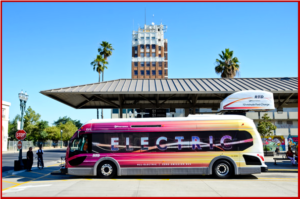
Click to Enlarge.
The U.S. Environmental Protection Agency (EPA) today announced it would nearly double the funding awarded for clean school buses* this year following increased demand, with school districts from all 50 states applying for the 2022 Clean School Bus Rebates.
This is the first round of funding from the EPA Clean School Bus Program, which President Biden’s Bipartisan Infrastructure Law created with a historic $5 billion investment for low- and zero-emission school buses over the next five years.
Last May, EPA announced the availability of $500 million, but given overwhelming demand from school districts across the country, including in low-income communities, Tribal nations, and territories, EPA is nearly doubling the amount of funding that will be awarded to $965 million.**
“Thanks to the leadership of the Biden-Harris Administration and the President’s Bipartisan Infrastructure Law, we’re working across all 50 states to accelerate the transition to a future where clean, zero-emissions school buses are the American standard,” said EPA Administrator Michael S. Regan. “America’s school districts delivered this message loud and clear – we must replace older, dirty diesel school buses. Together, we can reduce climate pollution, improve air quality, and reduce the risk of health impacts like asthma for as many as 25 million children who ride the bus every day.”
EPA said it will move swiftly to review applications submitted and expects to issue a robust slate of awards next month. EPA is also designing the next rounds of program funding to launch in the coming months, which will include an ambitious grant competition. Through future rounds of funding, EPA will make available another $1 billion for clean school buses in Fiscal Year 2023.
“Today’s announcement reflects what we know to be true—school districts across our country are eager to replace their heavy-polluting school buses with cleaner alternatives,” said Senator Carper (D-Del.), Chairman of the Senate Committee on Environment and Public Works. “I’m especially pleased to see that there is high demand for electric buses among low income, tribal, and other disadvantaged communities. These are the very communities that stand to gain the most from our historic clean school bus investments in the Bipartisan Infrastructure Law. Given the response to the availability of these dollars, it’s clear that more funding is needed. I look forward to working with Administrator Regan, the rest of the Biden Administration, and my colleagues in Congress to build on this progress so that more communities can realize the clean air and energy saving benefits of these cleaner vehicles.”
AutoInformed on
*The Clean School Bus Program will reduce greenhouse gas emissions and produce cleaner air for students, bus drivers, and school staff working near the bus loading areas, and the communities through which the buses drive each day. Diesel air pollution is linked to asthma and other conditions that harm students’ health and cause them to miss school, particularly in communities of color and Tribal communities. The reduction in greenhouse gas emissions from these bus replacements will also help to address the outsized role of the transportation sector in fueling the climate crisis. School districts can save money by upgrading their fleets.
** The rebate application period closed in August with an outstanding response from school districts seeking to purchase electric and low-emission school buses across the country. EPA received around 2,000 applications requesting nearly $4 billion for over 12,000 buses. More than 90 percent of buses requested were for zero-emission electric buses. Nearly 9 percent of applications were for propane buses and 1 percent were for compressed natural gas (CNG) buses. The applicant pool includes submissions from all 50 states, Washington D.C., Puerto Rico, the U.S. Virgin Islands, Guam, American Samoa, and federally recognized Tribes.

About Ken Zino
Ken Zino, editor and publisher of AutoInformed, is a versatile auto industry participant with global experience spanning decades in print and broadcast journalism, as well as social media. He has automobile testing, marketing, public relations and communications experience. He is past president of The International Motor Press Assn, the Detroit Press Club, founding member and first President of the Automotive Press Assn. He is a member of APA, IMPA and the Midwest Automotive Press Assn.
He also brings an historical perspective while citing their contemporary relevance of the work of legendary auto writers such as Ken Purdy, Jim Dunne or Jerry Flint, or writers such as Red Smith, Mark Twain, Thomas Jefferson – all to bring perspective to a chaotic automotive universe.
Above all, decades after he first drove a car, Zino still revels in the sound of the exhaust as the throttle is blipped during a downshift and the driver’s rush that occurs when the entry, apex and exit points of a turn are smoothly and swiftly crossed. It’s the beginning of a perfect lap.
AutoInformed has an editorial philosophy that loves transportation machines of all kinds while promoting critical thinking about the future use of cars and trucks.
Zino builds AutoInformed from his background in automotive journalism starting at Hearst Publishing in New York City on Motor and MotorTech Magazines and car testing where he reviewed hundreds of vehicles in his decade-long stint as the Detroit Bureau Chief of Road & Track magazine. Zino has also worked in Europe, and Asia – now the largest automotive market in the world with China at its center.







Biden-Harris Doubling Clean School Bus Rebates to $1 Billion
Click to Enlarge.
The U.S. Environmental Protection Agency (EPA) today announced it would nearly double the funding awarded for clean school buses* this year following increased demand, with school districts from all 50 states applying for the 2022 Clean School Bus Rebates.
This is the first round of funding from the EPA Clean School Bus Program, which President Biden’s Bipartisan Infrastructure Law created with a historic $5 billion investment for low- and zero-emission school buses over the next five years.
Last May, EPA announced the availability of $500 million, but given overwhelming demand from school districts across the country, including in low-income communities, Tribal nations, and territories, EPA is nearly doubling the amount of funding that will be awarded to $965 million.**
“Thanks to the leadership of the Biden-Harris Administration and the President’s Bipartisan Infrastructure Law, we’re working across all 50 states to accelerate the transition to a future where clean, zero-emissions school buses are the American standard,” said EPA Administrator Michael S. Regan. “America’s school districts delivered this message loud and clear – we must replace older, dirty diesel school buses. Together, we can reduce climate pollution, improve air quality, and reduce the risk of health impacts like asthma for as many as 25 million children who ride the bus every day.”
EPA said it will move swiftly to review applications submitted and expects to issue a robust slate of awards next month. EPA is also designing the next rounds of program funding to launch in the coming months, which will include an ambitious grant competition. Through future rounds of funding, EPA will make available another $1 billion for clean school buses in Fiscal Year 2023.
“Today’s announcement reflects what we know to be true—school districts across our country are eager to replace their heavy-polluting school buses with cleaner alternatives,” said Senator Carper (D-Del.), Chairman of the Senate Committee on Environment and Public Works. “I’m especially pleased to see that there is high demand for electric buses among low income, tribal, and other disadvantaged communities. These are the very communities that stand to gain the most from our historic clean school bus investments in the Bipartisan Infrastructure Law. Given the response to the availability of these dollars, it’s clear that more funding is needed. I look forward to working with Administrator Regan, the rest of the Biden Administration, and my colleagues in Congress to build on this progress so that more communities can realize the clean air and energy saving benefits of these cleaner vehicles.”
AutoInformed on
*The Clean School Bus Program will reduce greenhouse gas emissions and produce cleaner air for students, bus drivers, and school staff working near the bus loading areas, and the communities through which the buses drive each day. Diesel air pollution is linked to asthma and other conditions that harm students’ health and cause them to miss school, particularly in communities of color and Tribal communities. The reduction in greenhouse gas emissions from these bus replacements will also help to address the outsized role of the transportation sector in fueling the climate crisis. School districts can save money by upgrading their fleets.
** The rebate application period closed in August with an outstanding response from school districts seeking to purchase electric and low-emission school buses across the country. EPA received around 2,000 applications requesting nearly $4 billion for over 12,000 buses. More than 90 percent of buses requested were for zero-emission electric buses. Nearly 9 percent of applications were for propane buses and 1 percent were for compressed natural gas (CNG) buses. The applicant pool includes submissions from all 50 states, Washington D.C., Puerto Rico, the U.S. Virgin Islands, Guam, American Samoa, and federally recognized Tribes.
About Ken Zino
Ken Zino, editor and publisher of AutoInformed, is a versatile auto industry participant with global experience spanning decades in print and broadcast journalism, as well as social media. He has automobile testing, marketing, public relations and communications experience. He is past president of The International Motor Press Assn, the Detroit Press Club, founding member and first President of the Automotive Press Assn. He is a member of APA, IMPA and the Midwest Automotive Press Assn. He also brings an historical perspective while citing their contemporary relevance of the work of legendary auto writers such as Ken Purdy, Jim Dunne or Jerry Flint, or writers such as Red Smith, Mark Twain, Thomas Jefferson – all to bring perspective to a chaotic automotive universe. Above all, decades after he first drove a car, Zino still revels in the sound of the exhaust as the throttle is blipped during a downshift and the driver’s rush that occurs when the entry, apex and exit points of a turn are smoothly and swiftly crossed. It’s the beginning of a perfect lap. AutoInformed has an editorial philosophy that loves transportation machines of all kinds while promoting critical thinking about the future use of cars and trucks. Zino builds AutoInformed from his background in automotive journalism starting at Hearst Publishing in New York City on Motor and MotorTech Magazines and car testing where he reviewed hundreds of vehicles in his decade-long stint as the Detroit Bureau Chief of Road & Track magazine. Zino has also worked in Europe, and Asia – now the largest automotive market in the world with China at its center.