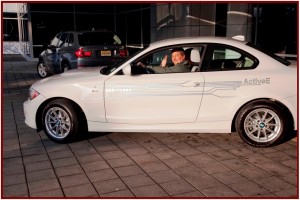
Tom Moloughney with the first leased BMW Active E.
BMW has delivered the first all-electric car, dubbed Active E, in the U.S. as part of a two-year lease experiment leading to the introduction of the series production BMW i3, which will come to market in 2013. A two-year Active E lease will be $499 a month with a $2,250 down payment. BMW recently cancelled the sale of its $90,000 X6 active hybrid in the U.S. due to lack of customer interest.
The fully electric Active E with its lithium-ion batteries have a claimed a driving range of up to 100 miles on a full charge. With an output of 170 horsepower, maximum torque of 184 lb-ft from a standstill, BMW said Active E accelerates from 0–60 mph in under nine seconds. If the driver is a lead-foot – or is that now lithium foot? and/or the weather is cold – the Bimmer won’t go that far, of course. All such mileage claims await independent verification.
Earlier this year The University of California, Davis and BMW released a study of electric vehicle (EV) users who drove the fully electric Mini E car more than 1 million miles in California, New York and New Jersey starting in June 2009.
One of the published observations about the 80 to 100 mile range – that it’s acceptable – challenges conventional wisdom. This will now be tested further as the all-electric BMW Active E deliveries, totaling 700, proceed in the metropolitan markets of Los Angeles, San Diego, San Francisco, Sacramento, New York, Boston and Hartford.
By using online and telephone surveys of the participating households, which were affluent enough to handle the $850 a month lease plus tax. Diaries, and in-person interviews of more than 40 households, were also used by the U.C. Davis team examined behavior, infrastructure use, costs, environmental benefits, and other aspects of electric driving.
Among the findings of the study are:
- 100% of respondents said EVs are fun to drive and practical for daily use
- Respondents said the Mini E met 90% of their daily driving needs
- 71% of respondents drove fewer than 40 miles/day; 95% drove fewer than 80
- 99% of respondents said home charging was easy to use
- 71% of respondents said they are now more likely to purchase an EV than they were a year ago while only 9% said they are less likely.
- 88% of respondents said they are interested in buying a EV or plug-in hybrid electric vehicle in the next five years
- By the end of the lease period, Mini E drivers overwhelmingly thought that the electricity for charging their EV should come from renewable resources such as solar, wind and hydropower, and were strongly opposed to using coal to generate electricity for their vehicles
This of course remains a huge problem in the U.S. where half of the electricity generated comes from burning dirty coal, which gives partial truth to the quip that electric vehicles aren’t zero emission vehicles but rather elsewhere emissions vehicles, as the CO2 produced comes from a utility smokestack, not the car while its running.
Last month, BMW Group and Toyota Motor Corporation (TMC) announced a memorandum of understanding (MOU) where the companies will research together the next-generation lithium-ion battery technologies. Current production Toyota hybrids use nickel metal hydride batteries, an older but thoroughly proven technology. Nevertheless, Toyota is about to introduce its first generation of Lithium ion batteries in the Prius Plug-in hybrid this year, as the U.S. National Highway Traffic Safety Administration investigates their potential to create vehicle fires. (See GM Will Lend Cars to Concerned Chevrolet Volt Owners as NHTSA Volt Battery Fire Investigation Continues
See also:
- Honda Claims it will lead in Fuel Economy in All Classes within Three Years. New EVs and Hybrids Coming
- Volkswagen Cross Coupe Plug-in Hybrid Unveiled at Tokyo
- Honda to Show AC-X Plug in Hybrid at Tokyo Motor Show
- 50 MPG Predicted for Toyota Prius c Hybrid
- Chevrolet Volt Fire After Crash Prompts NHTSA Investigation
- Ford Taking Orders for 2012 Focus Electric at $39,995
- Chevrolet to Produce Spark EV All-Electric Vehicle
- With BMW EV Due, Study Says Range Anxiety Not an Issue