
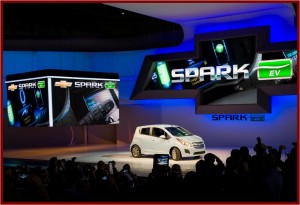
Using a dedicated 240V outlet, Spark EV recharges in less than seven hours. Range is still unstated.
The 2014 Chevrolet Spark EV will be priced under $25,000 with tax incentives, assuming you have $7,500 in federal tax liabilities, when it goes on sale starting next summer in California and Oregon Spark will also be available in small volumes in Canada and South Korea. Spark EV will be eligible for controversial high-occupancy vehicle (HOV) lanes in California. The price without incentives, starting at $32,500 is roughly 2.5X that of a gasoline-powered minicar.
The Korean made Chevrolet, along with a limited number of Chinese-built Sail Springo clones at the RMB equivalent of $41,425,will be powered by an electric motor rated at 130 horsepower (~100 kW) and 400 lb.-ft. (542 Nm) of torque, which will provide strong acceleration for the tiny four seat car. In theory this means zero-to-60 mph acceleration time of less than eight seconds is possible, but the car will no doubt be top-speed limited somewhere around 80 mph or so. The 20-kWh lithium ion battery-pack is expected to be among the best EVs for range in its segment, according to GM, which has not released certification numbers as yet.
Spark is a tiny five-door, four-passenger hatchback that has been on sale in Europe, Korea, India, Mexico, South America and Australia three years where minicars are more saleable, both thus far and historically. (Spark has sold more than 600,000 vehicles globally.) Spark came to the U.S. earlier this year as a 2013 model, and 8,400 have now been sold. In comparably-sized mini-cars, there is only the Fiat 500 (36,000 ytd), which is four inches shorter, and the Scion IQ (7,700). Here the Spark is a good value, since it starts at under $14,000, which is thousands less than the imported from Japan Scion or the Mexican-built Fiat.
General Motors needs the CAFE credits from the Spark EV and its gasoline versions to meet impending fuel economy requirements in the U.S. The Spark is now powered by a 1.2-liter four-cylinder engine that delivers 83 horsepower, and is rated at 32 mpg combined EPA mileage for the four-speed automatic version. (DOT and EPA Issue Record 54.5 MPG Fuel Economy Standards)
The current EV mileage champion is the much larger 2012 CODA, a five-passenger compact sedan with good rear seating and trunk space. The Coda with a bigger, more expensive 31kWh lithium ion battery-pack is rated at a combined range of 88 miles per charge. Depending on your driving habits and the climate, the Coda can be driven up to 125 miles on a single charge in what is said to be nearly four times the average daily U.S. commute. Test drives by AutoInformed show that the Coda mileage claims are credible. Moreover, if the Coda is driven with care, they are conservative. The Mitsubishi-based sedan in the federally mandated laboratory test that simulates city driving (the LA4 city cycle or Urban Dynamometer Driving Schedule) provides a range of 133.6 miles city and 116.1 miles highway.
The Honda Fit EV now on sale in California has a 20-kWh lithium-ion battery that provides the capacity to earn an EPA combined city/highway estimated driving range of 82 miles. This means the Fit EV – on paper and in press releases – surpasses the EPA efficiency and range ratings of the Ford Focus Electric (105 MPGe, 76-mile range), Nissan Leaf (99 MPGe, 73-mile range), and Mitsubishi I (112 MPGe, 62-mile range). Honda recently settled a class action lawsuit that said in effect that it had over-rated the mileage on the Civic hybrid.
Spark EV’s battery is warranted for eight years or 100,000 miles. It consists of a 560-pound (254 kg) lithium-ion battery pack with a volume of 133 liters, comprising 336 prismatic cells.
Lavish federal and California taxpayer subsidies, as well as access to coveted HOV – or high occupancy vehicle lanes – for politically favored EVs are bolstering sales of what remain mostly unsaleable electric vehicles, in the views of their many critics. While existing buyers of electric vehicles are true EV believers, the vast majority of car shoppers are decidedly not. In a new study, nearly half of EV owners claim the best benefit of their ac/dc wheels is lower emissions when compared with emissions from gasoline- or diesel-powered vehicles, but it’s not clear if they know how their electricity is generated.
However these people comprise only about 2.5% of the U.S. new vehicle market of more than 14 million – and that is only if you include hybrids as EVs; pure EVs have less than a 1% market share. Therefore, for EVs to be successful other people need to be brought into the tiny clan. Lowering the price is a necessary and profit destroying first step.
See:
- Green Talk from EV Makers Ignores Key Buyer Concern – Cost
- Spark Plug-in EV to Debut in La-La Land at Los Angeles Show
- GM to Increase Electric Vehicle Development in China







