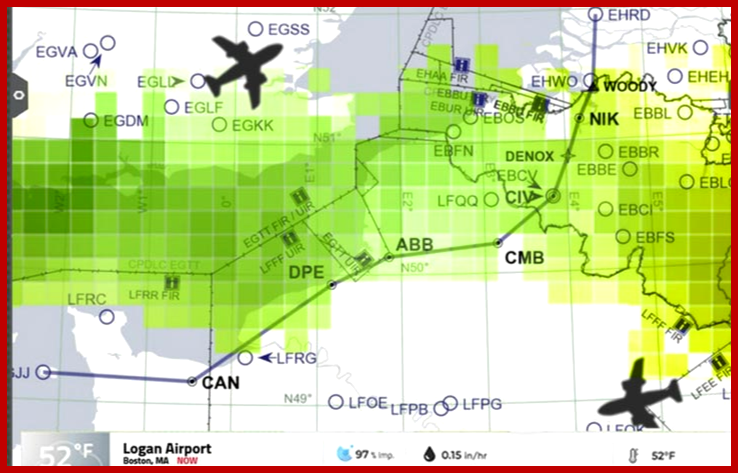
JetBlue uses ClimaCell’s aviation weather. Autonomous vehicles could also use it someday.
ClimaCell, a self-proclaimed micro-weather technology company that finds, and forecasts location-specific, short-term weather announced today that it has closed $45 million in Series B funding. The company says that in a weather industry that relies on small numbers of traditional sensing methods alone, it captures millions of new hyper-sensing points such as those from wireless and IoT networks.
ClimaCell aims to become the default weather platform for the emerging technology economy, including autonomous vehicles, unmanned aerial vehicles, and on-demand services, all while serving traditional consumers of weather products, such as aviation and utilities.
Clearvision Ventures led the financing round with participation from new investors Ford Smart Mobility, Envision Ventures, and existing investors Canaan, Fontinalis Partners, JetBlue Technology Ventures, and Square Peg Capital. The latest investment will be used to expand ClimaCell’s global presence, especially its sales team, and continue the company’s research and development of new weather sensing and forecasting methods.
Ford Motor’s interest is strictly commercial here. High-definition, micro-weather information supports multiple mobility and AV initiatives, including route planning, the services Ford can sell to customers via FordPass, and sharing information via the Transportation Mobility Cloud. Maybe in the future, real-time data will allow autonomous vehicles to be routed around bad weather.
It can be argued that there is a need for better weather data and forecasts with an increasing frequency of weather events costing $1 billion or more. Up to $1,344 billion, or three-to-six percent of variability in U.S. GDP, is attributed to weather, according to the U.S. National Weather Service.
However, the low density and slow update times of radars and weather stations can leave data gaps. Plus, radar can’t sense at low altitudes, and this makes weather more unpredictable, and dangerous. Since new hyper-sensing technologies capture millions of data points about ground-level weather, high-resolution data, such as ClimaCell’s, allegedly means more accurate forecasts. ClimaCell does hasten forecasting using big data techniques and high-performance computing. The question is how much of an improvement there is.
ClimaCell’s ambitious global expansion during next six months will see new coverage areas for the company, including places that have little to no weather forecasting infrastructure, including much of the developing world. ClimaCell’s claims its current offerings serve customers across both traditional and emerging industries, including aviation, automotive, shared mobility, UAVs, and utilities. Its micro-weather products (marketing babble alert) include HyperCast, a web-based interactive HD weather map, HyperCast Aviation, and the Microweather API, which provides a live weather data stream for integration with other software and platforms. Customers include JetBlue, Delta, Via, and Autodesk.
“The ClimaCell engine is built to map all the weather data in the world and brings critical weather data to its every corner with new hypersensing technologies and microweather forecasting,” said Shimon Elkabetz, CEO and Co-Founder, ClimaCell.
About ClimaCell
ClimaCell is the first microweather technology company, finding and forecasting location-specific, short-term weather that others can’t see. While traditional weather companies forecast at the city level, ClimaCell forecasts at the street level. ClimaCell can provide fresh data every minute in the past, present, and future, and requires no hardware installations. The company provides HyperCast and HyperCast Aviation HD weather map software, and the Microweather API as the default microweather platforms across many industries. ClimaCell’s technology is applicable to developing countries, enabling weather industries to be developed and public safety to be improved. Visit https://www.climacell.co/ or follow @WeatherRevealed.

About Ken Zino
Ken Zino, editor and publisher of AutoInformed, is a versatile auto industry participant with global experience spanning decades in print and broadcast journalism, as well as social media. He has automobile testing, marketing, public relations and communications experience. He is past president of The International Motor Press Assn, the Detroit Press Club, founding member and first President of the Automotive Press Assn. He is a member of APA, IMPA and the Midwest Automotive Press Assn.
He also brings an historical perspective while citing their contemporary relevance of the work of legendary auto writers such as Ken Purdy, Jim Dunne or Jerry Flint, or writers such as Red Smith, Mark Twain, Thomas Jefferson – all to bring perspective to a chaotic automotive universe.
Above all, decades after he first drove a car, Zino still revels in the sound of the exhaust as the throttle is blipped during a downshift and the driver’s rush that occurs when the entry, apex and exit points of a turn are smoothly and swiftly crossed. It’s the beginning of a perfect lap.
AutoInformed has an editorial philosophy that loves transportation machines of all kinds while promoting critical thinking about the future use of cars and trucks.
Zino builds AutoInformed from his background in automotive journalism starting at Hearst Publishing in New York City on Motor and MotorTech Magazines and car testing where he reviewed hundreds of vehicles in his decade-long stint as the Detroit Bureau Chief of Road & Track magazine. Zino has also worked in Europe, and Asia – now the largest automotive market in the world with China at its center.








ClimaCell Raises $45 Million to Map the World’s Microweather
JetBlue uses ClimaCell’s aviation weather. Autonomous vehicles could also use it someday.
ClimaCell, a self-proclaimed micro-weather technology company that finds, and forecasts location-specific, short-term weather announced today that it has closed $45 million in Series B funding. The company says that in a weather industry that relies on small numbers of traditional sensing methods alone, it captures millions of new hyper-sensing points such as those from wireless and IoT networks.
ClimaCell aims to become the default weather platform for the emerging technology economy, including autonomous vehicles, unmanned aerial vehicles, and on-demand services, all while serving traditional consumers of weather products, such as aviation and utilities.
Clearvision Ventures led the financing round with participation from new investors Ford Smart Mobility, Envision Ventures, and existing investors Canaan, Fontinalis Partners, JetBlue Technology Ventures, and Square Peg Capital. The latest investment will be used to expand ClimaCell’s global presence, especially its sales team, and continue the company’s research and development of new weather sensing and forecasting methods.
Ford Motor’s interest is strictly commercial here. High-definition, micro-weather information supports multiple mobility and AV initiatives, including route planning, the services Ford can sell to customers via FordPass, and sharing information via the Transportation Mobility Cloud. Maybe in the future, real-time data will allow autonomous vehicles to be routed around bad weather.
It can be argued that there is a need for better weather data and forecasts with an increasing frequency of weather events costing $1 billion or more. Up to $1,344 billion, or three-to-six percent of variability in U.S. GDP, is attributed to weather, according to the U.S. National Weather Service.
However, the low density and slow update times of radars and weather stations can leave data gaps. Plus, radar can’t sense at low altitudes, and this makes weather more unpredictable, and dangerous. Since new hyper-sensing technologies capture millions of data points about ground-level weather, high-resolution data, such as ClimaCell’s, allegedly means more accurate forecasts. ClimaCell does hasten forecasting using big data techniques and high-performance computing. The question is how much of an improvement there is.
ClimaCell’s ambitious global expansion during next six months will see new coverage areas for the company, including places that have little to no weather forecasting infrastructure, including much of the developing world. ClimaCell’s claims its current offerings serve customers across both traditional and emerging industries, including aviation, automotive, shared mobility, UAVs, and utilities. Its micro-weather products (marketing babble alert) include HyperCast, a web-based interactive HD weather map, HyperCast Aviation, and the Microweather API, which provides a live weather data stream for integration with other software and platforms. Customers include JetBlue, Delta, Via, and Autodesk.
“The ClimaCell engine is built to map all the weather data in the world and brings critical weather data to its every corner with new hypersensing technologies and microweather forecasting,” said Shimon Elkabetz, CEO and Co-Founder, ClimaCell.
About ClimaCell
ClimaCell is the first microweather technology company, finding and forecasting location-specific, short-term weather that others can’t see. While traditional weather companies forecast at the city level, ClimaCell forecasts at the street level. ClimaCell can provide fresh data every minute in the past, present, and future, and requires no hardware installations. The company provides HyperCast and HyperCast Aviation HD weather map software, and the Microweather API as the default microweather platforms across many industries. ClimaCell’s technology is applicable to developing countries, enabling weather industries to be developed and public safety to be improved. Visit https://www.climacell.co/ or follow @WeatherRevealed.
About Ken Zino
Ken Zino, editor and publisher of AutoInformed, is a versatile auto industry participant with global experience spanning decades in print and broadcast journalism, as well as social media. He has automobile testing, marketing, public relations and communications experience. He is past president of The International Motor Press Assn, the Detroit Press Club, founding member and first President of the Automotive Press Assn. He is a member of APA, IMPA and the Midwest Automotive Press Assn. He also brings an historical perspective while citing their contemporary relevance of the work of legendary auto writers such as Ken Purdy, Jim Dunne or Jerry Flint, or writers such as Red Smith, Mark Twain, Thomas Jefferson – all to bring perspective to a chaotic automotive universe. Above all, decades after he first drove a car, Zino still revels in the sound of the exhaust as the throttle is blipped during a downshift and the driver’s rush that occurs when the entry, apex and exit points of a turn are smoothly and swiftly crossed. It’s the beginning of a perfect lap. AutoInformed has an editorial philosophy that loves transportation machines of all kinds while promoting critical thinking about the future use of cars and trucks. Zino builds AutoInformed from his background in automotive journalism starting at Hearst Publishing in New York City on Motor and MotorTech Magazines and car testing where he reviewed hundreds of vehicles in his decade-long stint as the Detroit Bureau Chief of Road & Track magazine. Zino has also worked in Europe, and Asia – now the largest automotive market in the world with China at its center.