
GM needs to prove it can produce vehicles as well as the Japanese, and then sell them.
General Motors will invest $150 million in the reactivation of its Bekasi manufacturing facility in West Java, Indonesia. The plant, closed in the middle of the last decade, will begin production of a new line of “people movers” for Southeast Asia in 2013, GM said today in a release.
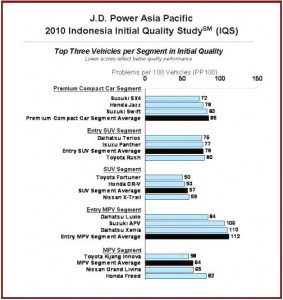
Japanese makes, led by Toyota & Daihatsu (50%), control 93% of the market in Indonesia thanks to their early – 1970s – entry there. GM, Ford and Chrysler have less than 3%. The balance goes to the Europeans (luxury cars) and the Korean automakers that are just ramping up.
The 11-hectare plant outside of Jakarta will initially manufacture up to 40,000 vehicles per year and ultimately create more than 800 new jobs. GM said it will introduce new vehicle manufacturing equipment and standard processes, including its Global Manufacturing System. Further details about the product such as its nameplate, design specifications and pricing will be announced at a later date.
The investment represents a change in GM strategy in Asia by expanding GM production away from Vietnam and especially Thailand, which provided a good infrastructure and, previously, political stability. However, Indonesia has been widely derided for its corruption and red tape.
GM’s Bekasi plant will join GM Thailand’s Rayong facility and GM Vietnam’s Hanoi plant as important drivers of GM’s Southeast Asia growth strategy. It will leverage the local supply base while spurring the expansion of GM’s local dealer network. ASEAN lowered tariffs and other trade barriers this year, making shipping among the bloc easier and less expensive.
Car sales in Southeast Asia are expected to be 2.2 million units in 2011. Some projections have them increasing to 2.7 million vehicles a year by 2015. Indonesian sales could total close to 900,000 vehicles this year, thereby making the archipelago the largest and fastest-growing market among the ASEAN trading block, according to auto analyst Michael Dunne who lives in Jakarta.
“This is one of the most significant undertakings we have made in the region,” said Martin Apfel, president of GM Southeast Asia. “The decision to reopen our Bekasi plant is an extension of GM’s commitment to maintain a strong manufacturing base in Indonesia and Southeast Asia for the production of world-class products that consumers will aspire to buy.”