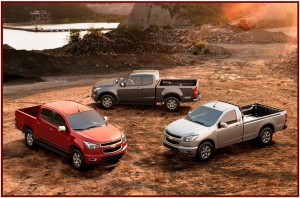
The new 2012 Chevrolet Colorado range has single, extended and crew-cab body styles is the product of a five-year, $2 billion vehicle program developed across five continents for customers in more than 60 markets. Thai production is ongoing.
Honda Automobile Thailand – HATC – continues to be shut down since October 4th because of the Thailand floods. “Due to the inability to access its facility in, Ayutthaya , HATC does not currently have a clear outlook for when production will resume,” Honda said today.
Toyota Motor Corporation has also “adjusted” production in Japan this week due to Thailand parts shortages at least through Friday, as the after affects of the Thailand Floods – responsible for at least 300 deaths – continue to grow. Toyota thus far has lost at least 6,000 units, and its production recovery plan from the Japan Earthquake and Tsunami now appears to be threatened by the floods. Three Toyota plants in Thailand remain closed at Samrong, Gateway and Ban Pho.
“A decision on production hours from October 29 onward will be made based on an assessment of the situation as it develops,” Toyota said today in a statement. (Read AutoInformed.com on: Thailand Floods – Worst in 50 Years – latest Tragedy to Hurt Auto Industry as Honda, Toyota and Ford Production Disrupted)
Japanese automakers led by Toyota, Honda Motor Co. and Nissan — are losing thousands of vehicles daily, according to the Japan Automobile Manufacturers Association. Thailand has an annual vehicle production capacity of almost 2 million units, extensive exports, as well as numerous component parts manufacturing operations.
In 2010 roughly 900,000 vehicles – 55% of total vehicle assembly in Thailand – were exported. The main export regions include Australia, New Zealand, Europe, Middle East, Mexico, South Africa and Brunei. Models exported now from flood affected makers include Honda Jazz, Civic, City, Accord, the Toyota Hilux pick-up, and the Ford Ranger pick-up, according to the Frost & Sullivan consultancy.
Thai Honda, Honda’s motorcycle and power products production subsidiary in Thailand, has suspended motorcycle production since October 11, and power products production since October 6, due to parts supply disruptions from suppliers impacted by the flooding. As the timing of the recovery of parts supply remains unclear, Thai Honda is scheduled to suspend its production until at least October 29. As of today, no flood water damage has been confirmed within the property of Thai Honda.
U.S. Honda operations will not be affected, a Honda spokesperson told AutoInformed. Honda group companies will provide approximately ¥280 million toward the relief and recovery efforts in Thailand where it has been doing business for 47 years.
Toyota has also stopped Thailand production while it sorts out supply problems. Toyota and Isuzu are likely to lose the next 2-3 weeks of production from parts shortages, with losses estimated at 30,000-35,000 and 10,000-15,000 units, respectively.
Ford’s joint venture with Mazda – AutoAlliance Thailand or AAT – has suspended production through at least Saturday 29 October. AAT is located in an area of Rayong that has not been affected by the floods. However, a number of AAT’s suppliers operating in Ayutthaya province have been affected. Ford said it is working with them on a daily basis to assist recovery actions. Ford also said it will continue with a day-to-day assessment of manufacturing readiness to decide when production can resume, while declining to provide estimates of lost sales. AAT builds Mazda 2 and Ford Fiesta subcompacts, Ford Ranger and Mazda B-Series pickup trucks, and the Ford Everest SUV.
General Motors appears to be the automaker least affected thus far since its plant and suppliers are outside the flood affected regions.