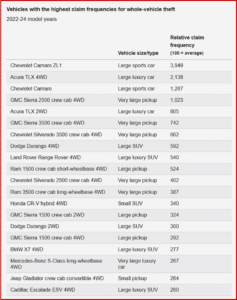
The Chevrolet Camaro ZL1 is at the top of the list of America’s most-stolen vehicles, while a software upgrade helped reduce theft rates for Hyundai and Kia vehicles, according to new research from the Highway Loss Data Institute. Relative to its numbers on the roads, the Camaro ZL1 had a whole-vehicle theft rate 39 times the average for all vehicles. The frequency of whole-vehicle theft claims for the standard Camaro was 13 times higher than the average. Along with the two Camaro variants, pickup trucks and other expensive or high-horsepower models dominate the list of the top 20 vehicles with the highest claim frequencies for whole-vehicle theft.*
“Muscle cars have often topped this list, as thieves are attracted to vehicles with high horsepower,” said Matt Moore, chief insurance operations officer at HLDI and the Insurance Institute for Highway Safety. “That also helps explain why the more expensive, more powerful ZL1 is stolen so much more often than the standard Camaro.”
Click for more.
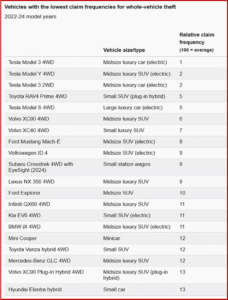
The 20 least-stolen vehicles include eight electric vehicles and two plug-in hybrids, all of which have whole-vehicle theft claim frequencies that are more than 85% lower than the all-vehicle average. As previous HLDI studies have found, electric vehicles are likely to be garaged or parked near buildings to facilitate charging, making them less attractive to thieves.
“On top of the high horsepower that makes the Camaro an attractive target, a technical glitch seems to have created new opportunities for thieves to steal it, according to news reports. Thieves can steal modern vehicles by cloning the owner’s key fob with an electronic device. Ordinarily, they need access to the fob to copy it. But some media outlets have reported that thieves are able to clone the key code for newer Camaros by accessing the on-board ports that technicians use to retrieve diagnostic codes and monitor data about fuel economy, emissions, and other aspects of performance.
“Most theft claims don’t indicate whether the entire vehicle or just some components or vehicle contents were stolen. For its ranking of the most-stolen vehicles, HLDI identifies whole-vehicle thefts by comparing the dollar amounts of theft claims with what insurers pay for the same vehicles when they’re totaled in a crash.
Click for more.
“HLDI delved deeper into the situation with a separate analysis of Camaro theft claims for model years 2010-24. That analysis showed that theft claim frequencies – both whole-vehicle and smaller claims – for Camaro variants were relatively stable from 2020 through 2022 but rose sharply in 2023 and continued to climb through much of 2024. It also indicated a clear break in the pattern beginning with model year 2016, which was when a keyless, push-button start system was introduced.
“We expect powerful and high-value vehicles to be targeted, and these models check both those boxes,” Moore said. “But it stood out to us that Camaros that were nearly 10 years old had such high claim frequencies.”
“Theft claims for model year 2016-24 Camaros began to soar in 2023. Claim frequency for the newer models peaked in March 2024 at 18.3 claims per 1000 insured vehicle years, compared with about 1.3 claims per 1000 insured vehicle years for 2010-15 models. (One insured vehicle year equals one vehicle insured for one year, two vehicles insured for six months, and so forth.)
“Texas and California were the first states to show spikes in theft claims for Camaros. In 2024, California recorded the highest theft claim frequencies for these vehicles, followed by Tennessee, Mississippi, Maryland, and Texas.
“In March 2025, General Motors launched a service campaign aimed at reducing theft risk for 2020-24 Camaro models. Under the initiative, owners can bring their vehicles to dealerships for a free software update.
“HLDI hopes to study how the new software influences theft claims. In the meantime, Camaro owners should contact a nearby dealer to get the update as soon as possible,” Moore said.
*The Insurance Institute for Highway Safety (IIHS) is an independent, non-profit scientific and educational organization dedicated to reducing deaths, injuries, and property damage from motor vehicle crashes through research and evaluation and through education of consumers, policymakers, and safety professionals. The Highway Loss Data Institute (HLDI) supports this mission through scientific studies of insurance data representing the human and economic losses resulting from the ownership and operation of different types of vehicles and by publishing insurance loss results by vehicle make and model. Both organizations are wholly supported by auto insurers and insurance associations.

About Ken Zino
Ken Zino, editor and publisher of AutoInformed, is a versatile auto industry participant with global experience spanning decades in print and broadcast journalism, as well as social media. He has automobile testing, marketing, public relations and communications experience. He is past president of The International Motor Press Assn, the Detroit Press Club, founding member and first President of the Automotive Press Assn. He is a member of APA, IMPA and the Midwest Automotive Press Assn.
He also brings an historical perspective while citing their contemporary relevance of the work of legendary auto writers such as Ken Purdy, Jim Dunne or Jerry Flint, or writers such as Red Smith, Mark Twain, Thomas Jefferson – all to bring perspective to a chaotic automotive universe.
Above all, decades after he first drove a car, Zino still revels in the sound of the exhaust as the throttle is blipped during a downshift and the driver’s rush that occurs when the entry, apex and exit points of a turn are smoothly and swiftly crossed. It’s the beginning of a perfect lap.
AutoInformed has an editorial philosophy that loves transportation machines of all kinds while promoting critical thinking about the future use of cars and trucks.
Zino builds AutoInformed from his background in automotive journalism starting at Hearst Publishing in New York City on Motor and MotorTech Magazines and car testing where he reviewed hundreds of vehicles in his decade-long stint as the Detroit Bureau Chief of Road & Track magazine. Zino has also worked in Europe, and Asia – now the largest automotive market in the world with China at its center.







Hot Cars – Camaro ZL1 Most Stolen Vehicle
The Chevrolet Camaro ZL1 is at the top of the list of America’s most-stolen vehicles, while a software upgrade helped reduce theft rates for Hyundai and Kia vehicles, according to new research from the Highway Loss Data Institute. Relative to its numbers on the roads, the Camaro ZL1 had a whole-vehicle theft rate 39 times the average for all vehicles. The frequency of whole-vehicle theft claims for the standard Camaro was 13 times higher than the average. Along with the two Camaro variants, pickup trucks and other expensive or high-horsepower models dominate the list of the top 20 vehicles with the highest claim frequencies for whole-vehicle theft.*
“Muscle cars have often topped this list, as thieves are attracted to vehicles with high horsepower,” said Matt Moore, chief insurance operations officer at HLDI and the Insurance Institute for Highway Safety. “That also helps explain why the more expensive, more powerful ZL1 is stolen so much more often than the standard Camaro.”
Click for more.
The 20 least-stolen vehicles include eight electric vehicles and two plug-in hybrids, all of which have whole-vehicle theft claim frequencies that are more than 85% lower than the all-vehicle average. As previous HLDI studies have found, electric vehicles are likely to be garaged or parked near buildings to facilitate charging, making them less attractive to thieves.
“On top of the high horsepower that makes the Camaro an attractive target, a technical glitch seems to have created new opportunities for thieves to steal it, according to news reports. Thieves can steal modern vehicles by cloning the owner’s key fob with an electronic device. Ordinarily, they need access to the fob to copy it. But some media outlets have reported that thieves are able to clone the key code for newer Camaros by accessing the on-board ports that technicians use to retrieve diagnostic codes and monitor data about fuel economy, emissions, and other aspects of performance.
“Most theft claims don’t indicate whether the entire vehicle or just some components or vehicle contents were stolen. For its ranking of the most-stolen vehicles, HLDI identifies whole-vehicle thefts by comparing the dollar amounts of theft claims with what insurers pay for the same vehicles when they’re totaled in a crash.
Click for more.
“HLDI delved deeper into the situation with a separate analysis of Camaro theft claims for model years 2010-24. That analysis showed that theft claim frequencies – both whole-vehicle and smaller claims – for Camaro variants were relatively stable from 2020 through 2022 but rose sharply in 2023 and continued to climb through much of 2024. It also indicated a clear break in the pattern beginning with model year 2016, which was when a keyless, push-button start system was introduced.
“We expect powerful and high-value vehicles to be targeted, and these models check both those boxes,” Moore said. “But it stood out to us that Camaros that were nearly 10 years old had such high claim frequencies.”
“Theft claims for model year 2016-24 Camaros began to soar in 2023. Claim frequency for the newer models peaked in March 2024 at 18.3 claims per 1000 insured vehicle years, compared with about 1.3 claims per 1000 insured vehicle years for 2010-15 models. (One insured vehicle year equals one vehicle insured for one year, two vehicles insured for six months, and so forth.)
“Texas and California were the first states to show spikes in theft claims for Camaros. In 2024, California recorded the highest theft claim frequencies for these vehicles, followed by Tennessee, Mississippi, Maryland, and Texas.
“In March 2025, General Motors launched a service campaign aimed at reducing theft risk for 2020-24 Camaro models. Under the initiative, owners can bring their vehicles to dealerships for a free software update.
“HLDI hopes to study how the new software influences theft claims. In the meantime, Camaro owners should contact a nearby dealer to get the update as soon as possible,” Moore said.
*The Insurance Institute for Highway Safety (IIHS) is an independent, non-profit scientific and educational organization dedicated to reducing deaths, injuries, and property damage from motor vehicle crashes through research and evaluation and through education of consumers, policymakers, and safety professionals. The Highway Loss Data Institute (HLDI) supports this mission through scientific studies of insurance data representing the human and economic losses resulting from the ownership and operation of different types of vehicles and by publishing insurance loss results by vehicle make and model. Both organizations are wholly supported by auto insurers and insurance associations.
About Ken Zino
Ken Zino, editor and publisher of AutoInformed, is a versatile auto industry participant with global experience spanning decades in print and broadcast journalism, as well as social media. He has automobile testing, marketing, public relations and communications experience. He is past president of The International Motor Press Assn, the Detroit Press Club, founding member and first President of the Automotive Press Assn. He is a member of APA, IMPA and the Midwest Automotive Press Assn. He also brings an historical perspective while citing their contemporary relevance of the work of legendary auto writers such as Ken Purdy, Jim Dunne or Jerry Flint, or writers such as Red Smith, Mark Twain, Thomas Jefferson – all to bring perspective to a chaotic automotive universe. Above all, decades after he first drove a car, Zino still revels in the sound of the exhaust as the throttle is blipped during a downshift and the driver’s rush that occurs when the entry, apex and exit points of a turn are smoothly and swiftly crossed. It’s the beginning of a perfect lap. AutoInformed has an editorial philosophy that loves transportation machines of all kinds while promoting critical thinking about the future use of cars and trucks. Zino builds AutoInformed from his background in automotive journalism starting at Hearst Publishing in New York City on Motor and MotorTech Magazines and car testing where he reviewed hundreds of vehicles in his decade-long stint as the Detroit Bureau Chief of Road & Track magazine. Zino has also worked in Europe, and Asia – now the largest automotive market in the world with China at its center.