Click for more.
Faster, more decisive action is required from America’s vehicle safety regulator is needed “to reverse a drastic escalation in fatal crashes on the nation’s roadways,” David Harkey, president of the Insurance Institute for Highway Safety,* said at a Congressional hearing today.
“The United States is in the middle of a road safety emergency, and the National Highway Traffic Safety Administration (NHTSA) is failing to meet the moment,” Harkey said in written testimony submitted to the U.S. House of Representatives Committee on Energy and Commerce’s Subcommittee on Commerce, Manufacturing, and Trade, which convened the hearing on the state of NHTSA and motor vehicle safety.
“Beginning in the 1960s, NHTSA and its predecessor agencies spurred dramatic improvements in road safety by issuing safety standards, funding vital research and supporting pilot projects to demonstrate the effectiveness of specific interventions,” Harkey said. As an example, the regulation that all vehicles be equipped with frontal airbags is estimated to have saved 70,000 lives through 2019.
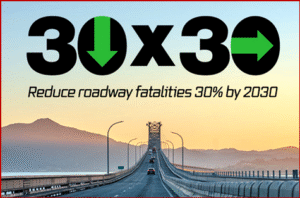
Now, in the view of IIHS, the numbers are trending in the wrong direction. Crash deaths on U.S. roads have risen nearly 30% from below 33,000 in 2014 to more than 42,000 in 2022. With a new initiative called 30×30, IIHS said it has targeted reversing that decline by 2030.
Insurance Institute for Highway Safety Recommendations for NHTSA
- Regulations requiring anti-lock braking systems for motorcycles.
- Mandating technology to prevent impaired driving.
- Setting stringent requirements for safety features on semitrailers.
- More active oversight from NHTSA is also needed on vehicle automation, where a regulatory gap has contributed to drivers’ confusion over the capabilities of technology in their vehicles.
- National maximum speed limit of 65 mph.
- Increasing seat belt use to 100%.
- Reducing the legally allowed blood alcohol concentration for drivers from 0.08% to 0.05% in all states.
*The Insurance Institute for Highway Safety (IIHS) is an independent, non-profit scientific and educational organization dedicated to reducing deaths, injuries and property damage from motor vehicle crashes through research and evaluation and through education of consumers, policymakers and safety professionals. The Highway Loss Data Institute (HLDI) supports this mission through scientific studies of insurance data representing the human and economic losses resulting from the ownership and operation of different types of vehicles and by publishing insurance loss results by vehicle make and model. Both organizations are wholly supported by auto insurers and insurance associations.

About Ken Zino
Ken Zino, editor and publisher of AutoInformed, is a versatile auto industry participant with global experience spanning decades in print and broadcast journalism, as well as social media. He has automobile testing, marketing, public relations and communications experience. He is past president of The International Motor Press Assn, the Detroit Press Club, founding member and first President of the Automotive Press Assn. He is a member of APA, IMPA and the Midwest Automotive Press Assn.
He also brings an historical perspective while citing their contemporary relevance of the work of legendary auto writers such as Ken Purdy, Jim Dunne or Jerry Flint, or writers such as Red Smith, Mark Twain, Thomas Jefferson – all to bring perspective to a chaotic automotive universe.
Above all, decades after he first drove a car, Zino still revels in the sound of the exhaust as the throttle is blipped during a downshift and the driver’s rush that occurs when the entry, apex and exit points of a turn are smoothly and swiftly crossed. It’s the beginning of a perfect lap.
AutoInformed has an editorial philosophy that loves transportation machines of all kinds while promoting critical thinking about the future use of cars and trucks.
Zino builds AutoInformed from his background in automotive journalism starting at Hearst Publishing in New York City on Motor and MotorTech Magazines and car testing where he reviewed hundreds of vehicles in his decade-long stint as the Detroit Bureau Chief of Road & Track magazine. Zino has also worked in Europe, and Asia – now the largest automotive market in the world with China at its center.








IIHS President – NHTSA Must Act Decisively on Fatal Crashes
Click for more.
Faster, more decisive action is required from America’s vehicle safety regulator is needed “to reverse a drastic escalation in fatal crashes on the nation’s roadways,” David Harkey, president of the Insurance Institute for Highway Safety,* said at a Congressional hearing today.
“The United States is in the middle of a road safety emergency, and the National Highway Traffic Safety Administration (NHTSA) is failing to meet the moment,” Harkey said in written testimony submitted to the U.S. House of Representatives Committee on Energy and Commerce’s Subcommittee on Commerce, Manufacturing, and Trade, which convened the hearing on the state of NHTSA and motor vehicle safety.
“Beginning in the 1960s, NHTSA and its predecessor agencies spurred dramatic improvements in road safety by issuing safety standards, funding vital research and supporting pilot projects to demonstrate the effectiveness of specific interventions,” Harkey said. As an example, the regulation that all vehicles be equipped with frontal airbags is estimated to have saved 70,000 lives through 2019.
Now, in the view of IIHS, the numbers are trending in the wrong direction. Crash deaths on U.S. roads have risen nearly 30% from below 33,000 in 2014 to more than 42,000 in 2022. With a new initiative called 30×30, IIHS said it has targeted reversing that decline by 2030.
Insurance Institute for Highway Safety Recommendations for NHTSA
*The Insurance Institute for Highway Safety (IIHS) is an independent, non-profit scientific and educational organization dedicated to reducing deaths, injuries and property damage from motor vehicle crashes through research and evaluation and through education of consumers, policymakers and safety professionals. The Highway Loss Data Institute (HLDI) supports this mission through scientific studies of insurance data representing the human and economic losses resulting from the ownership and operation of different types of vehicles and by publishing insurance loss results by vehicle make and model. Both organizations are wholly supported by auto insurers and insurance associations.
About Ken Zino
Ken Zino, editor and publisher of AutoInformed, is a versatile auto industry participant with global experience spanning decades in print and broadcast journalism, as well as social media. He has automobile testing, marketing, public relations and communications experience. He is past president of The International Motor Press Assn, the Detroit Press Club, founding member and first President of the Automotive Press Assn. He is a member of APA, IMPA and the Midwest Automotive Press Assn. He also brings an historical perspective while citing their contemporary relevance of the work of legendary auto writers such as Ken Purdy, Jim Dunne or Jerry Flint, or writers such as Red Smith, Mark Twain, Thomas Jefferson – all to bring perspective to a chaotic automotive universe. Above all, decades after he first drove a car, Zino still revels in the sound of the exhaust as the throttle is blipped during a downshift and the driver’s rush that occurs when the entry, apex and exit points of a turn are smoothly and swiftly crossed. It’s the beginning of a perfect lap. AutoInformed has an editorial philosophy that loves transportation machines of all kinds while promoting critical thinking about the future use of cars and trucks. Zino builds AutoInformed from his background in automotive journalism starting at Hearst Publishing in New York City on Motor and MotorTech Magazines and car testing where he reviewed hundreds of vehicles in his decade-long stint as the Detroit Bureau Chief of Road & Track magazine. Zino has also worked in Europe, and Asia – now the largest automotive market in the world with China at its center.