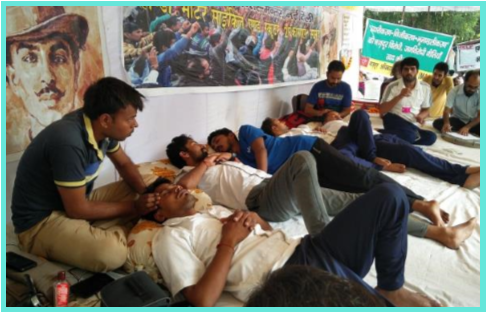
 Five fired employees of the Tapukara plant of Honda Motorcycle and Scooter India (HMSI) began a hunger strike on 19 September demanding reinstatement of workers and the “withdrawal of false police charges” filed against them. On 26 September, the eighth day of the protest, Vipin Kumar was hospitalized but refused to break his fast.
The hunger strike, a Gandhian method of non-violent political protest where participants do not take solid food, was launched to force the Honda management to come to the negotiating table.
It’s obvious that workers’ health is deteriorating each day. However, the five workers including Kumar Naresh Mehta, President of Honda Motorcycle and Scooter 2F Kamgar Union Tapukara, and workers Sunil, Ravi, Avinash and Vipin Kumar say they are determined to continue the hunger strike until their demands are met.
HMSI is a 100 % owned subsidiary of Honda Motor Company Ltd., Japan. The current industrial dispute at the HMSI 2f Tapukara plant, which employed 466 permanent workers and about 3000 contract workers, began in February this year following a clash between a contract worker and a supervisor against charges of denial of union rights and simmering discontent at the plant.
The clash sparked protests from workers demanding the right to form a union, regularization of contract workers, and punishment to the supervisor who manhandled the contract worker. The protest resulted in workers’ arrests and a series of disciplinary actions including suspension and termination of workers. In addition, the 3,000 contract workers were also dismissed, clearly a union busting tactic.
Prior to the dispute, workers had formed the Honda Motorcycle and Scooter 2f Kamgar Union Tapukara with the help of the All India Trade Union Congress (AITUC) to address workers’ concerns. Despite applying for registration with the labor department in 2015, the union has still not been registered and the issue is pending in court.
Soon after the clash on 16 February, the management supported the swift formation the HMSI 2F Karamchari Union in the factory backed by the right wing national trade union center, Bharatiya Mazdoor Sangh (BMS). Now the management say they will only negotiate with BMS.
Subsequently negotiations in the presence of the labor officials have resulted in the reinstatement of 281 workers. Despite management assuring that all workers would be reinstated, it has terminated 102 workers and 39 trainees have been let go. There has also been no progress on the status of 22 suspended workers. Instead of reinstating the 3,000 contract workers who were fired, the management has recruited about 2,800 fresh contract workers.
Since February workers have held a series protests across Rajasthan and appealed to Honda management and the government to resolve their issues. So far numerous conciliation meetings have taken place at the labor commissioner’s offices in Alwar and Jaipur. Company management has not participated in many of these meetings.
In September 2016, the management signed a collective bargaining agreement with the BMS supported union. However, none of the demands of the workers, including reinstatement of contract workers and withdrawal of police charges, are part of the settlement.
Honda workers’ protests received widespread support from automobile unions in the Delhi NCR region and representatives from central trade unions. Workers from the Honda Gurgaon plant have also extended solidarity to the workers on hunger strike.