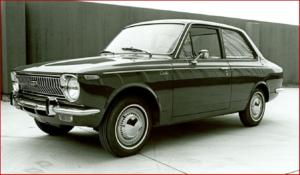
Click to Enlarge. The oldest Corolla …
Toyota notes today that it has sold the 50-millionth Corolla, a milestone not just in Toyota history, but automotive history too. Now in its 12th generation and more than 55 years in production, Corolla remains one of the world’s top-selling vehicles. Toyota introduced the Corolla in 1966. It arrived in the U.S. in spring 1968 as a 1969 model, starting at about $1700. The AM radio was an option. Gas cost $0.35 a gallon, and the median household income was $7,700. AutoInformed observes that until recently, the Honda Civic was had the better set-up and more technology for spirited, performance-oriented driving. (Gen 12 Corolla Rolls Off the Line at Toyota Mississippi)
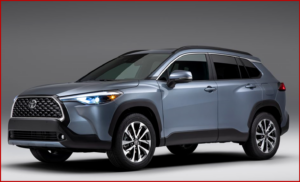
… the New Corolla Cross.
Tracking the seeming inevitable fate of automobiles and trucks in America, Corolla quickly evolved to offer more room, comfort and performance for close to three generations of customers. The 2022 Corolla combines advanced tech, sporty style and top-level comfort with up to 53/52/52 EPA estimated MPG in the hybrid model and the protection of standard Toyota Safety Sense 2.0 with automatic emergency braking. And, gasp, the first-ever Corolla Cross SUV-like version. Toyota invites everyone with a Corolla story to share it using #MyCorollaStory.
Corolla sales were growing here when the October 1973 Oil Embargo caused long lines and higher prices at the gas pump, and even fuel rationing. When the economy recovered, Toyota began to add more models, including a fastback coupe and liftback versions. By the mid-1980s, Toyota was building Corollas in the US – followed Honda’s bold mover here that prompted it. Corollas are now built at Toyota Motor Manufacturing Mississippi, Inc. (TMMMS), which opened in 2011. The new Mazda Toyota Manufacturing plant in Huntsville, Alabama, began building the all-new Toyota Corolla Cross this year.
AutoInformed.com on
Following is Toyota’s version of Corolla’s history.
First Generation: 1969-1970
The first Corolla was simple with good all-around visibility in coupe, four-door sedan and two-door wagon models. A coupe called Corolla Sprinter with a slightly lower semi-fastback roofline arrived later. All Corollas had a short-stroke 1,077-cc overhead-valve four-cylinder engine that used aluminum for the cylinder head, intake manifold, valve cover and clutch housing . Wheels were tiny at a 12-inch diameter, and the only transmission offered was a four-speed manual. With 60 horsepower (51 hp SAE net) zero-to-60 took around 17 gasping seconds, and the top fuel economy estimate was in the high 20s. The 1969 Corolla two-door sedan started at just under $1,700, and among its standard features were reclining front seats and a locking fuel-filler door.
Second Generation: 1971-1974
The second-generation Corolla grew, with a slightly longer wheelbase, moved up to 73 horsepower and offered Corolla’s first optional automatic transmission, a two-speed. (A three-speed arrived a later.) For 1972, an SR-5 coupe had an 88-hp (SAE net) 1.6-liter engine with a five-speed manual transmission. Corolla had by this time become the second-best-selling car in the world.
Third Generation: 1975-1979
The Corolla again increased in size and offered 1.2-, 1.3- and 1.6-liter engines. The line added fastback coupe and Liftback models for 1976 with tweaked front styling. The Liftback was claimed to be more like a sport wagon and added rear seat head room.
Fourth Generation: 1980-1984
An angular design marked the fourth-generation Corolla, which kept its wide range of models. The new design focused on roominess and quietness while adding more – as they were then called “amenities.” The U.S. model offered a 75-hp OHV 1.8-liter engine and the 4A-C 90-hp OHC 1.6-liter engine. The two-door models had front seats with a “memory” feature that allowed the seats to slide forward to assist with rear seat ingress/egress, and then return to the same position and recline angle.
Fifth Generation: 1985-1988
The fifth-generation Corolla switched to front-wheel drive for added interior room and better all-weather traction. In a joint venture with General Motors called New United Motor Manufacturing, Inc. (NUMMI), Toyota began building Corollas in California. All front-drive engines were now SOHC configuration.
A rear-drive Corolla model, known by its VIN prefix “AE86,” came in coupe and hatchback styles. The top GT-S version had the 4A-GE DOHC 1.6-liter engine. In 1987, a new front-drive FX hatchback was added, and the top version, the FX16 GT-S, inherited the 4A-GE engine to create a new “hot hatch” model. The rear-drive GT-S would later become a drifting legend, in real life and in video games.
Sixth Generation: 1989-1992
The sixth-generation Corolla line was now all front-wheel drive powered by 16-valve DOHC engines and with four-wheel independent suspension. The Corolla All-Trac wagon and sedan models had an all-wheel drive system. The new coupe had pop-up headlights like the AE86 and came in SR-5 and GT-S models. The latter had the 4A-GE engine, special wheels and a body kit. The GT-S had 135 horsepower in the 1990-1991 version.
Seventh Generation: 1993-1997
The seventh-generation Corolla, available only in sedan and wagon styles in the U.S., became more Camry-like in its design. It moved up in cabin size to the compact segment while the Camry moved to mid-size. Both 1.6-liter and 1.8-liter DOHC engines were offered. For 1997, a CE sedan packaged numerous popular options for a special value-priced model. Corolla becoming the best-selling car model in history that year.
Eighth Generation: 1998-2002
The eighth-generation Corolla had yet more cabin room on the same wheelbase as the previous model. The redesigned unibody improved passenger crash protection and, notably, side airbags became optional. A new all-aluminum 1ZZ-FE 1.8-liter DOHC four-cylinder engine debuted the Variable Valve Timing with intelligence (VVT-i) system and made 120 horsepower with higher fuel economy ratings. By 2002, the Corolla had achieved 25 million sold worldwide.
Ninth Generation: 2003-2008
In its ninth-generation, Corolla got longer and taller to create its roomiest cabin ever. A Corolla S model added sport-tuned suspension and special body styling. With its 130-horsepower engine, the Corolla had an EPA-estimated 31 combined MPG with the five-speed manual transmission and 28 combined MPG with the four-speed automatic. The center console box could hold 14 compact discs.
For 2005, the performance-tuned Corolla XRS model combined the high-revving 164-horsepower 2ZZ 1.8-liter engine from the Celica GT-S with a six-speed manual transmission and sport-tuned suspension.
10th Generation: 2009-2013
In the 10th-generation Corolla, a multi-faceted focus on refinement resulted in what “Motor Trend” magazine said, “must be the quietest car in its class, with less wind noise than many luxury cars.” The XRS model returned, now with the 2.4-liter engine from the Camry for higher torque and greater responsiveness in everyday driving. With CDs beginning to fade, the higher-grade Corolla models offered JBL Premium Audio with iPod connectivity, Bluetooth and steering-wheel-mounted audio controls. Comfort and tech had become higher priorities for compact car buyers, and the Corolla added the XLE grade, which offered an optional power moonroof and a JBL audio system with AM/FM/six-disc CD changer, plus satellite radio and eight speakers.
11th Generation: 2014-2018
The 11th-generation Corolla debuted a chiseled new body. The rear seat’s 41.4 inches of legroom exceeded that of some mid-size and full-size sedans. All Corolla models now had eight standard airbags, including a new driver’s knee airbag and front passenger seat cushion airbag. The 2017 Corolla came standard with Toyota Safety Sense-P, a total safety system with automatic emergency braking and that bundled the Pre-Collision System with Pedestrian Detection; Lane Departure Alert with Steering Assist; Full-Speed Dynamic Radar Cruise Control and Automatic High Beams.
Upgraded interior materials and a touchscreen audio system with Bluetooth, USB and iPod connectivity were standard. Automatic climate control became standard on the LE grade and above. The L and S grades had a standard six-speed manual transmission, while the automatic transmission was now a CVT to increase fuel economy. The Corolla Eco model with Valvematic engine technology had an EPA estimated 42 MPG highway / 34 MPG combined.
12th Generation: 2019-present
For 2019, the Toyota Corolla line brought a new sedan with a “lower, leaner, tauter look.” The hatch was back s hatchbacks no longer conveyed cheap wheels. A sporty hatchback returned to the line after a long absence. Real news – the first Corolla Hybrid Sedan debuted, becoming the fuel economy leader of the line with an EPA estimated 52 combined MPG.
The Corolla Hatchback has its own body. Toyota claims it channels the spirit of the past Corolla GT-S and XRS performance models with a 169-horsepower 2.0-liter marketing-babble alert> Dynamic Force engine and rev-matching intelligent six-speed manual transmission. This powerplant is also available in the Corolla sedan. And, while the Corolla Hybrid is the line’s MPG rating leader, the other models with the 2.0-liter models have an estimated rating of up to 35 combined MPG.
The Corolla Sedan and Hatchback offer a Nightshade Special Edition, an XSE sport model and a “luxury-flavored” XLE grade. The Dynamic Shift CVT available for all models (except the Hybrid) uses a geared first ratio for a better performance feel and efficiency. The limited-availability Corolla Apex has a body kit, track-developed suspension with lowering springs, lightweight 18-inch alloy wheels and a sport-tuned exhaust.
For 2022, the first-ever Corolla Cross joins the line, a new crossover with Toyota’s usual comfort and tech items. All Corolla models are built on the Toyota New Global Architecture (TNGA) platform for high levels of agility and safety. All Corolla models feature standard Toyota Safety Sense 2.0 on all grades.







Milestones: 50 Million Toyota Corollas or 12 Generations
Click to Enlarge. The oldest Corolla …
Toyota notes today that it has sold the 50-millionth Corolla, a milestone not just in Toyota history, but automotive history too. Now in its 12th generation and more than 55 years in production, Corolla remains one of the world’s top-selling vehicles. Toyota introduced the Corolla in 1966. It arrived in the U.S. in spring 1968 as a 1969 model, starting at about $1700. The AM radio was an option. Gas cost $0.35 a gallon, and the median household income was $7,700. AutoInformed observes that until recently, the Honda Civic was had the better set-up and more technology for spirited, performance-oriented driving. (Gen 12 Corolla Rolls Off the Line at Toyota Mississippi)
… the New Corolla Cross.
Tracking the seeming inevitable fate of automobiles and trucks in America, Corolla quickly evolved to offer more room, comfort and performance for close to three generations of customers. The 2022 Corolla combines advanced tech, sporty style and top-level comfort with up to 53/52/52 EPA estimated MPG in the hybrid model and the protection of standard Toyota Safety Sense 2.0 with automatic emergency braking. And, gasp, the first-ever Corolla Cross SUV-like version. Toyota invites everyone with a Corolla story to share it using #MyCorollaStory.
Corolla sales were growing here when the October 1973 Oil Embargo caused long lines and higher prices at the gas pump, and even fuel rationing. When the economy recovered, Toyota began to add more models, including a fastback coupe and liftback versions. By the mid-1980s, Toyota was building Corollas in the US – followed Honda’s bold mover here that prompted it. Corollas are now built at Toyota Motor Manufacturing Mississippi, Inc. (TMMMS), which opened in 2011. The new Mazda Toyota Manufacturing plant in Huntsville, Alabama, began building the all-new Toyota Corolla Cross this year.
AutoInformed.com on
Following is Toyota’s version of Corolla’s history.
First Generation: 1969-1970
The first Corolla was simple with good all-around visibility in coupe, four-door sedan and two-door wagon models. A coupe called Corolla Sprinter with a slightly lower semi-fastback roofline arrived later. All Corollas had a short-stroke 1,077-cc overhead-valve four-cylinder engine that used aluminum for the cylinder head, intake manifold, valve cover and clutch housing . Wheels were tiny at a 12-inch diameter, and the only transmission offered was a four-speed manual. With 60 horsepower (51 hp SAE net) zero-to-60 took around 17 gasping seconds, and the top fuel economy estimate was in the high 20s. The 1969 Corolla two-door sedan started at just under $1,700, and among its standard features were reclining front seats and a locking fuel-filler door.
Second Generation: 1971-1974
The second-generation Corolla grew, with a slightly longer wheelbase, moved up to 73 horsepower and offered Corolla’s first optional automatic transmission, a two-speed. (A three-speed arrived a later.) For 1972, an SR-5 coupe had an 88-hp (SAE net) 1.6-liter engine with a five-speed manual transmission. Corolla had by this time become the second-best-selling car in the world.
Third Generation: 1975-1979
The Corolla again increased in size and offered 1.2-, 1.3- and 1.6-liter engines. The line added fastback coupe and Liftback models for 1976 with tweaked front styling. The Liftback was claimed to be more like a sport wagon and added rear seat head room.
Fourth Generation: 1980-1984
An angular design marked the fourth-generation Corolla, which kept its wide range of models. The new design focused on roominess and quietness while adding more – as they were then called “amenities.” The U.S. model offered a 75-hp OHV 1.8-liter engine and the 4A-C 90-hp OHC 1.6-liter engine. The two-door models had front seats with a “memory” feature that allowed the seats to slide forward to assist with rear seat ingress/egress, and then return to the same position and recline angle.
Fifth Generation: 1985-1988
The fifth-generation Corolla switched to front-wheel drive for added interior room and better all-weather traction. In a joint venture with General Motors called New United Motor Manufacturing, Inc. (NUMMI), Toyota began building Corollas in California. All front-drive engines were now SOHC configuration.
A rear-drive Corolla model, known by its VIN prefix “AE86,” came in coupe and hatchback styles. The top GT-S version had the 4A-GE DOHC 1.6-liter engine. In 1987, a new front-drive FX hatchback was added, and the top version, the FX16 GT-S, inherited the 4A-GE engine to create a new “hot hatch” model. The rear-drive GT-S would later become a drifting legend, in real life and in video games.
Sixth Generation: 1989-1992
The sixth-generation Corolla line was now all front-wheel drive powered by 16-valve DOHC engines and with four-wheel independent suspension. The Corolla All-Trac wagon and sedan models had an all-wheel drive system. The new coupe had pop-up headlights like the AE86 and came in SR-5 and GT-S models. The latter had the 4A-GE engine, special wheels and a body kit. The GT-S had 135 horsepower in the 1990-1991 version.
Seventh Generation: 1993-1997
The seventh-generation Corolla, available only in sedan and wagon styles in the U.S., became more Camry-like in its design. It moved up in cabin size to the compact segment while the Camry moved to mid-size. Both 1.6-liter and 1.8-liter DOHC engines were offered. For 1997, a CE sedan packaged numerous popular options for a special value-priced model. Corolla becoming the best-selling car model in history that year.
Eighth Generation: 1998-2002
The eighth-generation Corolla had yet more cabin room on the same wheelbase as the previous model. The redesigned unibody improved passenger crash protection and, notably, side airbags became optional. A new all-aluminum 1ZZ-FE 1.8-liter DOHC four-cylinder engine debuted the Variable Valve Timing with intelligence (VVT-i) system and made 120 horsepower with higher fuel economy ratings. By 2002, the Corolla had achieved 25 million sold worldwide.
Ninth Generation: 2003-2008
In its ninth-generation, Corolla got longer and taller to create its roomiest cabin ever. A Corolla S model added sport-tuned suspension and special body styling. With its 130-horsepower engine, the Corolla had an EPA-estimated 31 combined MPG with the five-speed manual transmission and 28 combined MPG with the four-speed automatic. The center console box could hold 14 compact discs.
For 2005, the performance-tuned Corolla XRS model combined the high-revving 164-horsepower 2ZZ 1.8-liter engine from the Celica GT-S with a six-speed manual transmission and sport-tuned suspension.
10th Generation: 2009-2013
In the 10th-generation Corolla, a multi-faceted focus on refinement resulted in what “Motor Trend” magazine said, “must be the quietest car in its class, with less wind noise than many luxury cars.” The XRS model returned, now with the 2.4-liter engine from the Camry for higher torque and greater responsiveness in everyday driving. With CDs beginning to fade, the higher-grade Corolla models offered JBL Premium Audio with iPod connectivity, Bluetooth and steering-wheel-mounted audio controls. Comfort and tech had become higher priorities for compact car buyers, and the Corolla added the XLE grade, which offered an optional power moonroof and a JBL audio system with AM/FM/six-disc CD changer, plus satellite radio and eight speakers.
11th Generation: 2014-2018
The 11th-generation Corolla debuted a chiseled new body. The rear seat’s 41.4 inches of legroom exceeded that of some mid-size and full-size sedans. All Corolla models now had eight standard airbags, including a new driver’s knee airbag and front passenger seat cushion airbag. The 2017 Corolla came standard with Toyota Safety Sense-P, a total safety system with automatic emergency braking and that bundled the Pre-Collision System with Pedestrian Detection; Lane Departure Alert with Steering Assist; Full-Speed Dynamic Radar Cruise Control and Automatic High Beams.
Upgraded interior materials and a touchscreen audio system with Bluetooth, USB and iPod connectivity were standard. Automatic climate control became standard on the LE grade and above. The L and S grades had a standard six-speed manual transmission, while the automatic transmission was now a CVT to increase fuel economy. The Corolla Eco model with Valvematic engine technology had an EPA estimated 42 MPG highway / 34 MPG combined.
12th Generation: 2019-present
For 2019, the Toyota Corolla line brought a new sedan with a “lower, leaner, tauter look.” The hatch was back s hatchbacks no longer conveyed cheap wheels. A sporty hatchback returned to the line after a long absence. Real news – the first Corolla Hybrid Sedan debuted, becoming the fuel economy leader of the line with an EPA estimated 52 combined MPG.
The Corolla Hatchback has its own body. Toyota claims it channels the spirit of the past Corolla GT-S and XRS performance models with a 169-horsepower 2.0-liter marketing-babble alert> Dynamic Force engine and rev-matching intelligent six-speed manual transmission. This powerplant is also available in the Corolla sedan. And, while the Corolla Hybrid is the line’s MPG rating leader, the other models with the 2.0-liter models have an estimated rating of up to 35 combined MPG.
The Corolla Sedan and Hatchback offer a Nightshade Special Edition, an XSE sport model and a “luxury-flavored” XLE grade. The Dynamic Shift CVT available for all models (except the Hybrid) uses a geared first ratio for a better performance feel and efficiency. The limited-availability Corolla Apex has a body kit, track-developed suspension with lowering springs, lightweight 18-inch alloy wheels and a sport-tuned exhaust.
For 2022, the first-ever Corolla Cross joins the line, a new crossover with Toyota’s usual comfort and tech items. All Corolla models are built on the Toyota New Global Architecture (TNGA) platform for high levels of agility and safety. All Corolla models feature standard Toyota Safety Sense 2.0 on all grades.
About Ken Zino
Ken Zino, editor and publisher of AutoInformed, is a versatile auto industry participant with global experience spanning decades in print and broadcast journalism, as well as social media. He has automobile testing, marketing, public relations and communications experience. He is past president of The International Motor Press Assn, the Detroit Press Club, founding member and first President of the Automotive Press Assn. He is a member of APA, IMPA and the Midwest Automotive Press Assn. He also brings an historical perspective while citing their contemporary relevance of the work of legendary auto writers such as Ken Purdy, Jim Dunne or Jerry Flint, or writers such as Red Smith, Mark Twain, Thomas Jefferson – all to bring perspective to a chaotic automotive universe. Above all, decades after he first drove a car, Zino still revels in the sound of the exhaust as the throttle is blipped during a downshift and the driver’s rush that occurs when the entry, apex and exit points of a turn are smoothly and swiftly crossed. It’s the beginning of a perfect lap. AutoInformed has an editorial philosophy that loves transportation machines of all kinds while promoting critical thinking about the future use of cars and trucks. Zino builds AutoInformed from his background in automotive journalism starting at Hearst Publishing in New York City on Motor and MotorTech Magazines and car testing where he reviewed hundreds of vehicles in his decade-long stint as the Detroit Bureau Chief of Road & Track magazine. Zino has also worked in Europe, and Asia – now the largest automotive market in the world with China at its center.