
The forecast for total light-vehicle sales in the U.S. has been revised slightly up to 14.4 million units in 2012.
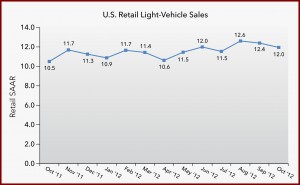
New-vehicle retail sales in October are forecast at 943,200 units, a 13% increase in volume compared with October 2011. This works out to a seasonally adjusted annualized rate or SAAR of 12 million new cars and light trucks. If true, October will be the second consecutive month above 12 million units, the first time since April and May 2008 before the Great Recession set in at the end of the Bush Administration took hold.
Total light-vehicle sales in October are projected to increase by 11% from October 2011, with volume at 1,134,800 units. Fleet sales in October are expected to be 17% of total sales, slightly below the 5-year average of 19% for the month, probably the result of more disciplined production levels at the Detroit Three automakers.
Vehicle inventory in early October climbed slightly to a 58-day supply, compared with 57 days in September. Nevertheless, inventories remain close to the 60-day optimum. Both car and truck inventories rose slightly – cars to a 51-day supply from 50 days in September, while truck inventory increased to a 65-day supply from 64 days.
“Each month, we’re seeing stronger signs of a healthy market, not only in terms of sales volumes, but also in dealer inventories, transaction prices and incentive levels,” said Deirdre Borrego, general manager of U.S. Automotive Operations at J.D. Power, the source of the data.
The forecast for total light-vehicle sales in the United States has been revised slightly to 14.4 million units in 2012 from the previous forecast of 14.3 million units. The retail sales forecast was also revised to 11.7 million units from 11.6 million units. The forecast for 2013 remains at 15 million units for total light-vehicles and 12.3 million for retail sales, still far below pre-Great Recession levels of 16-17 million units.
North American light-vehicle production volumes are up 20% throughout the first three quarters of 2012, compared with the same period in 2011, and continues to be one of the economy’s bright spots, particularly in the U.S. market. More than 1.9 million additional vehicles have been manufactured in 2012 through September, highlighting what Power claims is progress achieved from last year’s challenging production environment.








The United States economy continues to heal from the worst recession since the Great Depression, with economic activity continuing at a moderate pace this year. Economic growth reflects in part the effect of severe drought conditions on agricultural output and the ongoing sovereign debt crisis in Europe. These challenges notwithstanding, private-sector activity continues to expand and the housing market is beginning to improve, though there is clearly more work to do. Private forecasters expect moderate growth through the remainder of the year, with activity gradually strengthening over the course of 2013. According to the advance report on third-quarter GDP released late last week, real GDP growth accelerated to a 2.0% annual rate from 1.3% in the second quarter, partly reflecting faster growth of consumer spending and residential investment.
Personal consumption expenditures increased at a 2.0% pace in the third quarter, up from a 1.5% gain in the second quarter. Residential investment strengthened to a 14.4% annual rate from 8.5% in the second quarter. Government outlays increased by 3.7%, driven by an increase in volatile defense outlays. Declines in state and local spending continued to taper, and in the third quarter this sector’s contribution to growth was essentially neutral after being a drag on economic activity for the past three years — the longest period of falling state and local expenditures in post-war history. These developments were partly offset by a decline in nonresidential fixed investment. The severe drought, which lowered farm output, cut into inventory investment for a second straight quarter; private inventory accumulation slowed in Q3, subtracting 0.1%age point from real GDP growth during the quarter. Net exports also showed a slight decline.
Conditions in the labor market continue to improve gradually, though more work needs to be done to accelerate the pace of hiring. Private-sector firms added 104,000 workers to their payrolls in September, the 31st straight month of job growth. The latest gain brought the total number of private sector jobs created since the employment trough in early 2010 to 5.2 million, including the preliminary revision to the payroll data. The average private-sector workweek lengthened by 0.1 hour to 34.5 hours in September and is now just 0.1 hour shorter than its pre-recession level in late 2007. In addition, the index of aggregate production worker hours has risen steadily for the past six months. The unemployment rate declined 0.3%age point to 7.8% in September, with the largest declines occurring in the demographic groups with the highest unemployment rates. While the jobless rate is still high relative to its pre-recession average, the 1.3%age point decline recorded since August 2011 represents an improvement in the employment situation across a wide range of demographic groups and is largely the result of people leaving unemployment for employment.
Looking ahead, the economy is expected to strengthen, consistent with an improved pace of activity. Growth of real disposable income has strengthened this year to 2.5% at an annual rate. Household debt as a share of personal income has fallen notably from a pre-recession peak of nearly 130% to 109% in the second quarter of 2012. Household wealth relative to income continues to improve, reflecting gains in equity markets and the recent upturn in house prices. These developments are expected to put consumer budgets on a stronger footing going forward. The housing sector – which faced extraordinary challenges in the wake of the financial crisis — has also shown clear signs of improvement.
A consensus of private forecasters sees real GDP growing by 2.3% over the four quarters of 2013. While the outlook is positive, the U.S. economy remains vulnerable to global economic conditions, particularly the situation in Europe. Uncertainty about sovereign debt strains in the eurozone has already contributed to volatility in U.S. and global financial markets. The recent slowdown in global growth also has implications for U.S. exports, which have been an important source of strength for the U.S. economy over the past three years.
Putting federal finances on a more sustainable course in a way that supports growth and creates jobs in the near term is important both to maintaining our current recovery and ensuring stronger growth over the long term. In the fiscal year just ended, FY2012, the budget deficit continued to decline and is now roughly 3%age points below its peak as%age of GDP. The President’s FY2013 Budget would reduce the deficit further over the next decade, achieving primary balance and putting the debt-to-GDP ratio on a declining path by 2018. Importantly, it would achieve these goals in a way that preserves room for programs needed to support our most vulnerable citizens and to enhance our long-run competitiveness through targeted investments in education, infrastructure, and research and development.
The Administration remains focused on getting more Americans back to work, shoring up these gains, and advancing an agenda to provide near-term support for disposable income and job growth. If passed, these measures would further the progress made over the past three years, creating a stronger foundation for near-term economic growth and enhancing our nation’s competitiveness and standard of living for the long term.
(Jan Eberly is Assistant Secretary for Economic Policy – editor)