Lockheed Martin [NYSE: LMT] and General Motors Co. [NYSE: GM] are teaming up to develop new series of autonomous Electric Vehicles. Exact technical details are unknown, likely because they are closely held trade secrets, but the impending Artemis program appears to be the reason for a latter-day version of the famous skunk works. Some of the wizardry will likely evolve and morph into higher gravity-bound autonomous mobile devices.
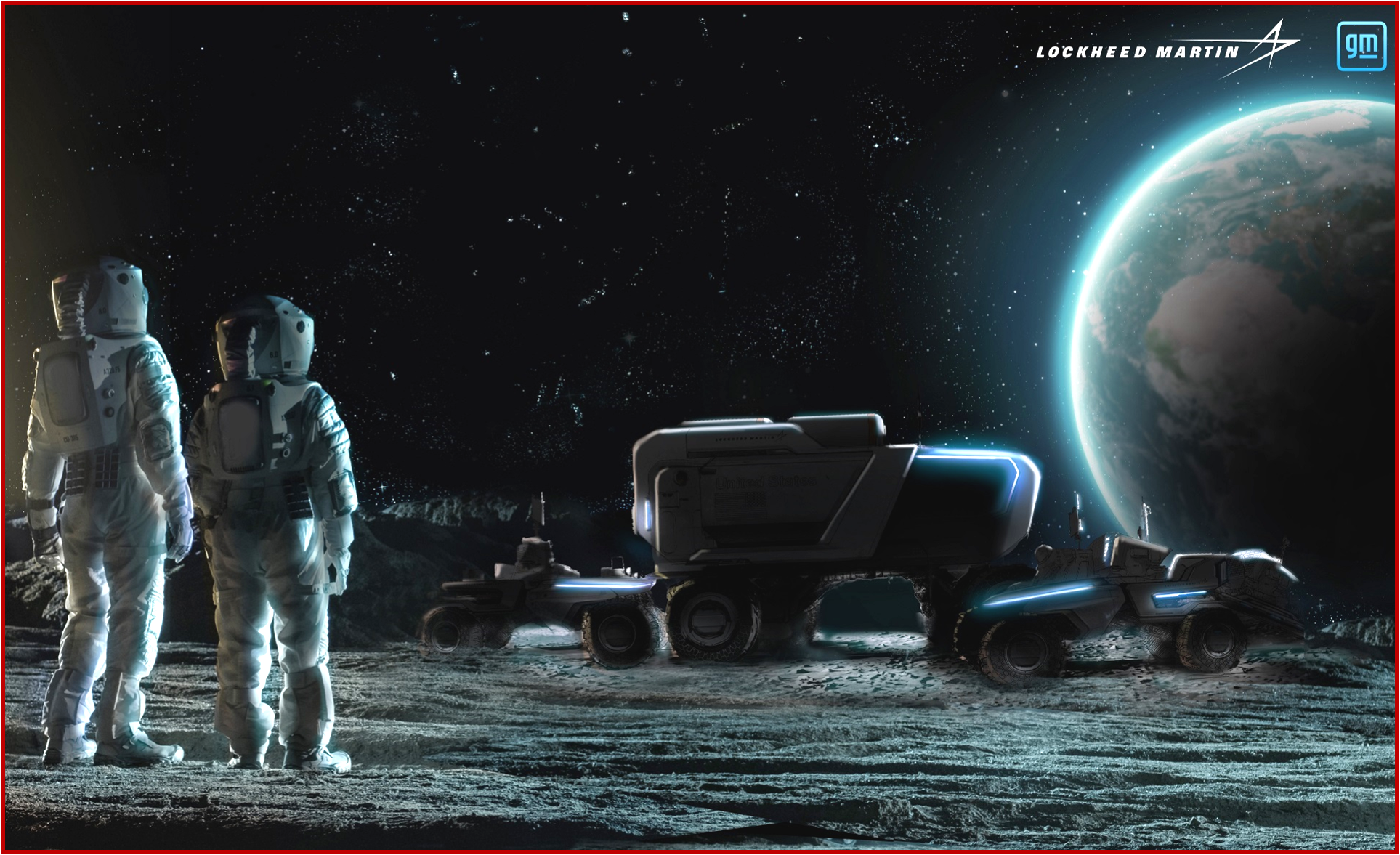 NASA’s Artemis program is sending humans back to the Moon for exploration and scientific experiments using a variety of rovers. NASA has challenged industry to develop a Lunar Terrain Vehicle (LTV) that will allow astronauts to explore the lunar surface farther than ever before. The LTV is the first of many types of surface mobility vehicles needed for the Artemis program.
Lockheed Martin will lead the team with GM with its more than 50-year-history of working with NASA on deep-space human and robotic spacecraft, such as NASA’s Orion exploration-class spaceship for Artemis and numerous Mars and planetary spacecraft. GM, which arguably styles vehicles better than Lockheed – pace’ SR22 fans – is a leader in battery-electric technologies and propulsion systems that are central to its multi-segment electric vehicle strategy for an all-electric future. Additionally, GM will use autonomous technology to help safer and more efficient operations on the Moon. It come in handy if GM management’s and Board’s all-in bets on EVs doesn’t work out to stockholders’ satisfaction.
“General Motors made history by applying advanced technologies and engineering to support the Lunar Rover Vehicle that the Apollo 15 astronauts drove on the Moon,” said Alan Wexler, senior vice president of Innovation and Growth at General Motors. “Working together with Lockheed Martin and their deep-space exploration expertise, we plan to support American astronauts on the Moon once again.”
Unlike the Apollo rovers that only traveled 4.7 miles (7.6 kilometers) from the landing site, the next-generation lunar vehicles are being designed to traverse significantly farther distances to support the first excursions of the Moon’s south pole, where it is cold and dark with more rugged terrain. Autonomous, self-driving systems will allow the rovers to prepare for human landings, provide commercial payload services, and enhance the range and utility of scientific payloads and experiments.
Lockheed Martin brings much experience and capabilities in space exploration. It has built spacecraft and systems that have gone to every planet, been on every NASA mission to Mars including building 11 of the agency’s Mars spacecraft, and played major roles on the space shuttle program and International Space Station power systems.
“This alliance brings together powerhouse innovation from both companies to make a transformative class of vehicles,” said Rick Ambrose, executive vice president, Lockheed Martin Space.

About Ken Zino
Ken Zino, editor and publisher of AutoInformed, is a versatile auto industry participant with global experience spanning decades in print and broadcast journalism, as well as social media. He has automobile testing, marketing, public relations and communications experience. He is past president of The International Motor Press Assn, the Detroit Press Club, founding member and first President of the Automotive Press Assn. He is a member of APA, IMPA and the Midwest Automotive Press Assn.
He also brings an historical perspective while citing their contemporary relevance of the work of legendary auto writers such as Ken Purdy, Jim Dunne or Jerry Flint, or writers such as Red Smith, Mark Twain, Thomas Jefferson – all to bring perspective to a chaotic automotive universe.
Above all, decades after he first drove a car, Zino still revels in the sound of the exhaust as the throttle is blipped during a downshift and the driver’s rush that occurs when the entry, apex and exit points of a turn are smoothly and swiftly crossed. It’s the beginning of a perfect lap.
AutoInformed has an editorial philosophy that loves transportation machines of all kinds while promoting critical thinking about the future use of cars and trucks.
Zino builds AutoInformed from his background in automotive journalism starting at Hearst Publishing in New York City on Motor and MotorTech Magazines and car testing where he reviewed hundreds of vehicles in his decade-long stint as the Detroit Bureau Chief of Road & Track magazine. Zino has also worked in Europe, and Asia – now the largest automotive market in the world with China at its center.








Out of this World! Secret Lockheed Martin, GM EV Revealed
Lockheed Martin [NYSE: LMT] and General Motors Co. [NYSE: GM] are teaming up to develop new series of autonomous Electric Vehicles. Exact technical details are unknown, likely because they are closely held trade secrets, but the impending Artemis program appears to be the reason for a latter-day version of the famous skunk works. Some of the wizardry will likely evolve and morph into higher gravity-bound autonomous mobile devices.
Lockheed Martin will lead the team with GM with its more than 50-year-history of working with NASA on deep-space human and robotic spacecraft, such as NASA’s Orion exploration-class spaceship for Artemis and numerous Mars and planetary spacecraft. GM, which arguably styles vehicles better than Lockheed – pace’ SR22 fans – is a leader in battery-electric technologies and propulsion systems that are central to its multi-segment electric vehicle strategy for an all-electric future. Additionally, GM will use autonomous technology to help safer and more efficient operations on the Moon. It come in handy if GM management’s and Board’s all-in bets on EVs doesn’t work out to stockholders’ satisfaction.
“General Motors made history by applying advanced technologies and engineering to support the Lunar Rover Vehicle that the Apollo 15 astronauts drove on the Moon,” said Alan Wexler, senior vice president of Innovation and Growth at General Motors. “Working together with Lockheed Martin and their deep-space exploration expertise, we plan to support American astronauts on the Moon once again.”
Unlike the Apollo rovers that only traveled 4.7 miles (7.6 kilometers) from the landing site, the next-generation lunar vehicles are being designed to traverse significantly farther distances to support the first excursions of the Moon’s south pole, where it is cold and dark with more rugged terrain. Autonomous, self-driving systems will allow the rovers to prepare for human landings, provide commercial payload services, and enhance the range and utility of scientific payloads and experiments.
Lockheed Martin brings much experience and capabilities in space exploration. It has built spacecraft and systems that have gone to every planet, been on every NASA mission to Mars including building 11 of the agency’s Mars spacecraft, and played major roles on the space shuttle program and International Space Station power systems.
“This alliance brings together powerhouse innovation from both companies to make a transformative class of vehicles,” said Rick Ambrose, executive vice president, Lockheed Martin Space.
About Ken Zino
Ken Zino, editor and publisher of AutoInformed, is a versatile auto industry participant with global experience spanning decades in print and broadcast journalism, as well as social media. He has automobile testing, marketing, public relations and communications experience. He is past president of The International Motor Press Assn, the Detroit Press Club, founding member and first President of the Automotive Press Assn. He is a member of APA, IMPA and the Midwest Automotive Press Assn. He also brings an historical perspective while citing their contemporary relevance of the work of legendary auto writers such as Ken Purdy, Jim Dunne or Jerry Flint, or writers such as Red Smith, Mark Twain, Thomas Jefferson – all to bring perspective to a chaotic automotive universe. Above all, decades after he first drove a car, Zino still revels in the sound of the exhaust as the throttle is blipped during a downshift and the driver’s rush that occurs when the entry, apex and exit points of a turn are smoothly and swiftly crossed. It’s the beginning of a perfect lap. AutoInformed has an editorial philosophy that loves transportation machines of all kinds while promoting critical thinking about the future use of cars and trucks. Zino builds AutoInformed from his background in automotive journalism starting at Hearst Publishing in New York City on Motor and MotorTech Magazines and car testing where he reviewed hundreds of vehicles in his decade-long stint as the Detroit Bureau Chief of Road & Track magazine. Zino has also worked in Europe, and Asia – now the largest automotive market in the world with China at its center.