Does the mild Justice Department plea deal really fit the crime of treasonous actions?
Pratt & Whitney Canada, a Canadian subsidiary of the Connecticut-based defense contractor United Technologies Corporation, today pled guilty to violating the Arms Export Control Act and making false statements in connection with its illegal export to China of U.S.-origin military software used in the development of China’s first modern military attack helicopter, the Z-10.
In addition, UTC, its U.S.-based subsidiary Hamilton Sundstrand Corporation and PWC have agreed to pay $75 million as part of a global settlement with the Justice Department and State Department in connection with the China arms export violations and for making false and belated disclosures to the U.S. government about these illegal exports. Critics of the deal covering what were treasonous acts say the small fines are laughable.
About $20.7 million will be paid to the Justice Department. The remaining $55 million is payable to the State Department as part of a separate consent agreement to resolve outstanding export issues, including those related to the Z-10. Worse, in the view of critics is that up to $20 million of this penalty can be suspended if applied by UTC to remedial compliance measures. As part of the settlement, the companies admitted conduct set forth in a stipulated and publicly filed “statement of facts.”
As a result, today in the District of Connecticut, the Justice Department filed three criminal counts charging UTC, PWC and HSC. Count One charges PWC with violating the Arms Export Control Act in connection with the illegal export of defense articles to China for the Z-10 helicopter. Count Two charges PWC, UTC and HSC with making false statements to the U.S. government in their belated disclosures relating to the illegal exports. Count Three charges PWC and HSC with failure to timely inform the U.S. government of exports of defense articles to China.
While PWC has pleaded guilty to Counts One and Two, the Justice Department has recommended that prosecution of UTC and HSC on Count Two, and PWC and HSC on Count Three be deferred for two years, provided the companies abide by the terms of a deferred prosecution agreement with the Justice Department. As part of the agreement, the companies must pay $75 million and retain an Independent Monitor to monitor and assess their compliance with export laws for the next two years.
Since 1989, the United States has imposed a prohibition upon the export to China of all U.S. defense articles and associated technical data because of the June 1989 Tiananmen Square massacre by the military of the People’s Republic of China. In February 1990, the U.S. Congress imposed a prohibition upon licenses or approvals for the export of defense articles to the People’s Republic of China. Congress specifically named helicopters for inclusion in the ban.
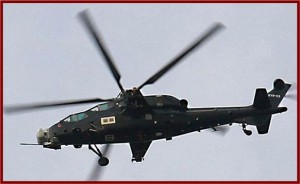
Justice claimed that dating back to the 1980s, China sought to develop a military attack helicopter. Beginning in the 1990s, after Congress had imposed the prohibition on exports to China, China sought to develop its attack helicopter under the guise of a civilian medium helicopter program in order to secure Western assistance. The Z-10, developed with assistance from Western suppliers who are lavishly paid by U.S. taxpayers, is China’s first modern military attack helicopter.
During the development phases of China’s Z-10 program, each Z-10 helicopter was powered by engines supplied by PWC. PWC delivered 10 of these development engines to China in 2001 and 2002. Despite the military nature of the Z-10 helicopter, PWC determined on its own that these development engines for the Z-10 did not constitute “defense articles,” requiring a U.S. export license, because they were identical to those engines PWC was already supplying China for a commercial helicopter.
Because the Electronic Engine Control software, made by HSC in the United States to test and operate the PWC engines, was modified for a military helicopter application, it was a defense article and required a U.S. export license.
“Still, PWC knowingly and willfully caused this software to be exported to China for the Z-10 without any U.S. export license. In 2002 and 2003, PWC caused six versions of the military software to be illegally exported from HSC in the United States to PWC in Canada, and then to China, where it was used in the PWC engines for the Z-10,” Justice said in a statement.
According to court documents, PWC knew from the start of the Z-10 project in 2000 that the Chinese were developing an attack helicopter and that supplying it with U.S.-origin components would be illegal. When the Chinese claimed that a civil version of the helicopter would be developed in parallel, PWC marketing personnel expressed skepticism internally about the “sudden appearance” of the civil program, the timing of which they questioned as “real or imagined.” PWC nevertheless saw an opening for PWC “to insist on exclusivity in [the] civil version of this helicopter,” and stated that the Chinese would “no longer make reference to the military program.” PWC failed to notify UTC or HSC about the attack helicopter until years later and purposely ignored the helicopter’s military application.
HSC in the United States believed it was providing its software to PWC for a civilian helicopter in China, based on claims from PWC. By early 2004, HSC learned there might an export problem and stopped working on the Z-10 project. UTC also began to ask PWC about the exports to China for the Z-10. Regardless, PWC on its own modified the software and continued to export it to China through June 2005.
According to court documents, PWC’s illegal conduct was driven by profit. PWC anticipated that its work on the Z-10 military attack helicopter in China would open the door to a far more lucrative civilian helicopter market in China, which according to PWC estimates, was potentially worth as much as $2 billion to PWC.
These companies failed to disclose to the U.S. government the illegal exports to China for several years and only did so after an investor group queried UTC in early 2006 about whether PWC’s role in China’s Z-10 attack helicopter might violate U.S. laws. The companies then made an initial disclosure to the State Department in July 2006, with follow-up submissions in August and September 2006.
The 2006 disclosures contained “numerous false statements.” Among other things, the companies falsely asserted that they were unaware until 2003 or 2004 that the Z-10 program involved a military helicopter. In fact, by the time of the disclosures, all three companies were aware that PWC officials knew at the project’s inception in 2000 that the Z-10 program involved an attack helicopter.
Today, the Z-10 helicopter is in production and initial batches were delivered to the People’s Liberation Army of China in 2009 and 2010. The primary mission of the Z-10 is anti-armor and battlefield interdiction. Weapons of the Z-10 have included 30 mm cannons, anti-tank guided missiles, air-to-air missiles and unguided rockets.








A Canadian subsidiary of a US company giving away military technology and participating in a greater lie. Our credibility as an ally and ethical trading partner is at stake here: I wonder what our Canadian Federal Government doing about this?