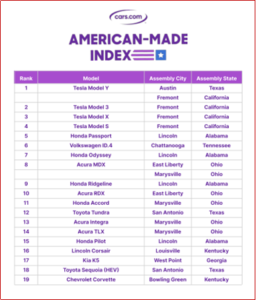
Click to enlarge.
The website Cars.com released its 2023 American-Made Index® today at a time of intense discussion about whether the term means anything. The standards for the American-Made Index include location of final assembly; percentage of US and Canadian parts; country of origin for available engines; country of origin for available transmissions; US manufacturing employees relative to the automaker’s footprint.
“Many Americans consider where the products they buy are made, in hopes their purchase will contribute to the U.S. economy. While that might seem easy enough with a T-shirt, few items get as complicated as the set of wheels in your driveway,” said Cars.com. Sources for the AMI include data obtained from automakers and Cars.com’s analysis of hundreds of thousands of vehicles in the Cars.com inventory, as well as in-person dealership audits on hundreds of new cars.
The index ranks individual models on a 100-point scale, grouping variants under the same nameplate and platform (a hatchback version of a sedan, for example) but separating full hybrid or plug-in variants. In cases of a tied index score, heavier curb weights function as a tiebreaker. For car shoppers who want to buy an American-made vehicle, Cars.com’s American-Made Index analyzes a range of factors that you should consider.*
The absence of union labor as a factor here obviously makes a difference on how consumers or households might view the index. So too does the vague but often used disclaimer on window stickers “Using domestic and globally sourced parts.” **
As another confounding example take the number of assembly plants on the AMI list from the Midwest at 43%, flat since 2020 where the middle class was – as we used to know it – was invented, but the South – politically hostile to diverse American people (Flori-dah’s driving Disney World out of the state for its awakened employment policies even though Disney is a clear economic benefit to the population for jobs, benefits, and economic activity) is 54%, up 15% since 2020.
Jenni Newman, editor-in-chief of Cars.com acknowledged the difficulties in an Automotive Press Association (APA) presentation and since it has previously changed the methodology of the index before in 2020 when it updated the formula for the last three years . We wouldn’t be surprised if it does so again. (Disclosure – I am a founding member of APA and was its first president, KZ, aka AutoCrat.)
When you get to EVs, the problem compounds. AutoInformed knows of no verifiable source on the source of EV components, which in the case of batteries traverse multiple borders before they get anywhere near an assembly plant. “If you localize Chinese technology in the US – the customer is going to get screwed,” Jim Farley CEO of said recently. The candid, tough talk comes at a time when Ford is investing more than $50 billion (2022 through 2026) in electric vehicles and battery components. Ford is on track to reach an annual targeted production run rate of 600,000 electric vehicles globally by the end of 2023, and 2 million by the end of 2026. Electric vehicles are expected to account for half of Ford’s sales by 2030. (see AutoInformed on Ford CEO says China is the Main Competitor, Not GM)
*The 2023 Reports
**The American Automobile Labeling Act (PDF, 8.5MB), requires automakers to annually report the percentage of US and Canadian parts, by value, for the vast majority of passenger cars. Such information is required to appear on the window sticker, or a separate sticker nearby, for virtually every new vehicle sold in the US.
“The AALA lumps Canada into the same pool as the U.S., so the American-Made Index also factors in the country of origin for a car’s available engines and transmissions, a calculation involving parts and labor that the AALA also requires automakers to disclose, to ensure the origins for such high-value components are American — not Canadian,” says Cars.com. “Beyond drivetrains, the AALA doesn’t emphasize labor costs, particularly when it comes to final assembly. To address that, the AMI factors each automaker’s U.S. manufacturing workforce against the number of cars it produces in the country, with index scores applied on an automaker-wide basis.”
Why Some Vehicles Don’t Qualify for the American-Made Index
- Although automakers assemble some 125 light-duty nameplates in the U.S. for the 2023 model year, not all of them qualify for AMI rankings.
- Automakers are not required to submit AALA data for vehicles with a gross vehicle weight rating of more than 8,500 pounds, an echelon that includes full-size vans, heavy-duty trucks and the like.
- What’s more, manufacturers that build fewer than 1000 cars in a given model year aren’t required to give percentages of U.S. and Canadian content.
- Due to insufficient data, the AMI excludes vehicles from either group.
- “We implement a few other dis-qualifiers beyond that: We don’t rank fleet-only vehicles, or vehicles slated for discontinuation after the current model year without a U.S.-built successor.
- We also exclude any vehicles for which we lack high confidence in the data therein, typically because they fall below minimum sales and inventory thresholds or aren’t yet on sale at the time of our research.
- Due to changes in methodology, results for the 2023 American-Made Index cannot be compared to results for the index’s prior generation, published from 2017 to 2019. The first iteration of the AMI ran from 2006-16.
- Editors and reviewers don’t accept gifts or free trips from automakers. The Editorial department is independent of Cars.com’s advertising, sales and sponsored content departments.

About Ken Zino
Ken Zino, editor and publisher of AutoInformed, is a versatile auto industry participant with global experience spanning decades in print and broadcast journalism, as well as social media. He has automobile testing, marketing, public relations and communications experience. He is past president of The International Motor Press Assn, the Detroit Press Club, founding member and first President of the Automotive Press Assn. He is a member of APA, IMPA and the Midwest Automotive Press Assn.
He also brings an historical perspective while citing their contemporary relevance of the work of legendary auto writers such as Ken Purdy, Jim Dunne or Jerry Flint, or writers such as Red Smith, Mark Twain, Thomas Jefferson – all to bring perspective to a chaotic automotive universe.
Above all, decades after he first drove a car, Zino still revels in the sound of the exhaust as the throttle is blipped during a downshift and the driver’s rush that occurs when the entry, apex and exit points of a turn are smoothly and swiftly crossed. It’s the beginning of a perfect lap.
AutoInformed has an editorial philosophy that loves transportation machines of all kinds while promoting critical thinking about the future use of cars and trucks.
Zino builds AutoInformed from his background in automotive journalism starting at Hearst Publishing in New York City on Motor and MotorTech Magazines and car testing where he reviewed hundreds of vehicles in his decade-long stint as the Detroit Bureau Chief of Road & Track magazine. Zino has also worked in Europe, and Asia – now the largest automotive market in the world with China at its center.








What Does American Made Mean?
Click to enlarge.
The website Cars.com released its 2023 American-Made Index® today at a time of intense discussion about whether the term means anything. The standards for the American-Made Index include location of final assembly; percentage of US and Canadian parts; country of origin for available engines; country of origin for available transmissions; US manufacturing employees relative to the automaker’s footprint.
“Many Americans consider where the products they buy are made, in hopes their purchase will contribute to the U.S. economy. While that might seem easy enough with a T-shirt, few items get as complicated as the set of wheels in your driveway,” said Cars.com. Sources for the AMI include data obtained from automakers and Cars.com’s analysis of hundreds of thousands of vehicles in the Cars.com inventory, as well as in-person dealership audits on hundreds of new cars.
The index ranks individual models on a 100-point scale, grouping variants under the same nameplate and platform (a hatchback version of a sedan, for example) but separating full hybrid or plug-in variants. In cases of a tied index score, heavier curb weights function as a tiebreaker. For car shoppers who want to buy an American-made vehicle, Cars.com’s American-Made Index analyzes a range of factors that you should consider.*
The absence of union labor as a factor here obviously makes a difference on how consumers or households might view the index. So too does the vague but often used disclaimer on window stickers “Using domestic and globally sourced parts.” **
As another confounding example take the number of assembly plants on the AMI list from the Midwest at 43%, flat since 2020 where the middle class was – as we used to know it – was invented, but the South – politically hostile to diverse American people (Flori-dah’s driving Disney World out of the state for its awakened employment policies even though Disney is a clear economic benefit to the population for jobs, benefits, and economic activity) is 54%, up 15% since 2020.
Jenni Newman, editor-in-chief of Cars.com acknowledged the difficulties in an Automotive Press Association (APA) presentation and since it has previously changed the methodology of the index before in 2020 when it updated the formula for the last three years . We wouldn’t be surprised if it does so again. (Disclosure – I am a founding member of APA and was its first president, KZ, aka AutoCrat.)
When you get to EVs, the problem compounds. AutoInformed knows of no verifiable source on the source of EV components, which in the case of batteries traverse multiple borders before they get anywhere near an assembly plant. “If you localize Chinese technology in the US – the customer is going to get screwed,” Jim Farley CEO of said recently. The candid, tough talk comes at a time when Ford is investing more than $50 billion (2022 through 2026) in electric vehicles and battery components. Ford is on track to reach an annual targeted production run rate of 600,000 electric vehicles globally by the end of 2023, and 2 million by the end of 2026. Electric vehicles are expected to account for half of Ford’s sales by 2030. (see AutoInformed on Ford CEO says China is the Main Competitor, Not GM)
*The 2023 Reports
**The American Automobile Labeling Act (PDF, 8.5MB), requires automakers to annually report the percentage of US and Canadian parts, by value, for the vast majority of passenger cars. Such information is required to appear on the window sticker, or a separate sticker nearby, for virtually every new vehicle sold in the US.
“The AALA lumps Canada into the same pool as the U.S., so the American-Made Index also factors in the country of origin for a car’s available engines and transmissions, a calculation involving parts and labor that the AALA also requires automakers to disclose, to ensure the origins for such high-value components are American — not Canadian,” says Cars.com. “Beyond drivetrains, the AALA doesn’t emphasize labor costs, particularly when it comes to final assembly. To address that, the AMI factors each automaker’s U.S. manufacturing workforce against the number of cars it produces in the country, with index scores applied on an automaker-wide basis.”
Why Some Vehicles Don’t Qualify for the American-Made Index
About Ken Zino
Ken Zino, editor and publisher of AutoInformed, is a versatile auto industry participant with global experience spanning decades in print and broadcast journalism, as well as social media. He has automobile testing, marketing, public relations and communications experience. He is past president of The International Motor Press Assn, the Detroit Press Club, founding member and first President of the Automotive Press Assn. He is a member of APA, IMPA and the Midwest Automotive Press Assn. He also brings an historical perspective while citing their contemporary relevance of the work of legendary auto writers such as Ken Purdy, Jim Dunne or Jerry Flint, or writers such as Red Smith, Mark Twain, Thomas Jefferson – all to bring perspective to a chaotic automotive universe. Above all, decades after he first drove a car, Zino still revels in the sound of the exhaust as the throttle is blipped during a downshift and the driver’s rush that occurs when the entry, apex and exit points of a turn are smoothly and swiftly crossed. It’s the beginning of a perfect lap. AutoInformed has an editorial philosophy that loves transportation machines of all kinds while promoting critical thinking about the future use of cars and trucks. Zino builds AutoInformed from his background in automotive journalism starting at Hearst Publishing in New York City on Motor and MotorTech Magazines and car testing where he reviewed hundreds of vehicles in his decade-long stint as the Detroit Bureau Chief of Road & Track magazine. Zino has also worked in Europe, and Asia – now the largest automotive market in the world with China at its center.