Click to enlarge.
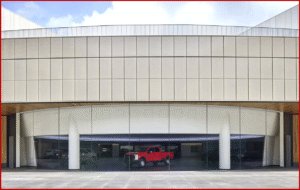
Yesterday Ford Motor Company (NYSE: F) held what it called a grand opening of the new World Headquarters, aka Henry Ford II World Center, although construction continues on the 2.1-million-square-foot headquarters in Dearborn, Michigan. (read AutoInformed. com on: Ford Motor to Demolish Glass House, Build New WHQ) [Local media said the event was sparsely attended with only a couple of hundred people. AutoInformed was not invited – AutoCrat]
“Like Ford Motor Company, this building is meant to last. We’ve used durable, timeless, and consistent materials, in a layout that can be adapted to accommodate future changes in décor and technology. When completed in 2027, it will accommodate 4000 employees, twice as many as our former World Headquarters, the Glass House. It is also more centrally located, within a 15-minute walk of other Ford buildings where 14,000 Ford employees work,” Jennifer Kolstad is global design and brand director at Ford.
“It starts when you enter the door. We want our employees to feel Ford when they walk in. In partnership with our design architect Snøhetta, we’ve designed the space, including our use of color, materials, and artwork, to bring our brand to life. We’ve also rethought how we address employees’ needs, weaving in a layer of hospitality into the building’s layout,” said Kolstad
Quick Look at WHQ in Ford’s View
- Distinct public and employee lobbies are front doors to the brand for those visiting and those arriving to work each day. The public entrance along Oakwood Blvd., a main thoroughfare, has color swatches of Ford models, from the iconic Model T to the Mustang Mach-E, adorning the main wall.
- The ceiling incorporates red cedar soffits, which can also be seen on the building’s exterior, perforated with white metal paneling that can also be found in the railings. There are also wrapped, micro-LED screens for curated programming, while durable terrazzo flooring — just one of the many sturdy materials selected for their longevity throughout the building — helps retain an aesthetic continuity.
- Both lobbies have large multifunction spaces, while the employee lobby can act as an event space in its own right, capable of accommodating as many as 700 people.
- Parts and pieces of a Bronco Raptor, sourced from a disassembled vehicle fresh off the line at Michigan Assembly Plant, adorn the wall in the American Road lobby, greeting employees as they enter. The specially designed brick is consistent with the brick on the building’s exterior.
- Showrooms Designed to Enable Superior Display and Comprehensive Product Reviews.
- The main showroom, part of a comprehensive trio of review spaces, features 10 floor turntables and “hidden” side walls that open to reveal the Colors and Materials Showroom and Digital Showroom, which includes another rotating platform and a 64-foot, micro-LED wall.
- These three adjoining spaces allow Ford Leaders to conduct comprehensive product reviews. The showroom is filled with natural light year-round thanks to the adjacent courtyard and a wall of floor-to-ceiling windows, plus custom indoor lighting. A center oculus [AI powered virtual reality – AutoCrat] light fixture is designed to mimic any kind of natural light, during any time of day, anywhere in the world.
- The showroom connects to the Savannah Courtyard, which has another three turntables for outdoor product reviews. The Courtyard features a mezzanine above, shared by designers in Studios 1 and 2, and is wrapped in a neutral glazed terra-cotta rain screen, which look great in product photos.
Click to enlarge.
Flexible Studios Drive Collaborative Design, Speed Movement of Properties
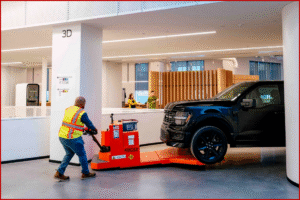
- Each of the six new design studios, split between the second and fourth floors, has an identical layout, size, and new technology and equipment for functions such as clay modeling and milling, while flexible workstations allow for collaborative work.
- Each room aligns with the customer profiles — Build, Thrill and Adventure — announced with the company’s new global brand strategy. The fabrication milling shop on the building’s first floor, known as Design Prototyping, is complete with metal, wood, trim, and paint shops. This is where models are constructed and undergo rough milling, a design process used to shape models, before reaching the final clay modeling phase. Special freight elevators are available so employees can easily move models between design studios.
Click to enlarge.
Dining Areas Provide Fuel for Collaboration
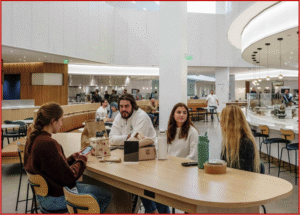
- Gallery Hall, on the building’s second floor, is the main employee dining area, featuring seven stand-up restaurants ranging from Asian and Mediterranean cuisine to pizza. Following Sunday’s grand opening, this part of the building will be open to all Ford employees for lunch and collaborative meetings.
- A Hive-branded dining area offering craft coffee and pastries is located on the mezzanine between the first and second floors. It offers booth seating for groups, while other spaces offer blue metal mesh curtains for privacy.
New Collaboration Zones Allow Employees to Take Teamwork Anywhere
- On the second floor, building residents, outside employees, and vendors can gather in special collaboration zones and arrival spaces near Gallery Hall. A learning stair offers available seating, ideal for small and large gatherings, between the mezzanine and the second floor.
- There’s also seating with metal mesh curtains for visual separation directly off Gallery Hall. A library area near Gallery Hall allows for open collaboration for informal work and meetings. A Tech Lounge is also in the open collaboration area.
Flexible Energy Rooms Bring Our Ideas to Life for Full-Size Reviews
- These program-specific, extra-large meeting rooms include flexible furniture for teams’ needs, large enough to accommodate a full-size vehicle for various reviews.
- The walls are wrapped in corkboard for pinning mock-ups.
Windows Reflect Our Past, Inspire the Future
- The unique glass banding on our exterior windows includes the patent numbers of historic innovations throughout Ford Motor Company history. The bands appear in a swoop pattern comprised of tiny ovals, which includes the embedded patent numbers. This nod to company history also serves a functional purpose in helping obscure sensitive products and information, as well as helping to regulate heating and cooling.
Vertical Building Design Enables Faster Vehicle Transport, Speeds Product Development
- Our new World Headquarters was designed with 22-inch-thick concrete floors to support the movement of vehicles throughout the facility. This allows us to transport vehicles via freight elevators and place them virtually anywhere, including energy rooms. Thanks to the building’s vertical orientation, moving properties and people throughout the space is 80% more efficient when compared to the previous Product Development Center.

About Ken Zino
Ken Zino, editor and publisher of AutoInformed, is a versatile auto industry participant with global experience spanning decades in print and broadcast journalism, as well as social media. He has automobile testing, marketing, public relations and communications experience. He is past president of The International Motor Press Assn, the Detroit Press Club, founding member and first President of the Automotive Press Assn. He is a member of APA, IMPA and the Midwest Automotive Press Assn.
He also brings an historical perspective while citing their contemporary relevance of the work of legendary auto writers such as Ken Purdy, Jim Dunne or Jerry Flint, or writers such as Red Smith, Mark Twain, Thomas Jefferson – all to bring perspective to a chaotic automotive universe.
Above all, decades after he first drove a car, Zino still revels in the sound of the exhaust as the throttle is blipped during a downshift and the driver’s rush that occurs when the entry, apex and exit points of a turn are smoothly and swiftly crossed. It’s the beginning of a perfect lap.
AutoInformed has an editorial philosophy that loves transportation machines of all kinds while promoting critical thinking about the future use of cars and trucks.
Zino builds AutoInformed from his background in automotive journalism starting at Hearst Publishing in New York City on Motor and MotorTech Magazines and car testing where he reviewed hundreds of vehicles in his decade-long stint as the Detroit Bureau Chief of Road & Track magazine. Zino has also worked in Europe, and Asia – now the largest automotive market in the world with China at its center.







Open House at Under Construction Ford World Headquarters
Click to enlarge.
Yesterday Ford Motor Company (NYSE: F) held what it called a grand opening of the new World Headquarters, aka Henry Ford II World Center, although construction continues on the 2.1-million-square-foot headquarters in Dearborn, Michigan. (read AutoInformed. com on: Ford Motor to Demolish Glass House, Build New WHQ) [Local media said the event was sparsely attended with only a couple of hundred people. AutoInformed was not invited – AutoCrat]
“Like Ford Motor Company, this building is meant to last. We’ve used durable, timeless, and consistent materials, in a layout that can be adapted to accommodate future changes in décor and technology. When completed in 2027, it will accommodate 4000 employees, twice as many as our former World Headquarters, the Glass House. It is also more centrally located, within a 15-minute walk of other Ford buildings where 14,000 Ford employees work,” Jennifer Kolstad is global design and brand director at Ford.
“It starts when you enter the door. We want our employees to feel Ford when they walk in. In partnership with our design architect Snøhetta, we’ve designed the space, including our use of color, materials, and artwork, to bring our brand to life. We’ve also rethought how we address employees’ needs, weaving in a layer of hospitality into the building’s layout,” said Kolstad
Quick Look at WHQ in Ford’s View
Click to enlarge.
Flexible Studios Drive Collaborative Design, Speed Movement of Properties
Click to enlarge.
Dining Areas Provide Fuel for Collaboration
New Collaboration Zones Allow Employees to Take Teamwork Anywhere
Flexible Energy Rooms Bring Our Ideas to Life for Full-Size Reviews
Windows Reflect Our Past, Inspire the Future
Vertical Building Design Enables Faster Vehicle Transport, Speeds Product Development
About Ken Zino
Ken Zino, editor and publisher of AutoInformed, is a versatile auto industry participant with global experience spanning decades in print and broadcast journalism, as well as social media. He has automobile testing, marketing, public relations and communications experience. He is past president of The International Motor Press Assn, the Detroit Press Club, founding member and first President of the Automotive Press Assn. He is a member of APA, IMPA and the Midwest Automotive Press Assn. He also brings an historical perspective while citing their contemporary relevance of the work of legendary auto writers such as Ken Purdy, Jim Dunne or Jerry Flint, or writers such as Red Smith, Mark Twain, Thomas Jefferson – all to bring perspective to a chaotic automotive universe. Above all, decades after he first drove a car, Zino still revels in the sound of the exhaust as the throttle is blipped during a downshift and the driver’s rush that occurs when the entry, apex and exit points of a turn are smoothly and swiftly crossed. It’s the beginning of a perfect lap. AutoInformed has an editorial philosophy that loves transportation machines of all kinds while promoting critical thinking about the future use of cars and trucks. Zino builds AutoInformed from his background in automotive journalism starting at Hearst Publishing in New York City on Motor and MotorTech Magazines and car testing where he reviewed hundreds of vehicles in his decade-long stint as the Detroit Bureau Chief of Road & Track magazine. Zino has also worked in Europe, and Asia – now the largest automotive market in the world with China at its center.