
Click for more.
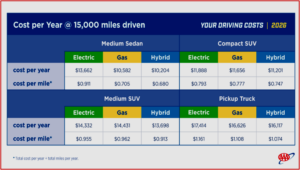
AAA said today that the average annual full cost of vehicle ownership in 2026 is $12,863, up ~11% compared to 2025. It’s at $1071.92 per month compared to $964.78 per month in 2025.* This reflects continued increases from fuel prices, depreciation, and finance charges However, methodology updates make this year’s results not directly comparable with last year’s estimate. This year’s Your Driving Costs (YDC) analysis integrates select electric vehicles (EVs) and hybrids into standard vehicle categories that used to be exclusively traditional gas-powered models, reflecting their growing share in the new-car market.
“By looking at EVs, hybrids and traditional gas-powered vehicles within the same categories, consumers can better understand how total ownership costs vary by powertrain,” said Greg Brannon, AAA’s director of automotive engineering. “Looking at the full ownership picture, including depreciation and other expense, can help consumers better understand the total cost of each option.”**
Key Cost Trends Under the Trump Mis-Administration – AutoCrat
- “Fuel Prices – At the time of the study, the regular-grade gasoline used by nearly all YDC vehicles averaged $4.152 per gallon, while electricity for home EV charging averaged 18.0 cents per kilowatt hour. Gas prices are up 31.8% compared to 2025, while electricity prices rose only 7.8%, improving the relative affordability of EVs and hybrids; however, fuel economy alone did not determine the most affordable vehicle to own.
- “Depreciation — The difference between a car’s purchase price and resale value remains the single largest ownership cost, with vehicles losing a weighted average of $4422 per year. Vehicle type and purchase price both have a significant effect on depreciation for EV shoppers; for example, EV medium sedans had about twice the depreciation of gas-powered models, helping push total ownership costs 29.1% higher in that category.
- “Car Prices – The sales-weighted average MSRP of new vehicles this year is $39,376. While MSRPs increased slightly on average, incentives, demand and rebates can affect what consumers ultimately pay. The actual purchase price is used to calculate finance costs and depreciation,” AAA said.
EV and Hybrid Comparisons
“By comparing select electric and hybrid models within the same categories as gas-powered vehicles, AAA gives shoppers a more practical view of how ownership costs compare across powertrains.
- “Gas-powered vehicles: Overall, gas models offered savings compared to EVs and hybrids in cost categories affected by purchase price, like finance charges, taxes and fees, and depreciation. For example, gas-powered medium sedans cost $10,582 per year to own — $3080 less than comparable EV medium sedans, which had significantly higher depreciation, fees and finance costs.
- “Electric vehicles: EVs delivered the lowest fuel costs, with charging costs for EVs about 66%–70% lower than fuel costs for traditional gas vehicles across the categories studied. However, those savings were often outweighed by higher depreciation, fees and finance costs; medium-sedan EVs, for example, cost 29.1% more to own annually than gas-powered models.
- “Hybrids: Hybrids were the most consistently lower-cost alternative to gas in the comparison categories. They combined meaningful fuel savings with smaller ownership-cost tradeoffs, costing less annually than gas-powered models in medium sedans, compact SUVs, medium SUVs and pickup trucks,” AAA said.
AAA’s Car Buying Guidance
“Vehicle category makes a major difference. Half-ton pickups cost $1.10 per mile to operate – 48 cents more than small sedans – adding an average of $7191 per year. In comparison, purchasing an EV may help offset annual fuel costs, but higher depreciation can increase total ownership costs over time. Choosing a vehicle that fits actual transportation needs can help buyers manage long-term costs.
- “Create a monthly and annual budget that includes ownership and operating costs before purchasing.
- “Keep the vehicle price, finance rate, and trade-in value as separate negotiations.
- “Get pre-approved by a financial institution, such as a bank, credit union or AAA, before discussing financing with the dealer,” AAA said.
Additional Assistance from AAA
Your Driving Costs calculator helps shoppers compare ownership costs by vehicle category, powertrain, location and driving habits. AAA also offers additional tools to support vehicle research, shopping and repair planning:
- AAA Car Guide: Annual guide that rates vehicles with the latest automotive technology.
- AAA’s Car Buying Program: Comparisons consumers can use while shopping for and buying a vehicle.
- EV 101 Digital Buyer’s Guide: Educational resource for consumers shopping for EVs.
- Repair Cost Calculator: Breakdown of estimated parts and labor costs, including AAA member discounts, available at AAA Approved Auto Repair facilities.
*AutoInformed on
- AAA – Labor Day Weekend Travelers Face Record Pump Prices
- AAA – August 20 Gasoline Prices Highest Ever!
**Methodology and Overall YDC Analysis
AAA’s YDC analysis estimates the cost of owning and operating a new vehicle for personal transportation over five years and 75,000 miles. Actual driving costs vary based on driving habits, location, operating conditions, and other factors. AAA evaluated seven vehicle categories and 34 top-selling models across fuel, maintenance, repair and tire costs, license, registration and taxes, depreciation and finance charges.
EV and Hybrid Cost Comparisons
For EV and hybrid comparisons, AAA evaluated selected top-selling models in four categories — medium sedans, compact SUVs, medium SUVs and pickup trucks — alongside gas-powered models to show how ownership costs vary by powertrain within the same vehicle categories. Because the EV and hybrid comparison uses a smaller set of categories, its overall results should not be directly compared with the overall results from the full YDC study.







