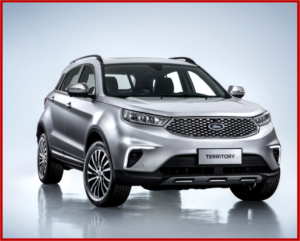
C-Max replacement or early 21st century JMC Chinese station wagon?
Ford today shared the first images of the new Territory, a mid-size SUV developed together with its joint venture partner, Jiangling Motors Corporation (JMC). The partnership largely benefited from JMC’s insights into Chinese customers’ tastes.
Ford was along for the ride with its engineering, testing and manufacturing knowledge. The move comes as the Mustang is the last passenger car due to be produced by Ford in the U.S. The cross-over market globally is the fastest growing among vehicle segments. The new Ford Territory is part of Ford’s China 2025 plan to launch more than 50 new vehicles in the country by 2025.
Territory was developed and tested at Ford in Nanjing, China and Melbourne, Australia. The all-new SUV will be manufactured at JMC’s Xiao Lan plant. No word yet on possible export plans to North America, which is currently embroiled in Trump’s trade wars, although Ford acknowledges it has another small crossover coming there. From where is not confirmed.
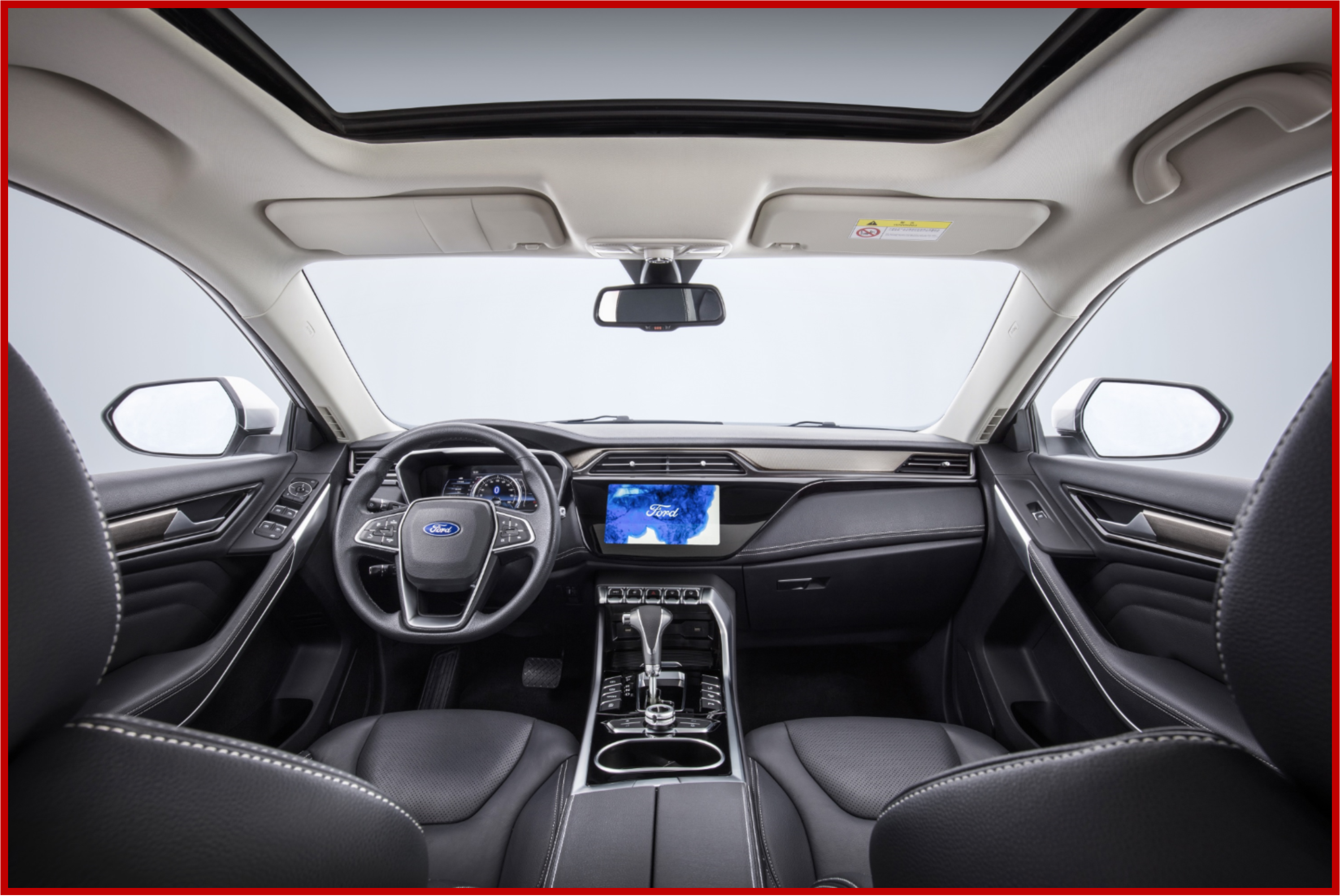 Territory customers can choose between a gasoline engine, a 48V mild hybrid with Miller-Cycle technology, and a plug-in hybrid powertrain when it goes on sale in early 2019. It also will offer Ford’s infotainment system with intuitive Mandarin voice-command function, and driver assistance technologies, such as Adaptive Cruise Control and FordPass Connect with embedded modem.
China’s Growth
China is and will likely remain the world’s largest automotive market. Ford says that the greatest growth in demand for automobiles will come not from traditional large cities such as Beijing and Shanghai, which have implemented license plate restrictions to manage traffic congestion, but rather from smaller but fast-growing cities in the interior of the country. In short, the Chinese version of Red states in the U.S.
The number of registered passenger vehicles in Chinese cities with no license plate restrictions is expected to be ~23.7 million in 2020, up from 10.8 million in 2010, according to IHS Markit’s latest China Provincial Forecast. In contrast, vehicle registrations in restricted cities is expected to fall to 1.6 million in 2019, from a peak of 2.2 million in 2010.
For these buyers, the mid-size SUVs is a common choice. McKinsey’s China auto consumer survey 2017, says the mid-size SUV segment saw an annual growth rate of 38% in China between 2012 to 2016. Indigenous Chinese automakers have capitalized on this trend as Ford and General Motors napped.
Chinese customers will be able to purchase a competitive Ford in the entry-level, mid-size SUV segment at an affordable price. Just how many of these exist in the highly chauvinistic society that has a taste for expensive imports remains to be seen.
“The new Ford Territory shows what can be achieved when two global companies collaborate closely, bringing their respective strengths to meet the needs of a broad spectrum of Chinese consumers,” said Qiu Tiangao, chairman of JMC.
The Territory further expands the Ford SUV family lineup, which is composed of Ford EcoSport, Ford Kuga, Ford Edge, Ford Explorer and Ford Everest in China.
Chinese Tastes
The front of Territory has usual Ford mesh grille, flanked by LED lights. There are uniquely shaped LED daytime running lamps and turn indicators. The rear of the vehicle is highlighted by horizontal lines, emphasizing the width and stance. A lower skid plate has outboard bright graphic elements and hints of the Territory’s SUV capability. The accent finishes on the grille and contemporary color palette offer what described as contrast, depth and a richness to the vehicle. The Chinese tend to like flashy products.

About Ken Zino
Ken Zino, editor and publisher of AutoInformed, is a versatile auto industry participant with global experience spanning decades in print and broadcast journalism, as well as social media. He has automobile testing, marketing, public relations and communications experience. He is past president of The International Motor Press Assn, the Detroit Press Club, founding member and first President of the Automotive Press Assn. He is a member of APA, IMPA and the Midwest Automotive Press Assn.
He also brings an historical perspective while citing their contemporary relevance of the work of legendary auto writers such as Ken Purdy, Jim Dunne or Jerry Flint, or writers such as Red Smith, Mark Twain, Thomas Jefferson – all to bring perspective to a chaotic automotive universe.
Above all, decades after he first drove a car, Zino still revels in the sound of the exhaust as the throttle is blipped during a downshift and the driver’s rush that occurs when the entry, apex and exit points of a turn are smoothly and swiftly crossed. It’s the beginning of a perfect lap.
AutoInformed has an editorial philosophy that loves transportation machines of all kinds while promoting critical thinking about the future use of cars and trucks.
Zino builds AutoInformed from his background in automotive journalism starting at Hearst Publishing in New York City on Motor and MotorTech Magazines and car testing where he reviewed hundreds of vehicles in his decade-long stint as the Detroit Bureau Chief of Road & Track magazine. Zino has also worked in Europe, and Asia – now the largest automotive market in the world with China at its center.







JMC, Ford Develop Territory in China
C-Max replacement or early 21st century JMC Chinese station wagon?
Ford today shared the first images of the new Territory, a mid-size SUV developed together with its joint venture partner, Jiangling Motors Corporation (JMC). The partnership largely benefited from JMC’s insights into Chinese customers’ tastes.
Ford was along for the ride with its engineering, testing and manufacturing knowledge. The move comes as the Mustang is the last passenger car due to be produced by Ford in the U.S. The cross-over market globally is the fastest growing among vehicle segments. The new Ford Territory is part of Ford’s China 2025 plan to launch more than 50 new vehicles in the country by 2025.
Territory was developed and tested at Ford in Nanjing, China and Melbourne, Australia. The all-new SUV will be manufactured at JMC’s Xiao Lan plant. No word yet on possible export plans to North America, which is currently embroiled in Trump’s trade wars, although Ford acknowledges it has another small crossover coming there. From where is not confirmed.
China’s Growth
China is and will likely remain the world’s largest automotive market. Ford says that the greatest growth in demand for automobiles will come not from traditional large cities such as Beijing and Shanghai, which have implemented license plate restrictions to manage traffic congestion, but rather from smaller but fast-growing cities in the interior of the country. In short, the Chinese version of Red states in the U.S.
The number of registered passenger vehicles in Chinese cities with no license plate restrictions is expected to be ~23.7 million in 2020, up from 10.8 million in 2010, according to IHS Markit’s latest China Provincial Forecast. In contrast, vehicle registrations in restricted cities is expected to fall to 1.6 million in 2019, from a peak of 2.2 million in 2010.
For these buyers, the mid-size SUVs is a common choice. McKinsey’s China auto consumer survey 2017, says the mid-size SUV segment saw an annual growth rate of 38% in China between 2012 to 2016. Indigenous Chinese automakers have capitalized on this trend as Ford and General Motors napped.
Chinese customers will be able to purchase a competitive Ford in the entry-level, mid-size SUV segment at an affordable price. Just how many of these exist in the highly chauvinistic society that has a taste for expensive imports remains to be seen.
“The new Ford Territory shows what can be achieved when two global companies collaborate closely, bringing their respective strengths to meet the needs of a broad spectrum of Chinese consumers,” said Qiu Tiangao, chairman of JMC.
The Territory further expands the Ford SUV family lineup, which is composed of Ford EcoSport, Ford Kuga, Ford Edge, Ford Explorer and Ford Everest in China.
Chinese Tastes
The front of Territory has usual Ford mesh grille, flanked by LED lights. There are uniquely shaped LED daytime running lamps and turn indicators. The rear of the vehicle is highlighted by horizontal lines, emphasizing the width and stance. A lower skid plate has outboard bright graphic elements and hints of the Territory’s SUV capability. The accent finishes on the grille and contemporary color palette offer what described as contrast, depth and a richness to the vehicle. The Chinese tend to like flashy products.
About Ken Zino
Ken Zino, editor and publisher of AutoInformed, is a versatile auto industry participant with global experience spanning decades in print and broadcast journalism, as well as social media. He has automobile testing, marketing, public relations and communications experience. He is past president of The International Motor Press Assn, the Detroit Press Club, founding member and first President of the Automotive Press Assn. He is a member of APA, IMPA and the Midwest Automotive Press Assn. He also brings an historical perspective while citing their contemporary relevance of the work of legendary auto writers such as Ken Purdy, Jim Dunne or Jerry Flint, or writers such as Red Smith, Mark Twain, Thomas Jefferson – all to bring perspective to a chaotic automotive universe. Above all, decades after he first drove a car, Zino still revels in the sound of the exhaust as the throttle is blipped during a downshift and the driver’s rush that occurs when the entry, apex and exit points of a turn are smoothly and swiftly crossed. It’s the beginning of a perfect lap. AutoInformed has an editorial philosophy that loves transportation machines of all kinds while promoting critical thinking about the future use of cars and trucks. Zino builds AutoInformed from his background in automotive journalism starting at Hearst Publishing in New York City on Motor and MotorTech Magazines and car testing where he reviewed hundreds of vehicles in his decade-long stint as the Detroit Bureau Chief of Road & Track magazine. Zino has also worked in Europe, and Asia – now the largest automotive market in the world with China at its center.