“The test with the small child dummy is the toughest,” says David Aylor, manager of active safety testing at IIHS. A total of 5,977 pedestrian deaths occurred in 2017.
The Insurance Institute for Highway Safety (IIHS) is launching a test program for automatic emergency braking systems on vehicles that can detect and brake for pedestrians. About a third of 2019 models have a standard autobrake system with pedestrian detection capabilities, and another third have an optional system that responds to pedestrians. (Read AutoInformed on Children Added to Virtual Crash Testing at Toyota and Euro NCAP to Publish First Crash Avoidance Ratings)
The pedestrian autobrake test is the fourth crash avoidance evaluation in the Institute’s group of safety tests, along with ratings of front crash prevention, rear crash prevention and headlights. Lurking in the background is the promise and threat of autonomous vehicles. (JAMA to Conduct Public Testing of Automated Driving)
In November, IIHS shared with auto manufacturers the protocol engineers will use in preparation for the early 2019 release of the first IIHS ratings of this feature. IIHS engineers have been conducting research tests with a variety of cars and SUVs to pave the way for the new program. A group of 11 small SUVs, all 2018–19 models, will be the first rated. (Challenge accepted: 57 models meet tougher criteria to clinch 2019 IIHS safety awards )
Along with IIHS ratings for front and rear crash prevention, vehicles will be rated as basic, advanced or superior, based on their ability to avoid or mitigate a crash with pedestrian dummies in track tests at different speeds.
Tests Simulate These Potential Collisions:
An adult pedestrian crosses a street from the right side of the vehicle and perpendicular to its path, with an impact location, in cases when autobrake doesn’t intervene, midway between the vehicle center line and right edge of the vehicle’s front end;
A child pedestrian runs across a street from behind two vehicles parked on the right side of the vehicle’s path, with a potential impact location on its front end at the center line;
An adult pedestrian in the lane near the road’s edge facing away from traffic, midway between the vehicle’s center line and right side.
Points are given based on average speed reductions for five repeated test runs in clear weather on dry pavement during the daytime. Tests are conducted at 20 km/h (12 mph) and 40 km/h (25 mph) in the perpendicular adult and child scenarios, and at 40 and 60 km/h (37 mph) in the parallel adult scenario. Systems that issue a timely warning get a 1-point credit in the parallel adult test.
“The test with the small child dummy is the toughest,” says David Aylor, manager of active safety testing at IIHS. “The dummy is hidden by a car and an SUV parked on the right side of the road as the test vehicle approaches, so there’s no clear sight line for the cameras — or driver — until the dummy emerges in the vehicle’s path.” (Read AutoInformed on Arizona Picks Intel to Lead Automated Vehicle Safety Institute)
Crashes involving child pedestrians are rare in comparison to ones involving adults, however engineers are designing these systems to consider this vulnerable population.
Autobrake with pedestrian detection already is making a difference in insurance claims. A 2017 HLDI analysis found that Subaru vehicles equipped with pedestrian detection had claim rates for pedestrian injuries that were 35% lower than the same vehicles without the system (see “Subaru crash avoidance system cuts pedestrian crashes,” May 8, 2018).
A 2011 IIHS analysis of 2005-09 crash data estimated that pedestrian detection systems could potentially mitigate or prevent up to 65% of single-vehicle crashes with pedestrians in the three most common crash configurations and 58% of pedestrian deaths in these crashes (see “Pedestrians stand to benefit from new vehicle technology and designs,” March 30, 2011).
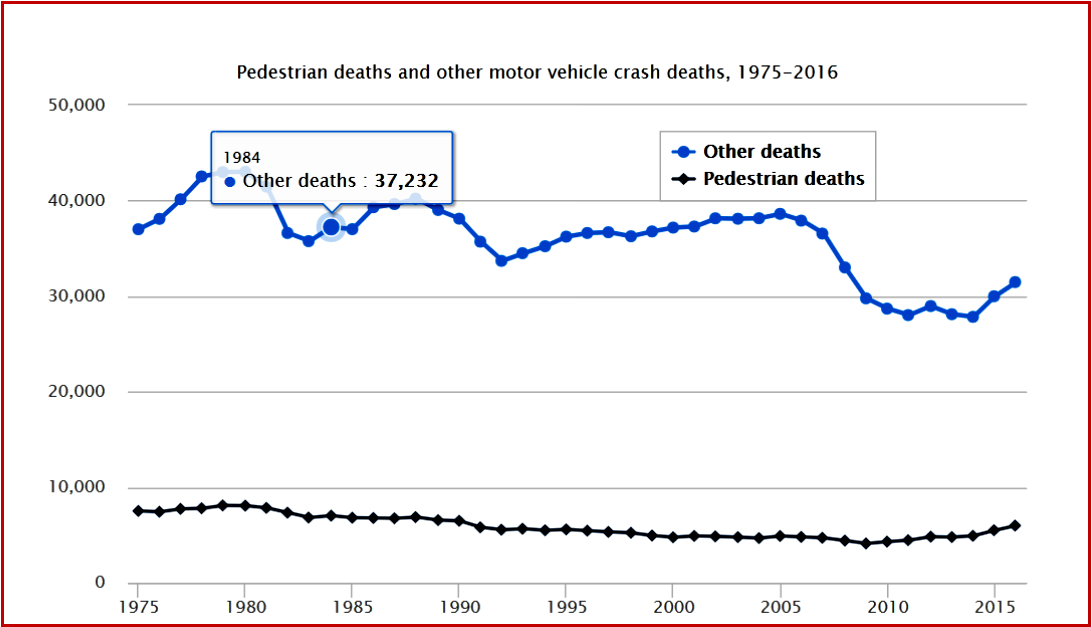
A total of 5,977 pedestrian deaths occurred in 2017. Of these, 170 were children younger than age 13. Although pedestrian fatalities in 2017 were 20% lower than in 1975, they have increased 45% since reaching their lowest point in 2009.

About Ken Zino
Ken Zino, editor and publisher of AutoInformed, is a versatile auto industry participant with global experience spanning decades in print and broadcast journalism, as well as social media. He has automobile testing, marketing, public relations and communications experience. He is past president of The International Motor Press Assn, the Detroit Press Club, founding member and first President of the Automotive Press Assn. He is a member of APA, IMPA and the Midwest Automotive Press Assn.
He also brings an historical perspective while citing their contemporary relevance of the work of legendary auto writers such as Ken Purdy, Jim Dunne or Jerry Flint, or writers such as Red Smith, Mark Twain, Thomas Jefferson – all to bring perspective to a chaotic automotive universe.
Above all, decades after he first drove a car, Zino still revels in the sound of the exhaust as the throttle is blipped during a downshift and the driver’s rush that occurs when the entry, apex and exit points of a turn are smoothly and swiftly crossed. It’s the beginning of a perfect lap.
AutoInformed has an editorial philosophy that loves transportation machines of all kinds while promoting critical thinking about the future use of cars and trucks.
Zino builds AutoInformed from his background in automotive journalism starting at Hearst Publishing in New York City on Motor and MotorTech Magazines and car testing where he reviewed hundreds of vehicles in his decade-long stint as the Detroit Bureau Chief of Road & Track magazine. Zino has also worked in Europe, and Asia – now the largest automotive market in the world with China at its center.







US Insurance Industry Group to Test Emergency Braking. Does the Driver Assist Technology Really Protect Pedestrians?
“The test with the small child dummy is the toughest,” says David Aylor, manager of active safety testing at IIHS. A total of 5,977 pedestrian deaths occurred in 2017.
The Insurance Institute for Highway Safety (IIHS) is launching a test program for automatic emergency braking systems on vehicles that can detect and brake for pedestrians. About a third of 2019 models have a standard autobrake system with pedestrian detection capabilities, and another third have an optional system that responds to pedestrians. (Read AutoInformed on Children Added to Virtual Crash Testing at Toyota and Euro NCAP to Publish First Crash Avoidance Ratings)
The pedestrian autobrake test is the fourth crash avoidance evaluation in the Institute’s group of safety tests, along with ratings of front crash prevention, rear crash prevention and headlights. Lurking in the background is the promise and threat of autonomous vehicles. (JAMA to Conduct Public Testing of Automated Driving)
In November, IIHS shared with auto manufacturers the protocol engineers will use in preparation for the early 2019 release of the first IIHS ratings of this feature. IIHS engineers have been conducting research tests with a variety of cars and SUVs to pave the way for the new program. A group of 11 small SUVs, all 2018–19 models, will be the first rated. (Challenge accepted: 57 models meet tougher criteria to clinch 2019 IIHS safety awards )
Along with IIHS ratings for front and rear crash prevention, vehicles will be rated as basic, advanced or superior, based on their ability to avoid or mitigate a crash with pedestrian dummies in track tests at different speeds.
Tests Simulate These Potential Collisions:
An adult pedestrian crosses a street from the right side of the vehicle and perpendicular to its path, with an impact location, in cases when autobrake doesn’t intervene, midway between the vehicle center line and right edge of the vehicle’s front end;
A child pedestrian runs across a street from behind two vehicles parked on the right side of the vehicle’s path, with a potential impact location on its front end at the center line;
An adult pedestrian in the lane near the road’s edge facing away from traffic, midway between the vehicle’s center line and right side.
Points are given based on average speed reductions for five repeated test runs in clear weather on dry pavement during the daytime. Tests are conducted at 20 km/h (12 mph) and 40 km/h (25 mph) in the perpendicular adult and child scenarios, and at 40 and 60 km/h (37 mph) in the parallel adult scenario. Systems that issue a timely warning get a 1-point credit in the parallel adult test.
“The test with the small child dummy is the toughest,” says David Aylor, manager of active safety testing at IIHS. “The dummy is hidden by a car and an SUV parked on the right side of the road as the test vehicle approaches, so there’s no clear sight line for the cameras — or driver — until the dummy emerges in the vehicle’s path.” (Read AutoInformed on Arizona Picks Intel to Lead Automated Vehicle Safety Institute)
Crashes involving child pedestrians are rare in comparison to ones involving adults, however engineers are designing these systems to consider this vulnerable population.
Autobrake with pedestrian detection already is making a difference in insurance claims. A 2017 HLDI analysis found that Subaru vehicles equipped with pedestrian detection had claim rates for pedestrian injuries that were 35% lower than the same vehicles without the system (see “Subaru crash avoidance system cuts pedestrian crashes,” May 8, 2018).
A 2011 IIHS analysis of 2005-09 crash data estimated that pedestrian detection systems could potentially mitigate or prevent up to 65% of single-vehicle crashes with pedestrians in the three most common crash configurations and 58% of pedestrian deaths in these crashes (see “Pedestrians stand to benefit from new vehicle technology and designs,” March 30, 2011).
A total of 5,977 pedestrian deaths occurred in 2017. Of these, 170 were children younger than age 13. Although pedestrian fatalities in 2017 were 20% lower than in 1975, they have increased 45% since reaching their lowest point in 2009.
About Ken Zino
Ken Zino, editor and publisher of AutoInformed, is a versatile auto industry participant with global experience spanning decades in print and broadcast journalism, as well as social media. He has automobile testing, marketing, public relations and communications experience. He is past president of The International Motor Press Assn, the Detroit Press Club, founding member and first President of the Automotive Press Assn. He is a member of APA, IMPA and the Midwest Automotive Press Assn. He also brings an historical perspective while citing their contemporary relevance of the work of legendary auto writers such as Ken Purdy, Jim Dunne or Jerry Flint, or writers such as Red Smith, Mark Twain, Thomas Jefferson – all to bring perspective to a chaotic automotive universe. Above all, decades after he first drove a car, Zino still revels in the sound of the exhaust as the throttle is blipped during a downshift and the driver’s rush that occurs when the entry, apex and exit points of a turn are smoothly and swiftly crossed. It’s the beginning of a perfect lap. AutoInformed has an editorial philosophy that loves transportation machines of all kinds while promoting critical thinking about the future use of cars and trucks. Zino builds AutoInformed from his background in automotive journalism starting at Hearst Publishing in New York City on Motor and MotorTech Magazines and car testing where he reviewed hundreds of vehicles in his decade-long stint as the Detroit Bureau Chief of Road & Track magazine. Zino has also worked in Europe, and Asia – now the largest automotive market in the world with China at its center.