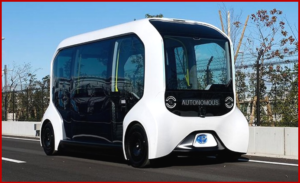
“In the future, the e-Palette will be able to be an office, a shop, or even a hotel. It will be able to become various kinds of services, and it will go to people,” said Toyoda in 1999.
On Thursday 26 August 2021, a Toyota e-Palette, an autonomous vehicle used to support mobility within the Athletes’ Village at the Olympic and Paralympic Games Tokyo, collided with a visually impaired person about to cross at a pedestrian crossing. At the Olympic Village there are 16 e-Palettes <Click to see them working) to facilitate athletes’ movement within the village. Although each e-Pallet has an onboard safety operator, the vehicles are essentially autonomous. A team of Toyota employees works around the clock in four groups in three shifts to keep the e-Pallets going.
All operations of the e-Palette are currently suspended. In a statement Toyota said: “We are fully cooperating with the police investigation into the incident to determine the cause of this accident. In addition, we will conduct our own thorough investigation into the cause of the accident, and we will continue to coordinate closely with the Tokyo Organizing Committee of the Olympic and Paralympic Games to ensure that we prevent any incidents from occurring in the future.”
This was a far different scenario than the one envisioned by Akio Toyoda at a press briefing during the always wacky Tokyo Motor Show in 2019. https://autoinformed.com/akio-toyoda-wants-mobility-centered-on-people/ Toyoda back then wanted to talk about people, not the vehicles that were and are the foundation of global automaker he leads. However, instead of the usual marketing babble, a 21st century view emerged as a laughing Toyoda posed questions in these vastly uncharted times of new forms of automobility, autonomous vehicles and artificial intelligence.
That’s when the “e-Palette” first appeared. It was scheduled to debut at the postponed cheap soma Olympic and Paralympic Games Tokyo 2020.
“In the future, the e-Palette will be able to be an office, a shop, or even a hotel. It will be able to become various kinds of services, and it will go to people,” said Toyoda back then. He observed that “when various kinds of information are linked, one would expect communities, society, and, of course, cars, to become more centered on people.”
He also noted that the birth of the automobile led to “15 million horses being replaced by cars in the United States.” He observed, “but still, we have racehorses. The joy of riding a horse can hold its own against or even outdo what cars have to offer. If there is an obstacle, a horse can avoid it. If there is a hole in the ground, a horse can make its own judgement and jump over it. Horses can communicate with people and their hearts. For people who ride them, horses are irreplaceable.”
“Through the evolution of artificial intelligence, I think that cars, too, can also become able to communicate with people and their hearts. that’s right… I think cars of the future will be like horses. If we look at shared forms of mobility, such as the e-Palette, as if they were horse carriages, forms of mobility owned by individuals, like the e-RACER, would be beloved horses,” said Toyoda.
Well, yes, but even a horse can sometimes through a rider.
“We would like to express our sincerest apologies to the individual that was injured due to this unfortunate collision, and we wish them a speedy recovery. We would also like to apologize for any inconvenience caused to those who use our mobility vehicles in the Athletes’ Village,” said Toyoda.
AutoInformed agrees, of course. The quest for mobility in the service of people and of society will continue.

About Ken Zino
Ken Zino, editor and publisher of AutoInformed, is a versatile auto industry participant with global experience spanning decades in print and broadcast journalism, as well as social media. He has automobile testing, marketing, public relations and communications experience. He is past president of The International Motor Press Assn, the Detroit Press Club, founding member and first President of the Automotive Press Assn. He is a member of APA, IMPA and the Midwest Automotive Press Assn.
He also brings an historical perspective while citing their contemporary relevance of the work of legendary auto writers such as Ken Purdy, Jim Dunne or Jerry Flint, or writers such as Red Smith, Mark Twain, Thomas Jefferson – all to bring perspective to a chaotic automotive universe.
Above all, decades after he first drove a car, Zino still revels in the sound of the exhaust as the throttle is blipped during a downshift and the driver’s rush that occurs when the entry, apex and exit points of a turn are smoothly and swiftly crossed. It’s the beginning of a perfect lap.
AutoInformed has an editorial philosophy that loves transportation machines of all kinds while promoting critical thinking about the future use of cars and trucks.
Zino builds AutoInformed from his background in automotive journalism starting at Hearst Publishing in New York City on Motor and MotorTech Magazines and car testing where he reviewed hundreds of vehicles in his decade-long stint as the Detroit Bureau Chief of Road & Track magazine. Zino has also worked in Europe, and Asia – now the largest automotive market in the world with China at its center.







Toyota e-Palette Hits Pedestrian at Paralympic Games
“In the future, the e-Palette will be able to be an office, a shop, or even a hotel. It will be able to become various kinds of services, and it will go to people,” said Toyoda in 1999.
On Thursday 26 August 2021, a Toyota e-Palette, an autonomous vehicle used to support mobility within the Athletes’ Village at the Olympic and Paralympic Games Tokyo, collided with a visually impaired person about to cross at a pedestrian crossing. At the Olympic Village there are 16 e-Palettes <Click to see them working) to facilitate athletes’ movement within the village. Although each e-Pallet has an onboard safety operator, the vehicles are essentially autonomous. A team of Toyota employees works around the clock in four groups in three shifts to keep the e-Pallets going.
All operations of the e-Palette are currently suspended. In a statement Toyota said: “We are fully cooperating with the police investigation into the incident to determine the cause of this accident. In addition, we will conduct our own thorough investigation into the cause of the accident, and we will continue to coordinate closely with the Tokyo Organizing Committee of the Olympic and Paralympic Games to ensure that we prevent any incidents from occurring in the future.”
This was a far different scenario than the one envisioned by Akio Toyoda at a press briefing during the always wacky Tokyo Motor Show in 2019. https://autoinformed.com/akio-toyoda-wants-mobility-centered-on-people/ Toyoda back then wanted to talk about people, not the vehicles that were and are the foundation of global automaker he leads. However, instead of the usual marketing babble, a 21st century view emerged as a laughing Toyoda posed questions in these vastly uncharted times of new forms of automobility, autonomous vehicles and artificial intelligence.
That’s when the “e-Palette” first appeared. It was scheduled to debut at the postponed cheap soma Olympic and Paralympic Games Tokyo 2020.
“In the future, the e-Palette will be able to be an office, a shop, or even a hotel. It will be able to become various kinds of services, and it will go to people,” said Toyoda back then. He observed that “when various kinds of information are linked, one would expect communities, society, and, of course, cars, to become more centered on people.”
He also noted that the birth of the automobile led to “15 million horses being replaced by cars in the United States.” He observed, “but still, we have racehorses. The joy of riding a horse can hold its own against or even outdo what cars have to offer. If there is an obstacle, a horse can avoid it. If there is a hole in the ground, a horse can make its own judgement and jump over it. Horses can communicate with people and their hearts. For people who ride them, horses are irreplaceable.”
“Through the evolution of artificial intelligence, I think that cars, too, can also become able to communicate with people and their hearts. that’s right… I think cars of the future will be like horses. If we look at shared forms of mobility, such as the e-Palette, as if they were horse carriages, forms of mobility owned by individuals, like the e-RACER, would be beloved horses,” said Toyoda.
Well, yes, but even a horse can sometimes through a rider.
“We would like to express our sincerest apologies to the individual that was injured due to this unfortunate collision, and we wish them a speedy recovery. We would also like to apologize for any inconvenience caused to those who use our mobility vehicles in the Athletes’ Village,” said Toyoda.
AutoInformed agrees, of course. The quest for mobility in the service of people and of society will continue.
About Ken Zino
Ken Zino, editor and publisher of AutoInformed, is a versatile auto industry participant with global experience spanning decades in print and broadcast journalism, as well as social media. He has automobile testing, marketing, public relations and communications experience. He is past president of The International Motor Press Assn, the Detroit Press Club, founding member and first President of the Automotive Press Assn. He is a member of APA, IMPA and the Midwest Automotive Press Assn. He also brings an historical perspective while citing their contemporary relevance of the work of legendary auto writers such as Ken Purdy, Jim Dunne or Jerry Flint, or writers such as Red Smith, Mark Twain, Thomas Jefferson – all to bring perspective to a chaotic automotive universe. Above all, decades after he first drove a car, Zino still revels in the sound of the exhaust as the throttle is blipped during a downshift and the driver’s rush that occurs when the entry, apex and exit points of a turn are smoothly and swiftly crossed. It’s the beginning of a perfect lap. AutoInformed has an editorial philosophy that loves transportation machines of all kinds while promoting critical thinking about the future use of cars and trucks. Zino builds AutoInformed from his background in automotive journalism starting at Hearst Publishing in New York City on Motor and MotorTech Magazines and car testing where he reviewed hundreds of vehicles in his decade-long stint as the Detroit Bureau Chief of Road & Track magazine. Zino has also worked in Europe, and Asia – now the largest automotive market in the world with China at its center.