Click for more
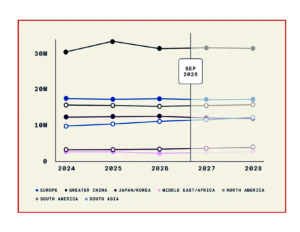
As the Iran war continues with limited options for the Trump mis-administration, Mobility Global [Formerly GlobalData and a frequent associate with J.D. Power – AutoCrat.] notes that global auto industry is still surviving the fallout from the ongoing and expanding Iran War, with higher oil prices adding inflation pressure, disrupting supply chains. This, of course, increases the risk of extensive negative economic consequences for many countries, and people.*
“Overall, the latest production update is a mix of smaller upward tweaks in several regions, partly offset by meaningful cuts in Greater China,” said Mike Wall, Executive Director, Automotive Analysis, Mobility Global.
“The biggest near-term swing factor is China, where weak domestic demand is dragging forecasts down. Chinese production is holding up better than sales because exports are doing a lot of the heavy lifting, with competitively priced vehicles gaining share in multiple markets,” said Wall.
Regional Highlights And Lowlights
“Europe’s 2026 production outlook was raised by about 100,000 units. Actual results have been stronger, and demand has held up better than expected. For 2027, the forecast was trimmed by about 100,000 units as Chinese imports maintain pressure on mainstream brands, especially smaller ICE passenger cars. Net: 2026 looks broadly flat, and 2027 is expected to slip by around 2%.
“Greater China production was cut by about 300,000 units for 2026 and 200,000 units for 2027, reflecting persistent weakness in domestic demand. The market is showing a clear split—retail is soft while production is steadier because exports are filling the gap. Looking ahead, exports are expected to face more friction from tariffs, investigations, tighter rules, and a gradual shift toward overseas localization.
“Japan/ Korea: Japan’s production outlook was raised by about 200,000 units for 2026 and 300,000 units for 2027, supported by steady domestic demand and strong hybrid exports to North America and Europe. Over time, Japan still faces pressure from aggressive Chinese pricing and slower progress on affordable BEVs. In South Korea, strike-related disruption hasn’t changed the 2026 total much, but 2027 was nudged up by roughly 40,000 units as exports remain resilient.
“Middle East/Africa production was increased by about 30,000 units for 2026 and 20,000 units for 2027, led by stronger near-term output in Iran and improved local demand. That said, the longer-run outlook for Iran is being treated more cautiously given the expected economic drag from the ongoing conflict. Outside Iran, growth is being helped by expanding Chinese OEM presence across Africa.
“North America production was reduced by roughly 50,000 units for 2026 and 70,000 units for 2027, even as US demand remains surprisingly solid. The adjustments are mainly about execution—uneven inventories, expected plant downtime, and delayed launches (including a pushout of key EV timing). Overall, 2026 production is now expected to be down about 1.6% year over year, to roughly 15.0 million units.
“South America production moved from flat to slightly up for 2026, as Brazil strength continues to be offset by Argentina weakness. For 2027, production was lifted by about 10,000 units, with most of the improvement concentrated in Brazil. A bigger Chinese OEM footprint is a key reason Brazil is outperforming the regional average.
“South Asia production was increased by about 200,000 units for 2026 and about 200,000 units for 2027, driven by a handful of faster-growing ASEAN markets plus continued strength in India. ASEAN growth is uneven—Indonesia, Malaysia, and Vietnam are doing most of the work, while other markets lag. India’s upgrade is backed by tax support, strong launches, and manageable inventory levels that leave room for more production,” said GlobalData.
*AutoInformed on

About Ken Zino
Ken Zino, editor and publisher of AutoInformed, is a versatile auto industry participant with global experience spanning decades in print and broadcast journalism, as well as social media. He has automobile testing, marketing, public relations and communications experience. He is past president of The International Motor Press Assn, the Detroit Press Club, founding member and first President of the Automotive Press Assn. He is a member of APA, IMPA and the Midwest Automotive Press Assn.
He also brings an historical perspective while citing their contemporary relevance of the work of legendary auto writers such as Ken Purdy, Jim Dunne or Jerry Flint, or writers such as Red Smith, Mark Twain, Thomas Jefferson – all to bring perspective to a chaotic automotive universe.
Above all, decades after he first drove a car, Zino still revels in the sound of the exhaust as the throttle is blipped during a downshift and the driver’s rush that occurs when the entry, apex and exit points of a turn are smoothly and swiftly crossed. It’s the beginning of a perfect lap.
AutoInformed has an editorial philosophy that loves transportation machines of all kinds while promoting critical thinking about the future use of cars and trucks.
Zino builds AutoInformed from his background in automotive journalism starting at Hearst Publishing in New York City on Motor and MotorTech Magazines and car testing where he reviewed hundreds of vehicles in his decade-long stint as the Detroit Bureau Chief of Road & Track magazine. Zino has also worked in Europe, and Asia – now the largest automotive market in the world with China at its center.







September 2026 Light Vehicle Production Forecast So-So
Click for more
As the Iran war continues with limited options for the Trump mis-administration, Mobility Global [Formerly GlobalData and a frequent associate with J.D. Power – AutoCrat.] notes that global auto industry is still surviving the fallout from the ongoing and expanding Iran War, with higher oil prices adding inflation pressure, disrupting supply chains. This, of course, increases the risk of extensive negative economic consequences for many countries, and people.*
“Overall, the latest production update is a mix of smaller upward tweaks in several regions, partly offset by meaningful cuts in Greater China,” said Mike Wall, Executive Director, Automotive Analysis, Mobility Global.
“The biggest near-term swing factor is China, where weak domestic demand is dragging forecasts down. Chinese production is holding up better than sales because exports are doing a lot of the heavy lifting, with competitively priced vehicles gaining share in multiple markets,” said Wall.
Regional Highlights And Lowlights
“Europe’s 2026 production outlook was raised by about 100,000 units. Actual results have been stronger, and demand has held up better than expected. For 2027, the forecast was trimmed by about 100,000 units as Chinese imports maintain pressure on mainstream brands, especially smaller ICE passenger cars. Net: 2026 looks broadly flat, and 2027 is expected to slip by around 2%.
“Greater China production was cut by about 300,000 units for 2026 and 200,000 units for 2027, reflecting persistent weakness in domestic demand. The market is showing a clear split—retail is soft while production is steadier because exports are filling the gap. Looking ahead, exports are expected to face more friction from tariffs, investigations, tighter rules, and a gradual shift toward overseas localization.
“Japan/ Korea: Japan’s production outlook was raised by about 200,000 units for 2026 and 300,000 units for 2027, supported by steady domestic demand and strong hybrid exports to North America and Europe. Over time, Japan still faces pressure from aggressive Chinese pricing and slower progress on affordable BEVs. In South Korea, strike-related disruption hasn’t changed the 2026 total much, but 2027 was nudged up by roughly 40,000 units as exports remain resilient.
“Middle East/Africa production was increased by about 30,000 units for 2026 and 20,000 units for 2027, led by stronger near-term output in Iran and improved local demand. That said, the longer-run outlook for Iran is being treated more cautiously given the expected economic drag from the ongoing conflict. Outside Iran, growth is being helped by expanding Chinese OEM presence across Africa.
“North America production was reduced by roughly 50,000 units for 2026 and 70,000 units for 2027, even as US demand remains surprisingly solid. The adjustments are mainly about execution—uneven inventories, expected plant downtime, and delayed launches (including a pushout of key EV timing). Overall, 2026 production is now expected to be down about 1.6% year over year, to roughly 15.0 million units.
“South America production moved from flat to slightly up for 2026, as Brazil strength continues to be offset by Argentina weakness. For 2027, production was lifted by about 10,000 units, with most of the improvement concentrated in Brazil. A bigger Chinese OEM footprint is a key reason Brazil is outperforming the regional average.
“South Asia production was increased by about 200,000 units for 2026 and about 200,000 units for 2027, driven by a handful of faster-growing ASEAN markets plus continued strength in India. ASEAN growth is uneven—Indonesia, Malaysia, and Vietnam are doing most of the work, while other markets lag. India’s upgrade is backed by tax support, strong launches, and manageable inventory levels that leave room for more production,” said GlobalData.
*AutoInformed on
About Ken Zino
Ken Zino, editor and publisher of AutoInformed, is a versatile auto industry participant with global experience spanning decades in print and broadcast journalism, as well as social media. He has automobile testing, marketing, public relations and communications experience. He is past president of The International Motor Press Assn, the Detroit Press Club, founding member and first President of the Automotive Press Assn. He is a member of APA, IMPA and the Midwest Automotive Press Assn. He also brings an historical perspective while citing their contemporary relevance of the work of legendary auto writers such as Ken Purdy, Jim Dunne or Jerry Flint, or writers such as Red Smith, Mark Twain, Thomas Jefferson – all to bring perspective to a chaotic automotive universe. Above all, decades after he first drove a car, Zino still revels in the sound of the exhaust as the throttle is blipped during a downshift and the driver’s rush that occurs when the entry, apex and exit points of a turn are smoothly and swiftly crossed. It’s the beginning of a perfect lap. AutoInformed has an editorial philosophy that loves transportation machines of all kinds while promoting critical thinking about the future use of cars and trucks. Zino builds AutoInformed from his background in automotive journalism starting at Hearst Publishing in New York City on Motor and MotorTech Magazines and car testing where he reviewed hundreds of vehicles in his decade-long stint as the Detroit Bureau Chief of Road & Track magazine. Zino has also worked in Europe, and Asia – now the largest automotive market in the world with China at its center.