The US Environmental Protection Agency (EPA) released today its annual interactive report tracking America’s progress in controlling air pollution. Our Nation’s Air: Trends Through 2022 shows that, between 1970 and 2022, the combined emissions of six key pollutants dropped by 78%, while the U.S. economy grew 304% over the same time.
“Even as the economy grows, we continue to see dramatic long-term reductions in air emissions. This progress is encouraging, and we will continue to collaborate with our partners to protect public health and ensure clean air for all,” said EPA Administrator Michael S. Regan.
Click for more information.
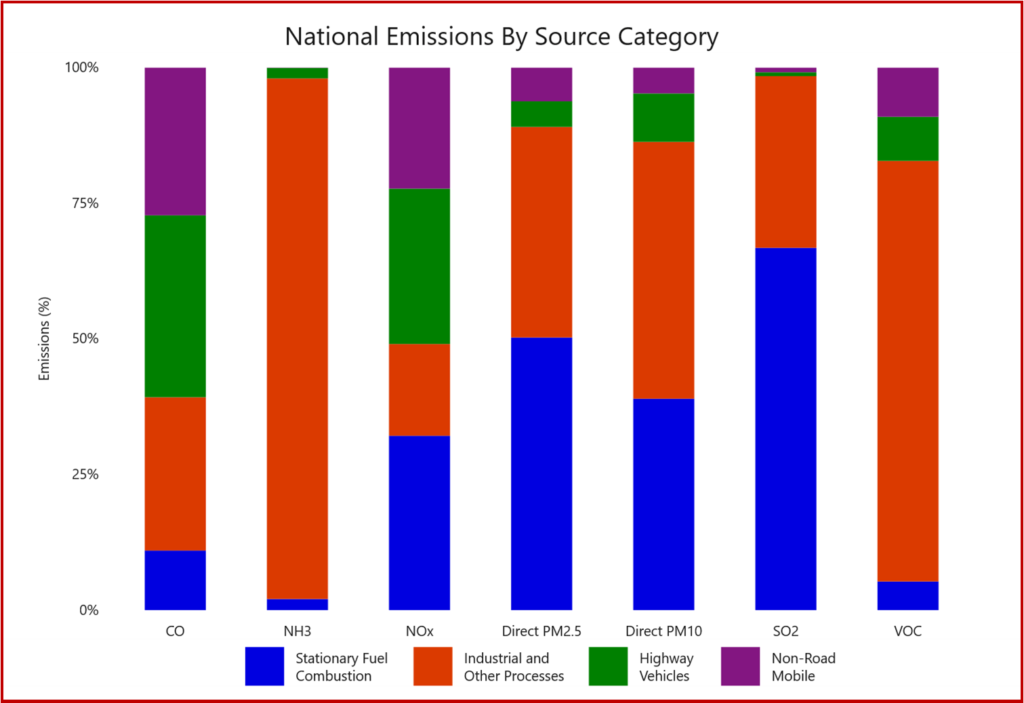
Emissions of air pollution come from:
- stationary fuel combustion sources (such as electric utilities and industrial boilers),
- industrial and other processes (such as metal smelters, petroleum refineries, cement kilns and dry cleaners),
- highway vehicles, and
- non-road mobile sources (such as recreational and construction equipment, marine vessels, aircraft and locomotives).
Air pollution contains gas and particle contaminants that are present in the atmosphere. Gaseous pollutants include sulfur dioxide (SO2), oxides of nitrogen (NOx), ozone (O3), carbon monoxide (CO), volatile organic compounds (VOCs), and certain toxic air pollutants. Particle pollution (PM2.5 and PM10) includes a mixture of compounds that EPA groups into five major categories: sulfate, nitrate, elemental (black) carbon, organic carbon and crustal material.
Some pollutants are released directly into the atmosphere. Other pollutants are formed in the air from chemical reactions. Ground-level ozone forms when emissions of NOx and VOCs react in the presence of sunlight. Air pollution impacts human health and the environment through a variety of pathways.
Click for more information.
National Averages
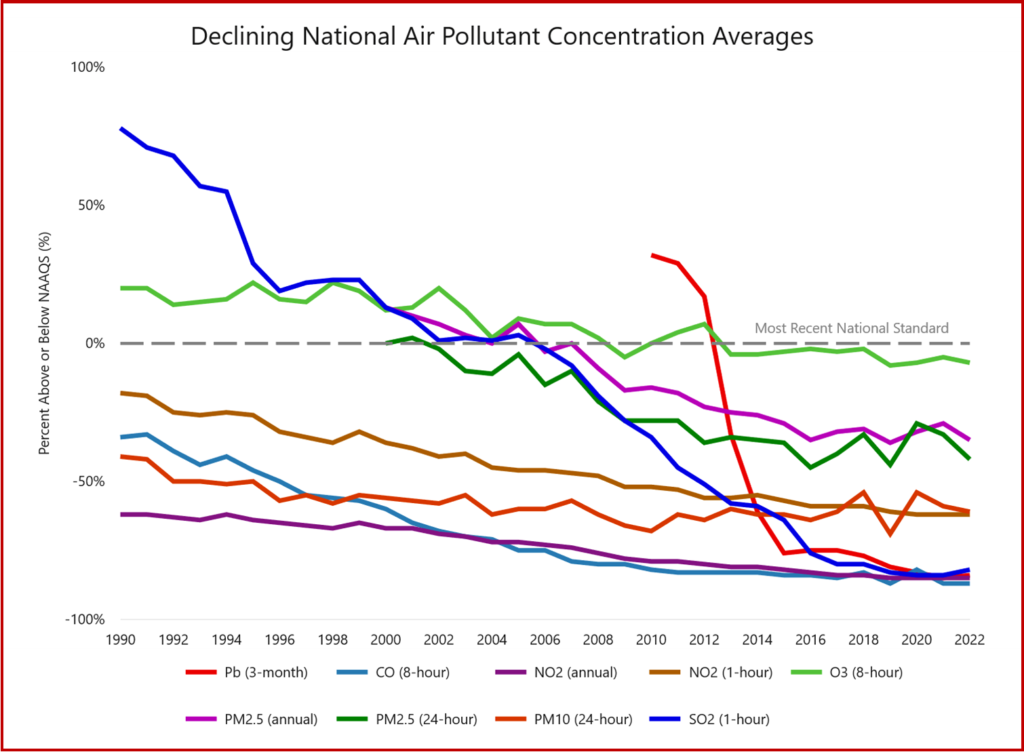
The national average concentrations of harmful air pollutants decreased considerably across our nation between 1990 and 2022:
- Carbon Monoxide (CO) 8-Hour, 81%
- Lead (Pb) 3-Month Average, 88% (from 2010)
- Nitrogen Dioxide (NO2) Annual,60%
- Nitrogen Dioxide (NO2) 1-Hour,54%
- Ozone (O3) 8-Hour,22%
- Particulate Matter 10 microns (PM10) 24-Hour, 34%
- Particulate Matter 2.5 microns (PM5) Annual, 42% (from 2000)
- Particulate Matter 2.5 microns (PM5) 24-Hour, 42% (from 2000)
- Sulfur Dioxide (SO2) 1-Hour, 90%
However, EPA said: “It is important to note that air quality concentrations can vary year to year, even as human-caused emissions continue to decline. In 2022, national average concentrations of lead and nitrogen dioxide increased slightly over 2021 levels. Variations in weather, and events such as dust storms and wildfires can have an impact on air quality in affected areas. Many environmental impacts associated with climate change can impact air quality particularly affecting the severity and timing of the wildfire season, including changes in temperature, precipitation, and drought.”
Explore the report click: Here.

About Ken Zino
Ken Zino, editor and publisher of AutoInformed, is a versatile auto industry participant with global experience spanning decades in print and broadcast journalism, as well as social media. He has automobile testing, marketing, public relations and communications experience. He is past president of The International Motor Press Assn, the Detroit Press Club, founding member and first President of the Automotive Press Assn. He is a member of APA, IMPA and the Midwest Automotive Press Assn.
He also brings an historical perspective while citing their contemporary relevance of the work of legendary auto writers such as Ken Purdy, Jim Dunne or Jerry Flint, or writers such as Red Smith, Mark Twain, Thomas Jefferson – all to bring perspective to a chaotic automotive universe.
Above all, decades after he first drove a car, Zino still revels in the sound of the exhaust as the throttle is blipped during a downshift and the driver’s rush that occurs when the entry, apex and exit points of a turn are smoothly and swiftly crossed. It’s the beginning of a perfect lap.
AutoInformed has an editorial philosophy that loves transportation machines of all kinds while promoting critical thinking about the future use of cars and trucks.
Zino builds AutoInformed from his background in automotive journalism starting at Hearst Publishing in New York City on Motor and MotorTech Magazines and car testing where he reviewed hundreds of vehicles in his decade-long stint as the Detroit Bureau Chief of Road & Track magazine. Zino has also worked in Europe, and Asia – now the largest automotive market in the world with China at its center.







EPA – As Economy Grows Key Pollutants are Declining
The US Environmental Protection Agency (EPA) released today its annual interactive report tracking America’s progress in controlling air pollution. Our Nation’s Air: Trends Through 2022 shows that, between 1970 and 2022, the combined emissions of six key pollutants dropped by 78%, while the U.S. economy grew 304% over the same time.
“Even as the economy grows, we continue to see dramatic long-term reductions in air emissions. This progress is encouraging, and we will continue to collaborate with our partners to protect public health and ensure clean air for all,” said EPA Administrator Michael S. Regan.
Click for more information.
Emissions of air pollution come from:
Air pollution contains gas and particle contaminants that are present in the atmosphere. Gaseous pollutants include sulfur dioxide (SO2), oxides of nitrogen (NOx), ozone (O3), carbon monoxide (CO), volatile organic compounds (VOCs), and certain toxic air pollutants. Particle pollution (PM2.5 and PM10) includes a mixture of compounds that EPA groups into five major categories: sulfate, nitrate, elemental (black) carbon, organic carbon and crustal material.
Some pollutants are released directly into the atmosphere. Other pollutants are formed in the air from chemical reactions. Ground-level ozone forms when emissions of NOx and VOCs react in the presence of sunlight. Air pollution impacts human health and the environment through a variety of pathways.
Click for more information.
National Averages
The national average concentrations of harmful air pollutants decreased considerably across our nation between 1990 and 2022:
However, EPA said: “It is important to note that air quality concentrations can vary year to year, even as human-caused emissions continue to decline. In 2022, national average concentrations of lead and nitrogen dioxide increased slightly over 2021 levels. Variations in weather, and events such as dust storms and wildfires can have an impact on air quality in affected areas. Many environmental impacts associated with climate change can impact air quality particularly affecting the severity and timing of the wildfire season, including changes in temperature, precipitation, and drought.”
Explore the report click: Here.
About Ken Zino
Ken Zino, editor and publisher of AutoInformed, is a versatile auto industry participant with global experience spanning decades in print and broadcast journalism, as well as social media. He has automobile testing, marketing, public relations and communications experience. He is past president of The International Motor Press Assn, the Detroit Press Club, founding member and first President of the Automotive Press Assn. He is a member of APA, IMPA and the Midwest Automotive Press Assn. He also brings an historical perspective while citing their contemporary relevance of the work of legendary auto writers such as Ken Purdy, Jim Dunne or Jerry Flint, or writers such as Red Smith, Mark Twain, Thomas Jefferson – all to bring perspective to a chaotic automotive universe. Above all, decades after he first drove a car, Zino still revels in the sound of the exhaust as the throttle is blipped during a downshift and the driver’s rush that occurs when the entry, apex and exit points of a turn are smoothly and swiftly crossed. It’s the beginning of a perfect lap. AutoInformed has an editorial philosophy that loves transportation machines of all kinds while promoting critical thinking about the future use of cars and trucks. Zino builds AutoInformed from his background in automotive journalism starting at Hearst Publishing in New York City on Motor and MotorTech Magazines and car testing where he reviewed hundreds of vehicles in his decade-long stint as the Detroit Bureau Chief of Road & Track magazine. Zino has also worked in Europe, and Asia – now the largest automotive market in the world with China at its center.