Click for more.
The U.S. Court of International Trade ruling Wednesday against Trump Administration tariffs is just a bump in the road. Although it was widely and loudly hailed as a defeat for President Trump and his whimsical, constantly changing tariff executive orders it is actually just a continuation of the economically damaging Administration policies, irrelevant to the misleading Wall Street TACO moniker – Trump Always Chickens Outs. (Read AutoInformed.com on: Trump Tariff Chaos – May Auto Sales Crash)
By late Thursday, the Administration had swiftly obtained an emergency stay. Tariffs on steel aluminum, automobiles and auto parts and remain in place.
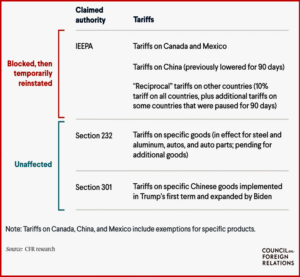
“The CIT’s ruling affects the tariffs that Trump imposed under the International Emergency Economic Powers Act (IEEPA), which gives the president some power to regulate commerce after declaring a national emergency. It does not affect other, more specific tariffs he has imposed on commodities such as steel,” said Inu Manak, a fellow for trade policy at the Council on Foreign Relations.*
“While this derails some of the Trump administration’s trade plans, it does not necessarily mean the end of its trade wars. On Thursday, a federal appeals court [U.S. Court of Appeals for the Federal Circuit – CAFC] while those judges consider the case. granted the administration’s request to pause the decision while it reviews the case, keeping the tariffs in place until at least June 9. The White House has also indicated its intention to take the case to the U.S. Supreme Court if necessary,” Manak said in a briefing on the complex legal matter.
Key Manak Points – excerpted and edited for space
What immediate effect will this ruling have?
- The CIT ordered the Trump administration to stop collecting tariffs imposed under IEEPA within ten days. Those tariffs include levies on Canada, China, and Mexico to allegedly curb illegal fentanyl trafficking, as well as Trump’s April 2 “Liberation Day” tariffs that imposed a baseline 10 percent rate on virtually all U.S. trading partners.
- The Trump administration has already appealed the CIT’s ruling, and it appears the stay they obtained will buy the White House some time. If the tariffs are lifted, as the CIT ordered, much of the administration’s trade agenda will be effectively reset.
- In the meantime, there will likely be a scramble to sort out what happens to goods that are imported into the United States before tariffs are no longer collected, and there’s a chance that shipments en route could turn around and await the order to lift the tariffs.
How will it affect U.S. industries and businesses?
- The lawsuits brought against the Trump administration’s IEEPA tariffs have mainly come from small businesses who have been especially hurt by the tariff actions. The CIT ruling would be welcome relief to those businesses who were worried about closing up shop, laying off staff, and simply staying afloat.
- Lifting the tariffs would have an impact across the broader economy as well, alleviating the need to raise prices on a range of consumer goods, as Walmart recently suggested it would need to do.
What effect will the court’s ruling have on Trump’s broader trade agenda and the administration’s tariff negotiations?
- The ruling delivers a stunning blow to the Trump administration’s trade agenda. It states that IEEPA does not provide “unbounded authority” to the president, nor does it grant him the power to use tariffs as leverage against an unconnected threat. This comprises the very basis of Trump’s push to negotiate a flurry of deals ahead of an arbitrary July 9 deadline. He has repeatedly threatened to impose additional “reciprocal” tariffs on countries that have not negotiated a solution by that date.
- With the IEEPA tariffs rescinded, the administration no longer has any leverage to compel countries to negotiate on the steepest tariffs that it has threatened. There will still be countries interested in negotiating the removal of duties imposed under other trade authorities, such as the Section 232 [https://www.cfr.org/report/tariffs-trading-partners-can-president-actually-do ]tariffs on aluminum and steel or on vehicles and auto parts. The Section 232 authority allows the president to “adjust” imports that “threaten to impair the national security.”
- Countries already in the negotiating queue are surely reevaluating their offers and are likely to revise their approach to ongoing trade talks. So far, only two “deals” have been reached, with China and the United Kingdom (UK). However, they are essentially frameworks for negotiating additional deals, though the UK deal provides relief on some Section 232 duties.
*This work represents the views and opinions solely of the author. The Council on Foreign Relations is an independent, nonpartisan membership organization, think tank, and publisher, and takes no institutional positions on matters of policy.

About Ken Zino
Ken Zino, editor and publisher of AutoInformed, is a versatile auto industry participant with global experience spanning decades in print and broadcast journalism, as well as social media. He has automobile testing, marketing, public relations and communications experience. He is past president of The International Motor Press Assn, the Detroit Press Club, founding member and first President of the Automotive Press Assn. He is a member of APA, IMPA and the Midwest Automotive Press Assn.
He also brings an historical perspective while citing their contemporary relevance of the work of legendary auto writers such as Ken Purdy, Jim Dunne or Jerry Flint, or writers such as Red Smith, Mark Twain, Thomas Jefferson – all to bring perspective to a chaotic automotive universe.
Above all, decades after he first drove a car, Zino still revels in the sound of the exhaust as the throttle is blipped during a downshift and the driver’s rush that occurs when the entry, apex and exit points of a turn are smoothly and swiftly crossed. It’s the beginning of a perfect lap.
AutoInformed has an editorial philosophy that loves transportation machines of all kinds while promoting critical thinking about the future use of cars and trucks.
Zino builds AutoInformed from his background in automotive journalism starting at Hearst Publishing in New York City on Motor and MotorTech Magazines and car testing where he reviewed hundreds of vehicles in his decade-long stint as the Detroit Bureau Chief of Road & Track magazine. Zino has also worked in Europe, and Asia – now the largest automotive market in the world with China at its center.







Trump Tariff Chaos Continues Despite Court Ruling
Click for more.
The U.S. Court of International Trade ruling Wednesday against Trump Administration tariffs is just a bump in the road. Although it was widely and loudly hailed as a defeat for President Trump and his whimsical, constantly changing tariff executive orders it is actually just a continuation of the economically damaging Administration policies, irrelevant to the misleading Wall Street TACO moniker – Trump Always Chickens Outs. (Read AutoInformed.com on: Trump Tariff Chaos – May Auto Sales Crash)
By late Thursday, the Administration had swiftly obtained an emergency stay. Tariffs on steel aluminum, automobiles and auto parts and remain in place.
“The CIT’s ruling affects the tariffs that Trump imposed under the International Emergency Economic Powers Act (IEEPA), which gives the president some power to regulate commerce after declaring a national emergency. It does not affect other, more specific tariffs he has imposed on commodities such as steel,” said Inu Manak, a fellow for trade policy at the Council on Foreign Relations.*
“While this derails some of the Trump administration’s trade plans, it does not necessarily mean the end of its trade wars. On Thursday, a federal appeals court [U.S. Court of Appeals for the Federal Circuit – CAFC] while those judges consider the case. granted the administration’s request to pause the decision while it reviews the case, keeping the tariffs in place until at least June 9. The White House has also indicated its intention to take the case to the U.S. Supreme Court if necessary,” Manak said in a briefing on the complex legal matter.
Key Manak Points – excerpted and edited for space
What immediate effect will this ruling have?
How will it affect U.S. industries and businesses?
What effect will the court’s ruling have on Trump’s broader trade agenda and the administration’s tariff negotiations?
*This work represents the views and opinions solely of the author. The Council on Foreign Relations is an independent, nonpartisan membership organization, think tank, and publisher, and takes no institutional positions on matters of policy.
About Ken Zino
Ken Zino, editor and publisher of AutoInformed, is a versatile auto industry participant with global experience spanning decades in print and broadcast journalism, as well as social media. He has automobile testing, marketing, public relations and communications experience. He is past president of The International Motor Press Assn, the Detroit Press Club, founding member and first President of the Automotive Press Assn. He is a member of APA, IMPA and the Midwest Automotive Press Assn. He also brings an historical perspective while citing their contemporary relevance of the work of legendary auto writers such as Ken Purdy, Jim Dunne or Jerry Flint, or writers such as Red Smith, Mark Twain, Thomas Jefferson – all to bring perspective to a chaotic automotive universe. Above all, decades after he first drove a car, Zino still revels in the sound of the exhaust as the throttle is blipped during a downshift and the driver’s rush that occurs when the entry, apex and exit points of a turn are smoothly and swiftly crossed. It’s the beginning of a perfect lap. AutoInformed has an editorial philosophy that loves transportation machines of all kinds while promoting critical thinking about the future use of cars and trucks. Zino builds AutoInformed from his background in automotive journalism starting at Hearst Publishing in New York City on Motor and MotorTech Magazines and car testing where he reviewed hundreds of vehicles in his decade-long stint as the Detroit Bureau Chief of Road & Track magazine. Zino has also worked in Europe, and Asia – now the largest automotive market in the world with China at its center.