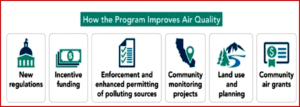
Click for more.
A new report released today by the California Air Resources Board (CARB) shows that the California law funded by Cap-and-Invest dollars improves air in the state’s most polluted communities. In each of the 19 communities the program supports, CARB and the local air districts established partnerships to develop plans to address local pollution problems where people live, work and play. CARB is now expanding the program’s offerings to 64 communities in coordination with other regulatory partners. In AutotInformed’s view this is democracy in action – in sharp contrast to the politics of grievances by the super-rich.
“The Community Air Protection Program has become a critical tool for improving air quality in areas most impacted by sources of pollution,” said CARB Chair Liane Randolph. “As one of the hallmark efforts funded by Cap-and-Invest revenue, it is recognized as a national model for substantially and cost-effectively reducing harmful emissions in vulnerable communities. The success of the program is a testament to the power of partnerships and a result of our collective commitment to the pursuit of clean air for all Californians.”
Funded through the state’s Cap-and-Invest Program, CARB has directed $632 million to more than 9000 incentive projects since 2017, with 85% of the funding reaching disadvantaged and low-income communities, far exceeding investment targets set by the Board.
The projects vary widely across the state based on community priorities including:
- Swapping out thousands of dirty old lawnmowers with electric replacements for landscapers and residents throughout the San Joaquin Valley.
- Reducing dust exposure by funding paving of school parking lots, urban greening projects, and installing air filtration systems in schools in the Imperial Valley.
- Helping fund a first-in-the-nation electric tugboat at the Port of San Diego, which will eliminate 30,000 gallons of diesel pollution per year.
The projects are producing permanent, enforceable reductions in harmful air pollutants, including reducing:
- 23,000+ tons of nitrogen oxides (NOx ), equivalent to removing about 22.5 million cars from the road for an entire year.
- 950 tons of diesel particulate matter, equivalent to annual emissions from up to two million heavy-duty trucks.
- 282,600 metric tons of greenhouse gas emissions, equivalent to emissions from driving a gasoline-powered car nearly 872 million miles.
On-the-Ground Progress
The report highlights several community-driven successes across California including:
- West Oakland: In West Oakland, a combination of actions, which included incentives to re-power 13 tugboats with cleaner engines, existing and new statewide regulations, and other changes, led to a 31% reduction in cancer-causing diesel emissions between 2017 and 2024, across an area of 29,000 residents.
- Shafter, Eastern Coachella Valley, and Arvin/Lamont: Communities in Shafter, Arvin and Lamont in Kern County, and in East Coachella Valley advocated for a pesticide notification strategy in their plans, which eventually led to Governor Newsom allocating $10 million to the Department of Pesticide Regulation for a statewide regulatory pesticide use notification system for neighborhoods near agricultural operations.
- Arvin/Lamont, Shafter, and South Los Angeles: CARB’s California Methane Task Force conducted 232 well and nine tank inspections in coordination with the California Geologic Energy Management Division, the San Joaquin Valley Air Pollution Control District, and the South Coast Air Quality Management District, addressing methane leaks and issuing notices of violation where needed.
- San Ysidro’s International Border Communities: With support from a U.S. Environmental Protection Agency grant, CARB launched a pilot air monitoring project to study cross-border emissions, border wait times, traffic pollution, odors from the Tijuana River, and other community concerns. Real-time monitoring of air pollutants is now underway.
- South Los Angeles: CARB proposed amendments to two rules that reduce cancer-causing volatile organic compounds from motor vehicle assembly and solvent cleaning operations in response to community concern.
More Information and Less Pollution
You can read more interactive and detailed stories of these projects in the Community Air Protection Progress highlights.

About Ken Zino
Ken Zino, editor and publisher of AutoInformed, is a versatile auto industry participant with global experience spanning decades in print and broadcast journalism, as well as social media. He has automobile testing, marketing, public relations and communications experience. He is past president of The International Motor Press Assn, the Detroit Press Club, founding member and first President of the Automotive Press Assn. He is a member of APA, IMPA and the Midwest Automotive Press Assn.
He also brings an historical perspective while citing their contemporary relevance of the work of legendary auto writers such as Ken Purdy, Jim Dunne or Jerry Flint, or writers such as Red Smith, Mark Twain, Thomas Jefferson – all to bring perspective to a chaotic automotive universe.
Above all, decades after he first drove a car, Zino still revels in the sound of the exhaust as the throttle is blipped during a downshift and the driver’s rush that occurs when the entry, apex and exit points of a turn are smoothly and swiftly crossed. It’s the beginning of a perfect lap.
AutoInformed has an editorial philosophy that loves transportation machines of all kinds while promoting critical thinking about the future use of cars and trucks.
Zino builds AutoInformed from his background in automotive journalism starting at Hearst Publishing in New York City on Motor and MotorTech Magazines and car testing where he reviewed hundreds of vehicles in his decade-long stint as the Detroit Bureau Chief of Road & Track magazine. Zino has also worked in Europe, and Asia – now the largest automotive market in the world with China at its center.







Cap-and-Invest Cleans Air in Most Polluted Areas
Click for more.
A new report released today by the California Air Resources Board (CARB) shows that the California law funded by Cap-and-Invest dollars improves air in the state’s most polluted communities. In each of the 19 communities the program supports, CARB and the local air districts established partnerships to develop plans to address local pollution problems where people live, work and play. CARB is now expanding the program’s offerings to 64 communities in coordination with other regulatory partners. In AutotInformed’s view this is democracy in action – in sharp contrast to the politics of grievances by the super-rich.
“The Community Air Protection Program has become a critical tool for improving air quality in areas most impacted by sources of pollution,” said CARB Chair Liane Randolph. “As one of the hallmark efforts funded by Cap-and-Invest revenue, it is recognized as a national model for substantially and cost-effectively reducing harmful emissions in vulnerable communities. The success of the program is a testament to the power of partnerships and a result of our collective commitment to the pursuit of clean air for all Californians.”
Funded through the state’s Cap-and-Invest Program, CARB has directed $632 million to more than 9000 incentive projects since 2017, with 85% of the funding reaching disadvantaged and low-income communities, far exceeding investment targets set by the Board.
The projects vary widely across the state based on community priorities including:
The projects are producing permanent, enforceable reductions in harmful air pollutants, including reducing:
On-the-Ground Progress
The report highlights several community-driven successes across California including:
More Information and Less Pollution
You can read more interactive and detailed stories of these projects in the Community Air Protection Progress highlights.
About Ken Zino
Ken Zino, editor and publisher of AutoInformed, is a versatile auto industry participant with global experience spanning decades in print and broadcast journalism, as well as social media. He has automobile testing, marketing, public relations and communications experience. He is past president of The International Motor Press Assn, the Detroit Press Club, founding member and first President of the Automotive Press Assn. He is a member of APA, IMPA and the Midwest Automotive Press Assn. He also brings an historical perspective while citing their contemporary relevance of the work of legendary auto writers such as Ken Purdy, Jim Dunne or Jerry Flint, or writers such as Red Smith, Mark Twain, Thomas Jefferson – all to bring perspective to a chaotic automotive universe. Above all, decades after he first drove a car, Zino still revels in the sound of the exhaust as the throttle is blipped during a downshift and the driver’s rush that occurs when the entry, apex and exit points of a turn are smoothly and swiftly crossed. It’s the beginning of a perfect lap. AutoInformed has an editorial philosophy that loves transportation machines of all kinds while promoting critical thinking about the future use of cars and trucks. Zino builds AutoInformed from his background in automotive journalism starting at Hearst Publishing in New York City on Motor and MotorTech Magazines and car testing where he reviewed hundreds of vehicles in his decade-long stint as the Detroit Bureau Chief of Road & Track magazine. Zino has also worked in Europe, and Asia – now the largest automotive market in the world with China at its center.