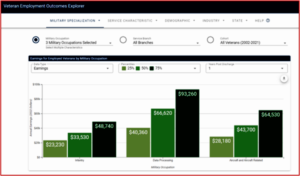
Click to enlarge.
The U.S. Census Bureau today released an expanded version of Veteran Employment Outcomes (VEO), an experimental data product showing earnings and employment outcomes for veterans of the U.S. armed forces.
“Coverage includes labor market outcomes one, five and 10 years after discharge, by military occupation, rank, demographics, industry and geography of employment. Among the findings, veterans with more specialized military training and work experience had higher civilian earnings and employment rates than infantry and combat veterans,” Census said.
Launched in 2020, VEO initially covered labor market outcomes for U.S. Army veterans. The update expands VEO coverage to also include data on Navy, Air Force, Marine Corps and Coast Guard veterans discharged between 2002 and 2021. (Statistics are not available yet for members of the Space Force, established in December 2019.) These data show earnings and employment outcomes of more than 2.8 million formerly enlisted service members.
Earnings
- Former operational intelligence specialists are among the highest earners after leaving the service. (The U.S. Army, Navy, Marines and Air Force have operational intelligence specialists who collect, analyze and disseminate intelligence information; the Coast Guard does not.)
- In their first year after service, Army veterans who were operational intelligence specialists typically had average earnings of $55,000 while former infantry veterans average earnings were $33,000. Veterans of the Navy, Marines and Air Force experienced similar gaps in initial median earnings in their first year after service.
- Former unmanned vehicle systems operators (such as drone operators) also had relatively high pay compared to other military occupations. (Average earnings include $52,000 for Army veterans, $79,000 for Marine Corps veterans, and $83,000 for Air Force veterans.)
Job Type
- Army and Marine Corps veterans, who were enlisted infantry and gun crews, primarily worked in the Administrative and Support Services and Manufacturing industry sectors.
- The largest share (16%) of new Army and Marine veterans were employed in the Administrative and Support Services sector. The next highest sectors were Retail Trade, Manufacturing and Construction.
- Recent Air Force infantry veterans were most likely to be employed in professional services: 15% had federal government jobs; 15% were employed in Administrative and Support Services; and 14% were employed in Professional, Scientific and Technical Services.
Pandemic Impact
- The global recession triggered by the COVID-19 pandemic in 2020 may have affected employment among new Air Force veterans who left service in 2020-2021.
- Air Force veterans had relatively high rates of employment in the Transportation sector, compared to veterans from other branches. (The transportation sector was negatively affected by the pandemic.)
- The share of new Air Force veterans with stable employment was 46% in 2020-2021, nearly the same as the share (47%) in 2018-2019. (Stable employment is defined as having worked at least three quarters in the calendar year and earned at least the equivalent of working full-time at the federal minimum wage.)
- In contrast, the share of new veterans from all other branches with stable employment was 54% in 2020-2021, which was up from 50% in 2018-2019.
The VEO are made possible through data-sharing partnerships between the U.S. Department of Defense, State Labor Market Information offices, and the Census Bureau.

About Ken Zino
Ken Zino, editor and publisher of AutoInformed, is a versatile auto industry participant with global experience spanning decades in print and broadcast journalism, as well as social media. He has automobile testing, marketing, public relations and communications experience. He is past president of The International Motor Press Assn, the Detroit Press Club, founding member and first President of the Automotive Press Assn. He is a member of APA, IMPA and the Midwest Automotive Press Assn.
He also brings an historical perspective while citing their contemporary relevance of the work of legendary auto writers such as Ken Purdy, Jim Dunne or Jerry Flint, or writers such as Red Smith, Mark Twain, Thomas Jefferson – all to bring perspective to a chaotic automotive universe.
Above all, decades after he first drove a car, Zino still revels in the sound of the exhaust as the throttle is blipped during a downshift and the driver’s rush that occurs when the entry, apex and exit points of a turn are smoothly and swiftly crossed. It’s the beginning of a perfect lap.
AutoInformed has an editorial philosophy that loves transportation machines of all kinds while promoting critical thinking about the future use of cars and trucks.
Zino builds AutoInformed from his background in automotive journalism starting at Hearst Publishing in New York City on Motor and MotorTech Magazines and car testing where he reviewed hundreds of vehicles in his decade-long stint as the Detroit Bureau Chief of Road & Track magazine. Zino has also worked in Europe, and Asia – now the largest automotive market in the world with China at its center.








Census Bureau – Varying Veteran Employment Outcomes
Click to enlarge.
The U.S. Census Bureau today released an expanded version of Veteran Employment Outcomes (VEO), an experimental data product showing earnings and employment outcomes for veterans of the U.S. armed forces.
“Coverage includes labor market outcomes one, five and 10 years after discharge, by military occupation, rank, demographics, industry and geography of employment. Among the findings, veterans with more specialized military training and work experience had higher civilian earnings and employment rates than infantry and combat veterans,” Census said.
Launched in 2020, VEO initially covered labor market outcomes for U.S. Army veterans. The update expands VEO coverage to also include data on Navy, Air Force, Marine Corps and Coast Guard veterans discharged between 2002 and 2021. (Statistics are not available yet for members of the Space Force, established in December 2019.) These data show earnings and employment outcomes of more than 2.8 million formerly enlisted service members.
Earnings
Job Type
Pandemic Impact
The VEO are made possible through data-sharing partnerships between the U.S. Department of Defense, State Labor Market Information offices, and the Census Bureau.
About Ken Zino
Ken Zino, editor and publisher of AutoInformed, is a versatile auto industry participant with global experience spanning decades in print and broadcast journalism, as well as social media. He has automobile testing, marketing, public relations and communications experience. He is past president of The International Motor Press Assn, the Detroit Press Club, founding member and first President of the Automotive Press Assn. He is a member of APA, IMPA and the Midwest Automotive Press Assn. He also brings an historical perspective while citing their contemporary relevance of the work of legendary auto writers such as Ken Purdy, Jim Dunne or Jerry Flint, or writers such as Red Smith, Mark Twain, Thomas Jefferson – all to bring perspective to a chaotic automotive universe. Above all, decades after he first drove a car, Zino still revels in the sound of the exhaust as the throttle is blipped during a downshift and the driver’s rush that occurs when the entry, apex and exit points of a turn are smoothly and swiftly crossed. It’s the beginning of a perfect lap. AutoInformed has an editorial philosophy that loves transportation machines of all kinds while promoting critical thinking about the future use of cars and trucks. Zino builds AutoInformed from his background in automotive journalism starting at Hearst Publishing in New York City on Motor and MotorTech Magazines and car testing where he reviewed hundreds of vehicles in his decade-long stint as the Detroit Bureau Chief of Road & Track magazine. Zino has also worked in Europe, and Asia – now the largest automotive market in the world with China at its center.