Congress designated September 17 as Constitution Day and Citizenship Day 0n 29 February 1952. This day commemorates the signing of the U.S. Constitution on 17 September 1787 and recognizes all American citizens as in the famous introductory phrase “We the People.” Central to the awakened document was the gathering of information so that facts would be available for governance. Article I, Section 2, of the U.S. Constitution stipulates that a count of the U.S. population be done every ten years. Where are the people? What are they doing and what is the economy? How many seats does each State gain in the U.S. House of Representatives?

Click to enlarge.
The U.S. population in 1790 was 3,929,214. The Congressional Budget Office (CBO)* projects that the U.S. population will increase from 350 million people in 2025 to 367 million people in 2055. It will be smaller and grow more slowly over the next 30 years, on average, than the agency previously projected it would. Sadly in the “Alice in Wonderland world of the Trump Administration” words mean what the administration wants them to mean, not what they really mean. Look at recent firings, conspicuously Erika McEntarfer, the director of the Bureau of Labor Statistics because the Bureau published weak employment numbers that inarguably contradicted Trump’s ongoing claims of prosperity and showed the follies of his ongoing trade war.**
The point here is that to govern without facts is madness. Leaving aside the historical revisions that show that King George III, the monarch who lost the colonies to what became the United States, was, well Alice, mad as a hatter in his later years. Donald J. Trump – the man who wishes to be our King now – should not be our president based on his deteriorating mental condition. He doesn’t even know what is going on in his own administration.Is Trump going to fire the entire CBO? [See the following] It’s time for “We the People” to fire Trump and his Curia Regis, the advisors – cabinet members, agency heads and the like – who are against the facts or falsify them.
*“The Congressional Budget Office periodically updates its demographic outlook to reflect recent developments and changes in laws and policies. The agency last published its demographic projections in January 2025. Since then, CBO has incorporated new data and reduced its estimates of net immigration over the 2025–2033 period and fertility over the 2025–2055 period. Administrative actions taken since January 20, 2025, are the largest factor decreasing CBO’s projections of the number of immigrants in the country. The 2025 reconciliation act (Public Law 119-21) also decreases that number.
Click to enlarge.
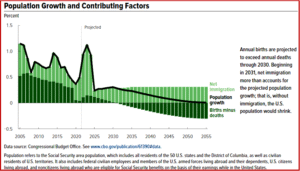
“CBO now projects that the U.S. population will increase from 350 million people in 2025 to 367 million people in 2055. It will be smaller and grow more slowly over the next 30 years, on average, than the agency previously projected it would. Those changes stem from lower projected net immigration through 2033 and lower fertility rates over the 2025–2055 period than the agency projected in January. In CBO’s current projections, the population in 2035 is 4.5 million people smaller (or 1.2%) than it was projected to be in the agency’s January projections. That difference grows to 5.4 million people (or 1.5%) in 2055. The population contains fewer people ages 25 to 54—the age group that is most likely to participate in the labor force—than the agency previously projected. Deaths are projected to exceed births in 2031, two years earlier than previously projected.
CBO’s population projections are highly uncertain, especially in the later years of the 2025–2055 period. If rates of fertility, mortality, or net immigration are higher or lower than CBO projects, the resulting population will differ in size and composition from the one described here. For example, immigration could differ significantly from CBO’s projections because of future legislative or administrative changes, which are not incorporated into the current projections. The effects of such differences would be larger in later years because the differences would compound over time,” CBO said in a report of 10 September 2025.
**AutoInformed on

About Ken Zino
Ken Zino, editor and publisher of AutoInformed, is a versatile auto industry participant with global experience spanning decades in print and broadcast journalism, as well as social media. He has automobile testing, marketing, public relations and communications experience. He is past president of The International Motor Press Assn, the Detroit Press Club, founding member and first President of the Automotive Press Assn. He is a member of APA, IMPA and the Midwest Automotive Press Assn.
He also brings an historical perspective while citing their contemporary relevance of the work of legendary auto writers such as Ken Purdy, Jim Dunne or Jerry Flint, or writers such as Red Smith, Mark Twain, Thomas Jefferson – all to bring perspective to a chaotic automotive universe.
Above all, decades after he first drove a car, Zino still revels in the sound of the exhaust as the throttle is blipped during a downshift and the driver’s rush that occurs when the entry, apex and exit points of a turn are smoothly and swiftly crossed. It’s the beginning of a perfect lap.
AutoInformed has an editorial philosophy that loves transportation machines of all kinds while promoting critical thinking about the future use of cars and trucks.
Zino builds AutoInformed from his background in automotive journalism starting at Hearst Publishing in New York City on Motor and MotorTech Magazines and car testing where he reviewed hundreds of vehicles in his decade-long stint as the Detroit Bureau Chief of Road & Track magazine. Zino has also worked in Europe, and Asia – now the largest automotive market in the world with China at its center.








Constitution Day 2025 Thoughts
Congress designated September 17 as Constitution Day and Citizenship Day 0n 29 February 1952. This day commemorates the signing of the U.S. Constitution on 17 September 1787 and recognizes all American citizens as in the famous introductory phrase “We the People.” Central to the awakened document was the gathering of information so that facts would be available for governance. Article I, Section 2, of the U.S. Constitution stipulates that a count of the U.S. population be done every ten years. Where are the people? What are they doing and what is the economy? How many seats does each State gain in the U.S. House of Representatives?
Click to enlarge.
The U.S. population in 1790 was 3,929,214. The Congressional Budget Office (CBO)* projects that the U.S. population will increase from 350 million people in 2025 to 367 million people in 2055. It will be smaller and grow more slowly over the next 30 years, on average, than the agency previously projected it would. Sadly in the “Alice in Wonderland world of the Trump Administration” words mean what the administration wants them to mean, not what they really mean. Look at recent firings, conspicuously Erika McEntarfer, the director of the Bureau of Labor Statistics because the Bureau published weak employment numbers that inarguably contradicted Trump’s ongoing claims of prosperity and showed the follies of his ongoing trade war.**
The point here is that to govern without facts is madness. Leaving aside the historical revisions that show that King George III, the monarch who lost the colonies to what became the United States, was, well Alice, mad as a hatter in his later years. Donald J. Trump – the man who wishes to be our King now – should not be our president based on his deteriorating mental condition. He doesn’t even know what is going on in his own administration.Is Trump going to fire the entire CBO? [See the following] It’s time for “We the People” to fire Trump and his Curia Regis, the advisors – cabinet members, agency heads and the like – who are against the facts or falsify them.
*“The Congressional Budget Office periodically updates its demographic outlook to reflect recent developments and changes in laws and policies. The agency last published its demographic projections in January 2025. Since then, CBO has incorporated new data and reduced its estimates of net immigration over the 2025–2033 period and fertility over the 2025–2055 period. Administrative actions taken since January 20, 2025, are the largest factor decreasing CBO’s projections of the number of immigrants in the country. The 2025 reconciliation act (Public Law 119-21) also decreases that number.
Click to enlarge.
“CBO now projects that the U.S. population will increase from 350 million people in 2025 to 367 million people in 2055. It will be smaller and grow more slowly over the next 30 years, on average, than the agency previously projected it would. Those changes stem from lower projected net immigration through 2033 and lower fertility rates over the 2025–2055 period than the agency projected in January. In CBO’s current projections, the population in 2035 is 4.5 million people smaller (or 1.2%) than it was projected to be in the agency’s January projections. That difference grows to 5.4 million people (or 1.5%) in 2055. The population contains fewer people ages 25 to 54—the age group that is most likely to participate in the labor force—than the agency previously projected. Deaths are projected to exceed births in 2031, two years earlier than previously projected.
CBO’s population projections are highly uncertain, especially in the later years of the 2025–2055 period. If rates of fertility, mortality, or net immigration are higher or lower than CBO projects, the resulting population will differ in size and composition from the one described here. For example, immigration could differ significantly from CBO’s projections because of future legislative or administrative changes, which are not incorporated into the current projections. The effects of such differences would be larger in later years because the differences would compound over time,” CBO said in a report of 10 September 2025.
**AutoInformed on
About Ken Zino
Ken Zino, editor and publisher of AutoInformed, is a versatile auto industry participant with global experience spanning decades in print and broadcast journalism, as well as social media. He has automobile testing, marketing, public relations and communications experience. He is past president of The International Motor Press Assn, the Detroit Press Club, founding member and first President of the Automotive Press Assn. He is a member of APA, IMPA and the Midwest Automotive Press Assn. He also brings an historical perspective while citing their contemporary relevance of the work of legendary auto writers such as Ken Purdy, Jim Dunne or Jerry Flint, or writers such as Red Smith, Mark Twain, Thomas Jefferson – all to bring perspective to a chaotic automotive universe. Above all, decades after he first drove a car, Zino still revels in the sound of the exhaust as the throttle is blipped during a downshift and the driver’s rush that occurs when the entry, apex and exit points of a turn are smoothly and swiftly crossed. It’s the beginning of a perfect lap. AutoInformed has an editorial philosophy that loves transportation machines of all kinds while promoting critical thinking about the future use of cars and trucks. Zino builds AutoInformed from his background in automotive journalism starting at Hearst Publishing in New York City on Motor and MotorTech Magazines and car testing where he reviewed hundreds of vehicles in his decade-long stint as the Detroit Bureau Chief of Road & Track magazine. Zino has also worked in Europe, and Asia – now the largest automotive market in the world with China at its center.