Click to Enlarge.
If you’re like most auto enthusiasts, likely you are comfortable with the progress of technology from manual chokes to feed-back carburetors to port and then direct fuel-injection. When looked at through the windshield of a sports car, electronic shifting and brake by wire via computer controls are just part of the evolving automotive landscape. Driver assistance safety systems and autonomous vehicles are just the latest technical trends made possible by the relentless pace of Automobility funded by the huge transportation universe of designing, testing, manufacturing, marketing and globally selling ~90 million machines each year.
However, aggregated research from Pew* indicates that these technologies raise critical questions about work, the autonomy of human beings and the ethics of a universe dominated by the latter day avatars of Alan Turning’s machines, aka computers.
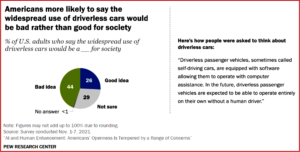
Pew puts it thus: “How will this impact people who drive for a living? Are Americans willing to give up control to a machine? And whose safety should be prioritized in a potential life-or-death situation?” Answers to these questions, among others, reveal that “ larger shares of U.S. adults think the widespread use of driverless passenger vehicles is a bad idea for society than think it is a good idea (44% vs. 26%).
“Additionally, 29% say they are not sure if this would be a good or bad idea for society. A majority of Americans are also wary about riding in an autonomous vehicle. Roughly six-in-ten adults (63%) say they would not want to ride in a driverless passenger vehicle if they had the opportunity, while a much smaller share (37%) say they would want to do this.”
Ugh. “Many Americans are not only reluctant to ride in driverless cars, but some are also concerned about sharing the road with one. In total, 45% of Americans say they would not feel comfortable sharing the road with driverless vehicles if use of them became widespread, including 18% who would not feel comfortable at all. Smaller shares indicate they would be extremely (7%) or very (14%) comfortable sharing the road with autonomous vehicles,” said Pew.
“Interest in riding in a driverless vehicle varies across demographic groups, with age being one of the most notable differences. Adults under the age of 50 are about twice as likely as those 50 and older to say they would ride in this type of car (47% vs. 25%),” said Pew.
AutoInformed on
* Pew Research Surveys worked on/authored by Lee Rainie, Cary Funk, Monica Anderson and Alec Tyson:

About Ken Zino
Ken Zino, editor and publisher of AutoInformed, is a versatile auto industry participant with global experience spanning decades in print and broadcast journalism, as well as social media. He has automobile testing, marketing, public relations and communications experience. He is past president of The International Motor Press Assn, the Detroit Press Club, founding member and first President of the Automotive Press Assn. He is a member of APA, IMPA and the Midwest Automotive Press Assn.
He also brings an historical perspective while citing their contemporary relevance of the work of legendary auto writers such as Ken Purdy, Jim Dunne or Jerry Flint, or writers such as Red Smith, Mark Twain, Thomas Jefferson – all to bring perspective to a chaotic automotive universe.
Above all, decades after he first drove a car, Zino still revels in the sound of the exhaust as the throttle is blipped during a downshift and the driver’s rush that occurs when the entry, apex and exit points of a turn are smoothly and swiftly crossed. It’s the beginning of a perfect lap.
AutoInformed has an editorial philosophy that loves transportation machines of all kinds while promoting critical thinking about the future use of cars and trucks.
Zino builds AutoInformed from his background in automotive journalism starting at Hearst Publishing in New York City on Motor and MotorTech Magazines and car testing where he reviewed hundreds of vehicles in his decade-long stint as the Detroit Bureau Chief of Road & Track magazine. Zino has also worked in Europe, and Asia – now the largest automotive market in the world with China at its center.







Driverless Cars – People Less Positive Than You Might Assume
Click to Enlarge.
If you’re like most auto enthusiasts, likely you are comfortable with the progress of technology from manual chokes to feed-back carburetors to port and then direct fuel-injection. When looked at through the windshield of a sports car, electronic shifting and brake by wire via computer controls are just part of the evolving automotive landscape. Driver assistance safety systems and autonomous vehicles are just the latest technical trends made possible by the relentless pace of Automobility funded by the huge transportation universe of designing, testing, manufacturing, marketing and globally selling ~90 million machines each year.
However, aggregated research from Pew* indicates that these technologies raise critical questions about work, the autonomy of human beings and the ethics of a universe dominated by the latter day avatars of Alan Turning’s machines, aka computers.
Pew puts it thus: “How will this impact people who drive for a living? Are Americans willing to give up control to a machine? And whose safety should be prioritized in a potential life-or-death situation?” Answers to these questions, among others, reveal that “ larger shares of U.S. adults think the widespread use of driverless passenger vehicles is a bad idea for society than think it is a good idea (44% vs. 26%).
“Additionally, 29% say they are not sure if this would be a good or bad idea for society. A majority of Americans are also wary about riding in an autonomous vehicle. Roughly six-in-ten adults (63%) say they would not want to ride in a driverless passenger vehicle if they had the opportunity, while a much smaller share (37%) say they would want to do this.”
Ugh. “Many Americans are not only reluctant to ride in driverless cars, but some are also concerned about sharing the road with one. In total, 45% of Americans say they would not feel comfortable sharing the road with driverless vehicles if use of them became widespread, including 18% who would not feel comfortable at all. Smaller shares indicate they would be extremely (7%) or very (14%) comfortable sharing the road with autonomous vehicles,” said Pew.
“Interest in riding in a driverless vehicle varies across demographic groups, with age being one of the most notable differences. Adults under the age of 50 are about twice as likely as those 50 and older to say they would ride in this type of car (47% vs. 25%),” said Pew.
AutoInformed on
* Pew Research Surveys worked on/authored by Lee Rainie, Cary Funk, Monica Anderson and Alec Tyson:
About Ken Zino
Ken Zino, editor and publisher of AutoInformed, is a versatile auto industry participant with global experience spanning decades in print and broadcast journalism, as well as social media. He has automobile testing, marketing, public relations and communications experience. He is past president of The International Motor Press Assn, the Detroit Press Club, founding member and first President of the Automotive Press Assn. He is a member of APA, IMPA and the Midwest Automotive Press Assn. He also brings an historical perspective while citing their contemporary relevance of the work of legendary auto writers such as Ken Purdy, Jim Dunne or Jerry Flint, or writers such as Red Smith, Mark Twain, Thomas Jefferson – all to bring perspective to a chaotic automotive universe. Above all, decades after he first drove a car, Zino still revels in the sound of the exhaust as the throttle is blipped during a downshift and the driver’s rush that occurs when the entry, apex and exit points of a turn are smoothly and swiftly crossed. It’s the beginning of a perfect lap. AutoInformed has an editorial philosophy that loves transportation machines of all kinds while promoting critical thinking about the future use of cars and trucks. Zino builds AutoInformed from his background in automotive journalism starting at Hearst Publishing in New York City on Motor and MotorTech Magazines and car testing where he reviewed hundreds of vehicles in his decade-long stint as the Detroit Bureau Chief of Road & Track magazine. Zino has also worked in Europe, and Asia – now the largest automotive market in the world with China at its center.