Click to enlarge.
The U.S. Environmental Protection Agency has made public its 50th annual Automotive Trends Report, showing that model year 2023 vehicle fuel economy reached a record high while greenhouse gas emissions dropped to record low levels.* The report notes that all 14 large automotive manufacturers are in compliance with EPA’s light-duty GHG program requirements through the MY 2023 reporting period. New MY 2023 electric vehicles and plug-in hybrid electric vehicles on the road have led to 11% lower CO2 emissions.**
“This report provides a critical data-driven affirmation that strong, technology-neutral standards can underpin environmental progress while saving drivers money at the pump,” said EPA Administrator Michael S. Regan. “Manufacturers continue to innovate and are bringing technologies to market which will directly improve air quality, better protecting people’s health and saving lives.”
Click to enlarge.
Since EPA began keeping data in 1975, vehicles now are roughly 99% cleaner for common pollutants (hydrocarbons, carbon monoxide, nitrogen oxides and particle emissions), which can help alleviate adverse health effects such as asthma and heart problems, and limit hospital days and cancer. In addition, fuel economy in the United States has improved from 13.1 miles per gallon in MY 1975 to 27.1 mpg for MY 2023 vehicles.
“Despite these significant improvements in local air pollution that have benefited Americans, passenger cars and light trucks still accounted for nearly 17% of total U.S. GHG emissions in 2022, indicating the importance of further reductions in GHG emissions and improvements in fuel economy,” EPA said.
2024 EPA Automotive Trends Report
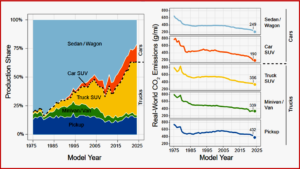
- For MY 2023, new vehicle fuel economy increased by 1.1 mpg reaching a record high 27.1 miles mpg.
- For MY 2023, new vehicle real-world CO2 emissions decreased to a record low of 319 grams per mile. By saving an additional 18 grams per mile of CO2 on each vehicle produced in the United States in MY 2023, the impact on climate change is reduced.
- Since MY 2004, CO2 emissions have decreased 31%, or 142 g/mi, and fuel economy has increased 40%, or 7.8 mpg.
- Since MY 2004, CO2 emissions have improved in 16 of 19 years.
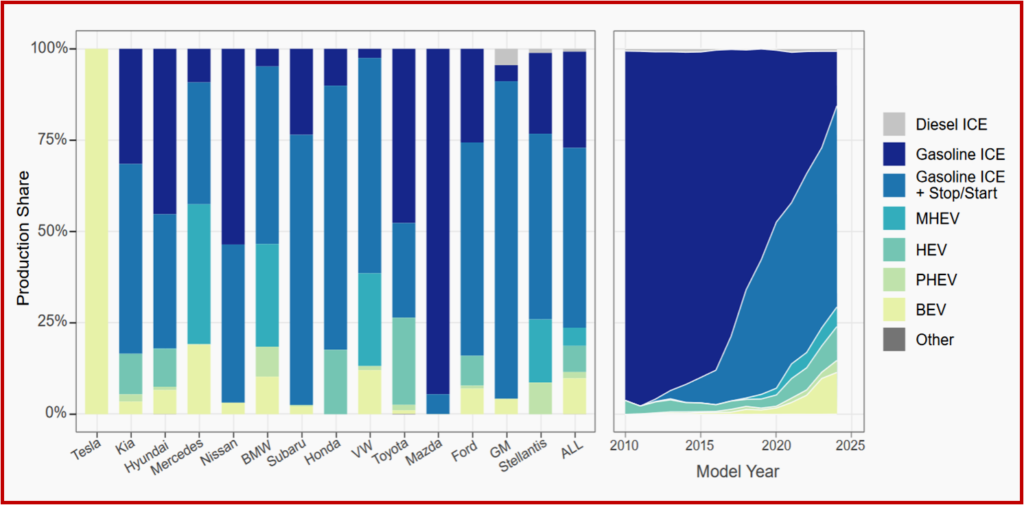
- EVs and PHEVs are accelerating the downward trend in new vehicle real-world emissions. These vehicles have reduced CO2 emissions by 38 g/mi and improved fuel economy by 2.2 mpg in MY 2023.
- In MY 2023, the combined category of battery-electric vehicles, PHEVs, and fuel cell vehicles increased from 6.7% of production in MY 2022 to 11.5% of production in MY 2023.
- They are forecast to reach 14.8% of production in model year 2024. This accelerating trend will likely continue as EV production is expected to grow across the industry in coming years.
“This annual report indicates EPA’s commitment to provide the public with information about new light-duty vehicle greenhouse gas emissions, fuel economy, technology data, and auto manufacturers’ performance in meeting the nation’s emissions standards.” EPA’s annual Automotive Trends Report is separate from the agency’s regulatory process, which is far more complex and has been subject to political and judicial interference funded by special interest groups. – AutoCrat.
* “This technical report does not necessarily represent final EPA decisions, positions, or validation of compliance data reported to EPA by manufacturers. It is intended to present technical analysis of issues using data that are currently available and that may be subject to change. Historic data have been adjusted, when appropriate, to reflect the result of compliance investigations by EPA or any other corrections necessary to maintain data integrity. The purpose of the release of such reports is to facilitate the exchange of technical information and to inform the public of technical developments. This edition of the report supersedes all previous versions,” EPA said.
** AutoInformed on

About Ken Zino
Ken Zino, editor and publisher of AutoInformed, is a versatile auto industry participant with global experience spanning decades in print and broadcast journalism, as well as social media. He has automobile testing, marketing, public relations and communications experience. He is past president of The International Motor Press Assn, the Detroit Press Club, founding member and first President of the Automotive Press Assn. He is a member of APA, IMPA and the Midwest Automotive Press Assn.
He also brings an historical perspective while citing their contemporary relevance of the work of legendary auto writers such as Ken Purdy, Jim Dunne or Jerry Flint, or writers such as Red Smith, Mark Twain, Thomas Jefferson – all to bring perspective to a chaotic automotive universe.
Above all, decades after he first drove a car, Zino still revels in the sound of the exhaust as the throttle is blipped during a downshift and the driver’s rush that occurs when the entry, apex and exit points of a turn are smoothly and swiftly crossed. It’s the beginning of a perfect lap.
AutoInformed has an editorial philosophy that loves transportation machines of all kinds while promoting critical thinking about the future use of cars and trucks.
Zino builds AutoInformed from his background in automotive journalism starting at Hearst Publishing in New York City on Motor and MotorTech Magazines and car testing where he reviewed hundreds of vehicles in his decade-long stint as the Detroit Bureau Chief of Road & Track magazine. Zino has also worked in Europe, and Asia – now the largest automotive market in the world with China at its center.








EPA – US Fuel Economy Record High. CO2 Record Low
Click to enlarge.
The U.S. Environmental Protection Agency has made public its 50th annual Automotive Trends Report, showing that model year 2023 vehicle fuel economy reached a record high while greenhouse gas emissions dropped to record low levels.* The report notes that all 14 large automotive manufacturers are in compliance with EPA’s light-duty GHG program requirements through the MY 2023 reporting period. New MY 2023 electric vehicles and plug-in hybrid electric vehicles on the road have led to 11% lower CO2 emissions.**
“This report provides a critical data-driven affirmation that strong, technology-neutral standards can underpin environmental progress while saving drivers money at the pump,” said EPA Administrator Michael S. Regan. “Manufacturers continue to innovate and are bringing technologies to market which will directly improve air quality, better protecting people’s health and saving lives.”
Click to enlarge.
Since EPA began keeping data in 1975, vehicles now are roughly 99% cleaner for common pollutants (hydrocarbons, carbon monoxide, nitrogen oxides and particle emissions), which can help alleviate adverse health effects such as asthma and heart problems, and limit hospital days and cancer. In addition, fuel economy in the United States has improved from 13.1 miles per gallon in MY 1975 to 27.1 mpg for MY 2023 vehicles.
“Despite these significant improvements in local air pollution that have benefited Americans, passenger cars and light trucks still accounted for nearly 17% of total U.S. GHG emissions in 2022, indicating the importance of further reductions in GHG emissions and improvements in fuel economy,” EPA said.
2024 EPA Automotive Trends Report
“This annual report indicates EPA’s commitment to provide the public with information about new light-duty vehicle greenhouse gas emissions, fuel economy, technology data, and auto manufacturers’ performance in meeting the nation’s emissions standards.” EPA’s annual Automotive Trends Report is separate from the agency’s regulatory process, which is far more complex and has been subject to political and judicial interference funded by special interest groups. – AutoCrat.
* “This technical report does not necessarily represent final EPA decisions, positions, or validation of compliance data reported to EPA by manufacturers. It is intended to present technical analysis of issues using data that are currently available and that may be subject to change. Historic data have been adjusted, when appropriate, to reflect the result of compliance investigations by EPA or any other corrections necessary to maintain data integrity. The purpose of the release of such reports is to facilitate the exchange of technical information and to inform the public of technical developments. This edition of the report supersedes all previous versions,” EPA said.
** AutoInformed on
About Ken Zino
Ken Zino, editor and publisher of AutoInformed, is a versatile auto industry participant with global experience spanning decades in print and broadcast journalism, as well as social media. He has automobile testing, marketing, public relations and communications experience. He is past president of The International Motor Press Assn, the Detroit Press Club, founding member and first President of the Automotive Press Assn. He is a member of APA, IMPA and the Midwest Automotive Press Assn. He also brings an historical perspective while citing their contemporary relevance of the work of legendary auto writers such as Ken Purdy, Jim Dunne or Jerry Flint, or writers such as Red Smith, Mark Twain, Thomas Jefferson – all to bring perspective to a chaotic automotive universe. Above all, decades after he first drove a car, Zino still revels in the sound of the exhaust as the throttle is blipped during a downshift and the driver’s rush that occurs when the entry, apex and exit points of a turn are smoothly and swiftly crossed. It’s the beginning of a perfect lap. AutoInformed has an editorial philosophy that loves transportation machines of all kinds while promoting critical thinking about the future use of cars and trucks. Zino builds AutoInformed from his background in automotive journalism starting at Hearst Publishing in New York City on Motor and MotorTech Magazines and car testing where he reviewed hundreds of vehicles in his decade-long stint as the Detroit Bureau Chief of Road & Track magazine. Zino has also worked in Europe, and Asia – now the largest automotive market in the world with China at its center.