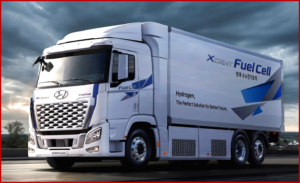
Hyundai shipped only 46 XCIENTs to Switzerland in 2020. Click to Enlarge.
Hyundai Motor Company has released images of its newly “upgraded” XCIENT Fuel Cell truck.
In a running battle with Toyota, Hyundai claims this will be the world’s first mass-produced, heavy-duty truck powered by hydrogen. Hyundai will begin production of 2021 XCIENT Fuel Cell in August this year. It’s a slow moving vehicle – road block? – at 85 km/h. *(Toyota Gen 2 Prototype Fuel-Cell Trucks to Start Drayage Runs at the Ports of L.A. and Long Beach. Carbon Free Hauling)
“Hyundai Motor is leveraging more than 20 years of experience in fuel cell technology to further its vision of an eco-friendly hydrogen society,” said Jaehoon (Jay) Chang, CEO and President of Commercial Vehicle Division at Hyundai Motor Company. “With 2021 XCIENT Fuel Cell, Hyundai will contribute to the widespread adoption of commercial vehicles powered by hydrogen.”
Click to Enlarge.
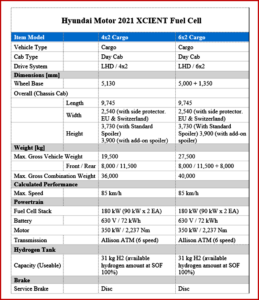
The 2021 XCIENT Fuel Cell is equipped with a 180-kW hydrogen fuel cell system with two 90-kW fuel cell stacks, newly modified for this heavy-duty truck model. The fuel cell system’s durability as well as the vehicle’s overall fuel efficiency “has been improved to the demands of commercial fleet customers.” The 350-kW e-motor has maximum torque of 2,237 Nm.
Seven large hydrogen tanks offer a combined storage capacity of around 31 kg of fuel. Three 72-kWh high voltage batteries provide an additional source of power. The maximum driving range of 2021 XCIENT Fuel Cell is not known but predicted to be around 400 km. Refueling a full tank of hydrogen takes about 8 to 20 minutes, depending on the ambient temperature at 350 bar.
The 2021 XCIENT Fuel Cell is now available in a 6×2 rigid body configuration as well as the 4×2 option introduced in the previous model. With the launch of the enhanced model, Hyundai plans to accelerate the global advancement of its heavy-duty fuel cell truck.
Hyundai shipped only 46 units of XCIENT Fuel Cell to Switzerland last year. As of May 2021, the cumulative driving range of those trucks in operation reached 750,000 kilometers. Over that distance, the hydrogen-powered trucks have reduced carbon emissions by an estimated 585 tons based on an estimate that of 0.78 kilograms of CO2, compared to diesel-powered vehicles.
Hyundai will ship another 140 units of the new XCIENT Fuel Cell towards Switzerland by the end of this year as part of its plan to roll out 1,600 heavy-duty fuel cell electric trucks in Europe by 2025. Hyundai Hydrogen Mobility, a joint venture between Hyundai Motor and H2 Energy, is working on the introduction of XCIENT Fuel Cell in other European markets.
Hyundai also plans to present XCIENT Fuel Cell to the North American market this year. Hyundai is in talks with several local governments and logistics businesses in the U.S. to establish potential joint operations of hydrogen-powered trucks for various purposes. The company is also planning to host XCIENT Fuel Cell roadshows and other events open to the general public. China is looking at heavy-duty trucks powered by hydrogen. Hyundai is “carefully reviewing multiple options to introduce its fuel cell technology to corporate and government customers in China.”
* AutoInformed on

About Ken Zino
Ken Zino, editor and publisher of AutoInformed, is a versatile auto industry participant with global experience spanning decades in print and broadcast journalism, as well as social media. He has automobile testing, marketing, public relations and communications experience. He is past president of The International Motor Press Assn, the Detroit Press Club, founding member and first President of the Automotive Press Assn. He is a member of APA, IMPA and the Midwest Automotive Press Assn.
He also brings an historical perspective while citing their contemporary relevance of the work of legendary auto writers such as Ken Purdy, Jim Dunne or Jerry Flint, or writers such as Red Smith, Mark Twain, Thomas Jefferson – all to bring perspective to a chaotic automotive universe.
Above all, decades after he first drove a car, Zino still revels in the sound of the exhaust as the throttle is blipped during a downshift and the driver’s rush that occurs when the entry, apex and exit points of a turn are smoothly and swiftly crossed. It’s the beginning of a perfect lap.
AutoInformed has an editorial philosophy that loves transportation machines of all kinds while promoting critical thinking about the future use of cars and trucks.
Zino builds AutoInformed from his background in automotive journalism starting at Hearst Publishing in New York City on Motor and MotorTech Magazines and car testing where he reviewed hundreds of vehicles in his decade-long stint as the Detroit Bureau Chief of Road & Track magazine. Zino has also worked in Europe, and Asia – now the largest automotive market in the world with China at its center.








Hyundai Motor Teases “Enhanced” XCIENT Fuel Cell Truck
Hyundai shipped only 46 XCIENTs to Switzerland in 2020. Click to Enlarge.
Hyundai Motor Company has released images of its newly “upgraded” XCIENT Fuel Cell truck.
In a running battle with Toyota, Hyundai claims this will be the world’s first mass-produced, heavy-duty truck powered by hydrogen. Hyundai will begin production of 2021 XCIENT Fuel Cell in August this year. It’s a slow moving vehicle – road block? – at 85 km/h. *(Toyota Gen 2 Prototype Fuel-Cell Trucks to Start Drayage Runs at the Ports of L.A. and Long Beach. Carbon Free Hauling)
“Hyundai Motor is leveraging more than 20 years of experience in fuel cell technology to further its vision of an eco-friendly hydrogen society,” said Jaehoon (Jay) Chang, CEO and President of Commercial Vehicle Division at Hyundai Motor Company. “With 2021 XCIENT Fuel Cell, Hyundai will contribute to the widespread adoption of commercial vehicles powered by hydrogen.”
Click to Enlarge.
The 2021 XCIENT Fuel Cell is equipped with a 180-kW hydrogen fuel cell system with two 90-kW fuel cell stacks, newly modified for this heavy-duty truck model. The fuel cell system’s durability as well as the vehicle’s overall fuel efficiency “has been improved to the demands of commercial fleet customers.” The 350-kW e-motor has maximum torque of 2,237 Nm.
Seven large hydrogen tanks offer a combined storage capacity of around 31 kg of fuel. Three 72-kWh high voltage batteries provide an additional source of power. The maximum driving range of 2021 XCIENT Fuel Cell is not known but predicted to be around 400 km. Refueling a full tank of hydrogen takes about 8 to 20 minutes, depending on the ambient temperature at 350 bar.
The 2021 XCIENT Fuel Cell is now available in a 6×2 rigid body configuration as well as the 4×2 option introduced in the previous model. With the launch of the enhanced model, Hyundai plans to accelerate the global advancement of its heavy-duty fuel cell truck.
Hyundai shipped only 46 units of XCIENT Fuel Cell to Switzerland last year. As of May 2021, the cumulative driving range of those trucks in operation reached 750,000 kilometers. Over that distance, the hydrogen-powered trucks have reduced carbon emissions by an estimated 585 tons based on an estimate that of 0.78 kilograms of CO2, compared to diesel-powered vehicles.
Hyundai will ship another 140 units of the new XCIENT Fuel Cell towards Switzerland by the end of this year as part of its plan to roll out 1,600 heavy-duty fuel cell electric trucks in Europe by 2025. Hyundai Hydrogen Mobility, a joint venture between Hyundai Motor and H2 Energy, is working on the introduction of XCIENT Fuel Cell in other European markets.
Hyundai also plans to present XCIENT Fuel Cell to the North American market this year. Hyundai is in talks with several local governments and logistics businesses in the U.S. to establish potential joint operations of hydrogen-powered trucks for various purposes. The company is also planning to host XCIENT Fuel Cell roadshows and other events open to the general public. China is looking at heavy-duty trucks powered by hydrogen. Hyundai is “carefully reviewing multiple options to introduce its fuel cell technology to corporate and government customers in China.”
* AutoInformed on
About Ken Zino
Ken Zino, editor and publisher of AutoInformed, is a versatile auto industry participant with global experience spanning decades in print and broadcast journalism, as well as social media. He has automobile testing, marketing, public relations and communications experience. He is past president of The International Motor Press Assn, the Detroit Press Club, founding member and first President of the Automotive Press Assn. He is a member of APA, IMPA and the Midwest Automotive Press Assn. He also brings an historical perspective while citing their contemporary relevance of the work of legendary auto writers such as Ken Purdy, Jim Dunne or Jerry Flint, or writers such as Red Smith, Mark Twain, Thomas Jefferson – all to bring perspective to a chaotic automotive universe. Above all, decades after he first drove a car, Zino still revels in the sound of the exhaust as the throttle is blipped during a downshift and the driver’s rush that occurs when the entry, apex and exit points of a turn are smoothly and swiftly crossed. It’s the beginning of a perfect lap. AutoInformed has an editorial philosophy that loves transportation machines of all kinds while promoting critical thinking about the future use of cars and trucks. Zino builds AutoInformed from his background in automotive journalism starting at Hearst Publishing in New York City on Motor and MotorTech Magazines and car testing where he reviewed hundreds of vehicles in his decade-long stint as the Detroit Bureau Chief of Road & Track magazine. Zino has also worked in Europe, and Asia – now the largest automotive market in the world with China at its center.