Click for more.
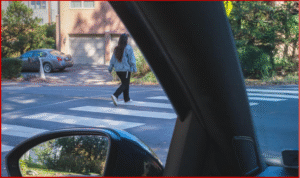
Vehicles with large driver-side blind zones [think large pick-ups and SUVs – AutoCrat] are much more likely to strike crossing pedestrians while turning left than those with small blind zones. A new study released today from the Insurance Institute for Highway Safety shows the risks. A large driver-side blind zone raises the risk of a left-turn pedestrian crash 70% compared with a small blind zone, the study found. Thick and slanted A-pillars, bulky side mirrors, and tall, long hoods all obstruct driver views. The field of view offered by the windshield, which alters the location of the blind zones, also affects the driver’s ability to see.*
“These results clearly identify problematic aspects of vehicle design,” IIHS President David Harkey said. “The challenge for automakers will be to find ways to address them that don’t diminish the protection vehicles provide to their occupants in a crash.”
An Awful Deadly Trend
“Pedestrian deaths have soared 78% since hitting their low point in 2009 and now account for more than 7,300 crash fatalities a year. Higher vehicle speeds and vehicle-centric infrastructure designs are among the likely culprits in the increase. The trend toward vehicles with taller, blunter front ends — especially SUVs and pickups — is another suspected factor. These vehicles are more likely to injure and kill pedestrians when crashes occur. In addition, they are at a higher risk of hitting pedestrians while turning,” IIHS said.
In the current study, IIHS researchers revisited turning crash risk, examining the influence of blind zones and other design elements that affect the driver’s ability to see.
Click to enlarge.
Using a camera-based technique developed by Institute engineers, the researchers measured the blind zones of 168 vehicles from the vantage points of an average-size man and a small woman. The two heights correspond to the size of dummies commonly used in crash tests and represent a wide range of the driving population.
Because designs don’t change every year, the measurements applied to many make, model and model year combinations, allowing the researchers to analyze a large volume of pedestrian crashes involving these vehicles:
- For a 5-foot-9-inch driver, cars had the largest driver-side blind zones on average, while pickups had the smallest. However, the windshields of pickups and SUVs generally provided a tighter field of view. The nearest visible point on the ground in front of these vehicles was also farther away.
- For a 4-foot-11-inch driver, SUVs and pickups had the largest average driver-side blind zones. SUVs and pickups also provided the narrowest field of view and had the greatest distance to the nearest visible point.
- Across all vehicle types, the average driver-side blind zone blocked 27% of the area to the left and front of the vehicle for a 5-foot-9 driver. For a 4-foot-11 driver, the average blind zone blocked 33%.
- The average windshield afforded an 88-degree field of view for drivers of either height. The nearest visible point on the ground was 26 feet ahead for the taller driver and 30 feet away for the shorter one.
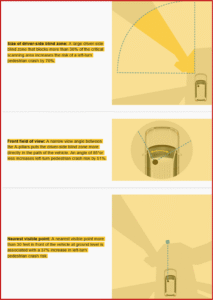
Using the measurements for the 5-foot-9 driver (representative of a broader population than the 4-foot-11 driver) the researchers defined blind zones that blocked more than 30% of the driver-side view as large. They categorized those that blocked 20%-30% as medium. Under 20% was small.
Blind Zones and Turning Crashes
An analysis of ~4500 police-reported pedestrian crashes in seven states showed that large driver-side blind zones were associated with a 70% increase in the risk of left-turn crashes with pedestrians, compared with small ones. Medium driver-side blind zones were associated with a 59% increase in left-turn crash risk.
“To reach this estimate, the researchers counted how many times a vehicle in each of the three blind zone categories (small, medium and large) hit a pedestrian while turning left and how many times a vehicle in the same group hit a pedestrian while going straight. They then compared the ratios of left-turn to straight-moving crashes for each group.
“Straight-moving crashes were included to help account for how often vehicles encounter and hit pedestrians, independent of driver-side blind zones. A similar analysis of 3500 crashes showed that passenger-side blind zones had no significant impact on the risk of right-turn crashes,” IIHS said.
Location of Driver-Side Blind Zones Also Important
- A front field of view of 85 degrees or less was associated with a 51% increase in left-turn crash risk versus a front field of view wider than 90 degrees. A narrower field of view moves the A-pillars and side mirrors forward relative to the driver’s line of sight, so they block more of the area in the vehicle’s path.
- A nearest ground-level visible point more than 30 feet from the driver was associated with a 37% increase in left-turn crash risk. When the nearest visible point is farther away, more of the blind zone is directly ahead of the driver.
“When a driver’s view is partially blocked, it’s easy for a person in the crosswalk to disappear from sight,” said Wen Hu, senior research transportation engineer at IIHS and lead author of the study. “That’s exactly the kind of situation that leads to turning crashes.”
*AutoInformed on

About Ken Zino
Ken Zino, editor and publisher of AutoInformed, is a versatile auto industry participant with global experience spanning decades in print and broadcast journalism, as well as social media. He has automobile testing, marketing, public relations and communications experience. He is past president of The International Motor Press Assn, the Detroit Press Club, founding member and first President of the Automotive Press Assn. He is a member of APA, IMPA and the Midwest Automotive Press Assn.
He also brings an historical perspective while citing their contemporary relevance of the work of legendary auto writers such as Ken Purdy, Jim Dunne or Jerry Flint, or writers such as Red Smith, Mark Twain, Thomas Jefferson – all to bring perspective to a chaotic automotive universe.
Above all, decades after he first drove a car, Zino still revels in the sound of the exhaust as the throttle is blipped during a downshift and the driver’s rush that occurs when the entry, apex and exit points of a turn are smoothly and swiftly crossed. It’s the beginning of a perfect lap.
AutoInformed has an editorial philosophy that loves transportation machines of all kinds while promoting critical thinking about the future use of cars and trucks.
Zino builds AutoInformed from his background in automotive journalism starting at Hearst Publishing in New York City on Motor and MotorTech Magazines and car testing where he reviewed hundreds of vehicles in his decade-long stint as the Detroit Bureau Chief of Road & Track magazine. Zino has also worked in Europe, and Asia – now the largest automotive market in the world with China at its center.







IIHS – Driver-Side Blind Zone Risk for Pedestrians
Click for more.
Vehicles with large driver-side blind zones [think large pick-ups and SUVs – AutoCrat] are much more likely to strike crossing pedestrians while turning left than those with small blind zones. A new study released today from the Insurance Institute for Highway Safety shows the risks. A large driver-side blind zone raises the risk of a left-turn pedestrian crash 70% compared with a small blind zone, the study found. Thick and slanted A-pillars, bulky side mirrors, and tall, long hoods all obstruct driver views. The field of view offered by the windshield, which alters the location of the blind zones, also affects the driver’s ability to see.*
“These results clearly identify problematic aspects of vehicle design,” IIHS President David Harkey said. “The challenge for automakers will be to find ways to address them that don’t diminish the protection vehicles provide to their occupants in a crash.”
An Awful Deadly Trend
“Pedestrian deaths have soared 78% since hitting their low point in 2009 and now account for more than 7,300 crash fatalities a year. Higher vehicle speeds and vehicle-centric infrastructure designs are among the likely culprits in the increase. The trend toward vehicles with taller, blunter front ends — especially SUVs and pickups — is another suspected factor. These vehicles are more likely to injure and kill pedestrians when crashes occur. In addition, they are at a higher risk of hitting pedestrians while turning,” IIHS said.
In the current study, IIHS researchers revisited turning crash risk, examining the influence of blind zones and other design elements that affect the driver’s ability to see.
Click to enlarge.
Using a camera-based technique developed by Institute engineers, the researchers measured the blind zones of 168 vehicles from the vantage points of an average-size man and a small woman. The two heights correspond to the size of dummies commonly used in crash tests and represent a wide range of the driving population.
Because designs don’t change every year, the measurements applied to many make, model and model year combinations, allowing the researchers to analyze a large volume of pedestrian crashes involving these vehicles:
Using the measurements for the 5-foot-9 driver (representative of a broader population than the 4-foot-11 driver) the researchers defined blind zones that blocked more than 30% of the driver-side view as large. They categorized those that blocked 20%-30% as medium. Under 20% was small.
Blind Zones and Turning Crashes
An analysis of ~4500 police-reported pedestrian crashes in seven states showed that large driver-side blind zones were associated with a 70% increase in the risk of left-turn crashes with pedestrians, compared with small ones. Medium driver-side blind zones were associated with a 59% increase in left-turn crash risk.
“To reach this estimate, the researchers counted how many times a vehicle in each of the three blind zone categories (small, medium and large) hit a pedestrian while turning left and how many times a vehicle in the same group hit a pedestrian while going straight. They then compared the ratios of left-turn to straight-moving crashes for each group.
“Straight-moving crashes were included to help account for how often vehicles encounter and hit pedestrians, independent of driver-side blind zones. A similar analysis of 3500 crashes showed that passenger-side blind zones had no significant impact on the risk of right-turn crashes,” IIHS said.
Location of Driver-Side Blind Zones Also Important
“When a driver’s view is partially blocked, it’s easy for a person in the crosswalk to disappear from sight,” said Wen Hu, senior research transportation engineer at IIHS and lead author of the study. “That’s exactly the kind of situation that leads to turning crashes.”
*AutoInformed on
About Ken Zino
Ken Zino, editor and publisher of AutoInformed, is a versatile auto industry participant with global experience spanning decades in print and broadcast journalism, as well as social media. He has automobile testing, marketing, public relations and communications experience. He is past president of The International Motor Press Assn, the Detroit Press Club, founding member and first President of the Automotive Press Assn. He is a member of APA, IMPA and the Midwest Automotive Press Assn. He also brings an historical perspective while citing their contemporary relevance of the work of legendary auto writers such as Ken Purdy, Jim Dunne or Jerry Flint, or writers such as Red Smith, Mark Twain, Thomas Jefferson – all to bring perspective to a chaotic automotive universe. Above all, decades after he first drove a car, Zino still revels in the sound of the exhaust as the throttle is blipped during a downshift and the driver’s rush that occurs when the entry, apex and exit points of a turn are smoothly and swiftly crossed. It’s the beginning of a perfect lap. AutoInformed has an editorial philosophy that loves transportation machines of all kinds while promoting critical thinking about the future use of cars and trucks. Zino builds AutoInformed from his background in automotive journalism starting at Hearst Publishing in New York City on Motor and MotorTech Magazines and car testing where he reviewed hundreds of vehicles in his decade-long stint as the Detroit Bureau Chief of Road & Track magazine. Zino has also worked in Europe, and Asia – now the largest automotive market in the world with China at its center.