Click for more inflation.
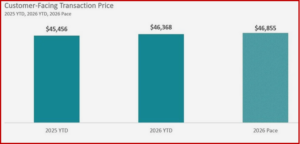
The latest report from the JD Power Consultancy shows that automakers have managed to retain retail sales in the face of the Trump mis-administration foreign policy, trade, tariff and shooting wars. The JD Power Automotive OEM Intelligence Report* reviews supply chain management and segment mix, careful use of incentives and a focus on moving the right vehicles off dealer lots were among the key success factors. [The collateral damage is the consumer as the 2025 average consumer transaction price (CFTP – Customer-Facing Transaction Price – is Power’s term) was ~$45,500, and it has increased to $46,400 year-to-date in 2026, Worse, Power forecasts it will be $46,600 to $46,900 by year’s end – AutoCrat.]**
“While it isn’t time to don party hats and start tossing confetti, there is no doubt that the auto industry has been able to negotiate the slings and arrows of 2026 much more nimbly than might have been anticipated. A potentially toxic combination of historic supply chain challenges, spiraling fuel costs, record high new-vehicle prices and economic uncertainty could have caused retail sales to plummet. Instead, year-over-year retail sales volumes are in line with forecasts. In fact, fourth quarter retail sales are expected to be stronger than last year, bringing the full year result to nearly flat in 2026,” said Power this morning.
Key Power Observations
Year-Over-Year Sales Return to Forecast: “U.S. retail vehicle sales returned to the expected year-over-year trajectory this past month. The gap between the JD Power 2026 forecast, published in February, and actual performance was just 11,000 units, a scant 0.12%. Through the first eight months of this year, actual daily selling rate changes have closely tracked the forecast. Retail sales totaled 8.8 million units through August, down from 9.2 million during the same period in 2025.”
Smarter Segment Mix: “This year, OEMs have largely managed to maintain strong sales volumes by altering their segment mixes to achieve better profitability and mitigate tariff-related supply-chain issues. Notably, OEMs produced fewer compact SUVs while ratcheting up production of more profitable, domestically manufactured segments that have been less affected by tariffs. Large SUVs, large light-duty pickups, midsize SUVs and midsize cars all have recorded delivery gains.”
Tight Inventories in Select Segments: “The change in product mix has tightened available inventory in several smaller, fuel-efficient segments. While demand in those segments has remained strong, supply has not kept pace. For instance, compact-car supply fell from 52 days in January to just 36 days in August, while compact SUV supply dropped from 54 to 44 days in the same period. Hybrid vehicles have shown a similar pattern across all segments and models. Higher fuel prices have boosted demand for smaller, more fuel-efficient vehicles while, at the same time, OEMs have reduced deliveries in those segments.”
Supply Constraints Grow for In-Demand Vehicles: “The significant change in vehicle mix versus previous years has created a bifurcated market. The retail share of individual models with fewer than 30 days of supply has jumped up markedly this year, hitting the 21-percent mark. For context, that number was 17% just last year, and in 2019 it was just 2%. On the other extreme, models with more than 120 days of supply account for 5% of sales in 2026, up from 3% in 2025. The result is a more polarized inventory picture, with an increasing share of highly constrained vehicles, particularly fuel-efficient models, alongside a modest increase in slow-moving models that are available in abundance.
Incentives Kept Low: “What appears to be more strategic management of production and inventory has resulted in strong pricing and relatively low incentive spending. Average incentive spending per unit has increased from about $,000 year-to-date in 2025 to $3300 year-to-date in 2026. Forecasts suggest incentives will come in at roughly $3500 for the full year, and the current pace is closer to $3400.
Despite the modest increase in incentive spending, customer-facing transaction prices have continued to climb. The 2025 average CFTP was about $45,500, and it has increased to $46,400 year-to-date in 2026. By year’s end it is likely to sit between $46,600 and $46,900. Overall, constrained supply in several high-demand segments is diminishing the need for vastly higher incentives while keeping overall pricing relatively firm even in the face of lower total unit sales.
*The Automotive OEM Intelligence Report herein is based on insights gathered from JD Power intelligence and proprietary market data. It was authored by Tyson Jominy, senior vice president of OEM customer success, and Srini Rajagopalan, vice president of OEM customer success at JD Power.
**AutoInformed on

About Ken Zino
Ken Zino, editor and publisher of AutoInformed, is a versatile auto industry participant with global experience spanning decades in print and broadcast journalism, as well as social media. He has automobile testing, marketing, public relations and communications experience. He is past president of The International Motor Press Assn, the Detroit Press Club, founding member and first President of the Automotive Press Assn. He is a member of APA, IMPA and the Midwest Automotive Press Assn.
He also brings an historical perspective while citing their contemporary relevance of the work of legendary auto writers such as Ken Purdy, Jim Dunne or Jerry Flint, or writers such as Red Smith, Mark Twain, Thomas Jefferson – all to bring perspective to a chaotic automotive universe.
Above all, decades after he first drove a car, Zino still revels in the sound of the exhaust as the throttle is blipped during a downshift and the driver’s rush that occurs when the entry, apex and exit points of a turn are smoothly and swiftly crossed. It’s the beginning of a perfect lap.
AutoInformed has an editorial philosophy that loves transportation machines of all kinds while promoting critical thinking about the future use of cars and trucks.
Zino builds AutoInformed from his background in automotive journalism starting at Hearst Publishing in New York City on Motor and MotorTech Magazines and car testing where he reviewed hundreds of vehicles in his decade-long stint as the Detroit Bureau Chief of Road & Track magazine. Zino has also worked in Europe, and Asia – now the largest automotive market in the world with China at its center.







New Vehicle Transaction Prices Continue to Soar in U.S.
Click for more inflation.
The latest report from the JD Power Consultancy shows that automakers have managed to retain retail sales in the face of the Trump mis-administration foreign policy, trade, tariff and shooting wars. The JD Power Automotive OEM Intelligence Report* reviews supply chain management and segment mix, careful use of incentives and a focus on moving the right vehicles off dealer lots were among the key success factors. [The collateral damage is the consumer as the 2025 average consumer transaction price (CFTP – Customer-Facing Transaction Price – is Power’s term) was ~$45,500, and it has increased to $46,400 year-to-date in 2026, Worse, Power forecasts it will be $46,600 to $46,900 by year’s end – AutoCrat.]**
“While it isn’t time to don party hats and start tossing confetti, there is no doubt that the auto industry has been able to negotiate the slings and arrows of 2026 much more nimbly than might have been anticipated. A potentially toxic combination of historic supply chain challenges, spiraling fuel costs, record high new-vehicle prices and economic uncertainty could have caused retail sales to plummet. Instead, year-over-year retail sales volumes are in line with forecasts. In fact, fourth quarter retail sales are expected to be stronger than last year, bringing the full year result to nearly flat in 2026,” said Power this morning.
Key Power Observations
Year-Over-Year Sales Return to Forecast: “U.S. retail vehicle sales returned to the expected year-over-year trajectory this past month. The gap between the JD Power 2026 forecast, published in February, and actual performance was just 11,000 units, a scant 0.12%. Through the first eight months of this year, actual daily selling rate changes have closely tracked the forecast. Retail sales totaled 8.8 million units through August, down from 9.2 million during the same period in 2025.”
Smarter Segment Mix: “This year, OEMs have largely managed to maintain strong sales volumes by altering their segment mixes to achieve better profitability and mitigate tariff-related supply-chain issues. Notably, OEMs produced fewer compact SUVs while ratcheting up production of more profitable, domestically manufactured segments that have been less affected by tariffs. Large SUVs, large light-duty pickups, midsize SUVs and midsize cars all have recorded delivery gains.”
Tight Inventories in Select Segments: “The change in product mix has tightened available inventory in several smaller, fuel-efficient segments. While demand in those segments has remained strong, supply has not kept pace. For instance, compact-car supply fell from 52 days in January to just 36 days in August, while compact SUV supply dropped from 54 to 44 days in the same period. Hybrid vehicles have shown a similar pattern across all segments and models. Higher fuel prices have boosted demand for smaller, more fuel-efficient vehicles while, at the same time, OEMs have reduced deliveries in those segments.”
Supply Constraints Grow for In-Demand Vehicles: “The significant change in vehicle mix versus previous years has created a bifurcated market. The retail share of individual models with fewer than 30 days of supply has jumped up markedly this year, hitting the 21-percent mark. For context, that number was 17% just last year, and in 2019 it was just 2%. On the other extreme, models with more than 120 days of supply account for 5% of sales in 2026, up from 3% in 2025. The result is a more polarized inventory picture, with an increasing share of highly constrained vehicles, particularly fuel-efficient models, alongside a modest increase in slow-moving models that are available in abundance.
Incentives Kept Low: “What appears to be more strategic management of production and inventory has resulted in strong pricing and relatively low incentive spending. Average incentive spending per unit has increased from about $,000 year-to-date in 2025 to $3300 year-to-date in 2026. Forecasts suggest incentives will come in at roughly $3500 for the full year, and the current pace is closer to $3400.
Despite the modest increase in incentive spending, customer-facing transaction prices have continued to climb. The 2025 average CFTP was about $45,500, and it has increased to $46,400 year-to-date in 2026. By year’s end it is likely to sit between $46,600 and $46,900. Overall, constrained supply in several high-demand segments is diminishing the need for vastly higher incentives while keeping overall pricing relatively firm even in the face of lower total unit sales.
*The Automotive OEM Intelligence Report herein is based on insights gathered from JD Power intelligence and proprietary market data. It was authored by Tyson Jominy, senior vice president of OEM customer success, and Srini Rajagopalan, vice president of OEM customer success at JD Power.
**AutoInformed on
About Ken Zino
Ken Zino, editor and publisher of AutoInformed, is a versatile auto industry participant with global experience spanning decades in print and broadcast journalism, as well as social media. He has automobile testing, marketing, public relations and communications experience. He is past president of The International Motor Press Assn, the Detroit Press Club, founding member and first President of the Automotive Press Assn. He is a member of APA, IMPA and the Midwest Automotive Press Assn. He also brings an historical perspective while citing their contemporary relevance of the work of legendary auto writers such as Ken Purdy, Jim Dunne or Jerry Flint, or writers such as Red Smith, Mark Twain, Thomas Jefferson – all to bring perspective to a chaotic automotive universe. Above all, decades after he first drove a car, Zino still revels in the sound of the exhaust as the throttle is blipped during a downshift and the driver’s rush that occurs when the entry, apex and exit points of a turn are smoothly and swiftly crossed. It’s the beginning of a perfect lap. AutoInformed has an editorial philosophy that loves transportation machines of all kinds while promoting critical thinking about the future use of cars and trucks. Zino builds AutoInformed from his background in automotive journalism starting at Hearst Publishing in New York City on Motor and MotorTech Magazines and car testing where he reviewed hundreds of vehicles in his decade-long stint as the Detroit Bureau Chief of Road & Track magazine. Zino has also worked in Europe, and Asia – now the largest automotive market in the world with China at its center.