
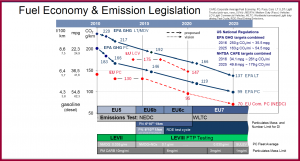
Estimates for the cost of compliance ranged from zero to $10,000 per vehicle for what is a difficult engineering task. The higher estimates – industry driven – never materialized. Click to Enlarge.
The Sierra Club Michigan Chapter says the U.S. Environmental Protection Agency (EPA) should maintain current fuel economy standards that “protect our air, land and Great Lakes.” The comments – not surprisingly – mirror the national position of the Sierra Club.
Under the beleaguered, under legal attack Trump Administration, the EPA is re-examining previously finalized clean cars standards that reduce tailpipe carbon pollution, improve fuel economy, and combat climate change.
In 2009, automakers agreed to the Obama administration’s rules, which would bring the average fleetwide fuel economy to between 50 and 52.6 mpg in 2025. (see AutoInformed on President Obama Unveils 54.5 MPG Fuel Economy Regulation for 2017-25. It will Alter Vehicle Choices and Increase Costs, DOT and EPA Issue Record 54.5 MPG Fuel Economy Standards, EPA Keeps 54.5 MPG Fuel Economy Rules in Place, California Proposes Strict Greenhouse Gases, Fuel Economy Rules for 2030)
In January under the Obama administration, the EPA finalized its proposed decision on fuel efficiency standards, originally set in 2012. The decision kept the fuel economy goals at their current level through year 2025. This decision came after a technical assessment report, a 30-day comment period, a proposed decision, and a second 30-day comment period. The Sierra Club and allies submitted more than 400,000 comments in support of the standards. Critics claim that the review was conducted too hastily.
“By reconsidering these critical clean air protections, President Trump and EPA Administrator Scott Pruitt have once again clearly demonstrated they don’t care about the future of Michigan’s air, land and Great Lakes,” said Mike Berkowitz, political director at Sierra Club Michigan.
“Today’s strong federal clean vehicle and fuel economy standards have sparked innovation and investment while reducing pollution in the air we breathe, and any attempt by the Trump Administration to roll back these crucial policies would be a massive step backward for Michigan families and for the health of our environment,” Berkowitz concluded.
Berkowitz said vehicle efficiency and carbon pollution standards, which combat climate change, are one important strategy to prevent air quality from further worsening.
More of AutoInformed on CAFE
- CARB Defies Trump on Vehicle Emission Standards
- 54.5 in 2025 Subject of Critical CAR CAFE Seminar
- Auto Engineering Now White-Water Rafting as CAFE Goes Up
- CAFE, Global Warming Rules Approved for 2022-25
- CARB Issues Mid-Term CAFE, Green House Gas Review







