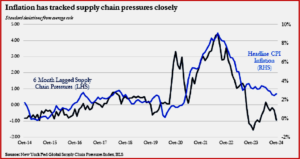
Click for explanation.
The U.S. Department of Transportation (DOT) today released a four-year review of the Supply Chains for the Transportation Industrial Base– a new assessment of progress made strengthening supply chains. It’s part of the White House Council on Supply Chain Resilience, which when t was established in January 2021 saw America’s supply chains in poor shape from the COVID-19 pandemic and decades of under-investment.
“In less than four years, we’ve gone from supply chain disruptions unlike anything we’ve seen in peacetime, to much higher levels of resiliency and reliability. That work has helped make it possible to move record levels of cargo in and out of the U.S., bring shipping costs down, and ensure essential goods arrive on time,” said U.S. Transportation Secretary Pete Buttigieg.
As well as historic funding from the infrastructure law, DOT started the Office of Multimodal Freight Infrastructure and Policy (Multimodal Freight Office) to oversee the maintenance and improvement of the nation’s freight network and supply chains. This office created DOT’s Freight Logistics Optimization Works (FLOW) program. FLOW brings together freight carriers, cargo owners, logistics providers, port operators, and trade associations. DOT claims it has successfully improved supply chain visibility and allowed different parts of the supply chain to anticipate shipments.
“Efficient supply chains enable American businesses to deliver goods faster and reduce costs for consumers. DOT is also working to establish the National Multimodal Freight Network to assist states in directing resources toward improved system performance for the efficient movement of freight on the Network, to inform freight transportation planning, and to assist in the prioritization of federal investment,” DOT said.
The FLOW program has grown from zero members in the spring of 2022 to 86 data-sharing participants, including:
- Eleven of the world’s largest ocean carriers.
- Nine of the largest U.S. container ports.
- Ten of the largest US importers.
- With 75% of all US container imports and 80% of US container terminal capacity part of the FLOW so to speak.
DOT also said today that it has identified key priority actions to maintain resilience and safeguard the U.S. economy. These recommended actions include:
- Strengthening domestic manufacturing of port cranes to reduce reliance on foreign suppliers through on-shoring initiatives, financial incentives, and regional partnerships with ally and partner nations.
- Supporting domestic shipbuilding and near-shoring to boost ship production by considering tax incentives and workforce development programs, while also prioritizing military and commercial shipbuilding to enhance national security.
- Expanding domestic EV manufacturing to focus on increasing the production of batteries and critical components domestically, reducing dependency on foreign entities of concern in international supply chains. This effort will be helped by sustainable mining and recycling practices in collaboration with global partners.
- Increasing supplier diversity in aerospace manufacturing.
- Improving data transparency to enhance supply chain resilience by expanding the use of the Freight Logistics Optimization Works (FLOW) platform.
AutoInformed notes that this will be nearly impossible to do with the pending government shutdown, which will make America less safe and poorer again.
AutoInformed on

About Ken Zino
Ken Zino, editor and publisher of AutoInformed, is a versatile auto industry participant with global experience spanning decades in print and broadcast journalism, as well as social media. He has automobile testing, marketing, public relations and communications experience. He is past president of The International Motor Press Assn, the Detroit Press Club, founding member and first President of the Automotive Press Assn. He is a member of APA, IMPA and the Midwest Automotive Press Assn.
He also brings an historical perspective while citing their contemporary relevance of the work of legendary auto writers such as Ken Purdy, Jim Dunne or Jerry Flint, or writers such as Red Smith, Mark Twain, Thomas Jefferson – all to bring perspective to a chaotic automotive universe.
Above all, decades after he first drove a car, Zino still revels in the sound of the exhaust as the throttle is blipped during a downshift and the driver’s rush that occurs when the entry, apex and exit points of a turn are smoothly and swiftly crossed. It’s the beginning of a perfect lap.
AutoInformed has an editorial philosophy that loves transportation machines of all kinds while promoting critical thinking about the future use of cars and trucks.
Zino builds AutoInformed from his background in automotive journalism starting at Hearst Publishing in New York City on Motor and MotorTech Magazines and car testing where he reviewed hundreds of vehicles in his decade-long stint as the Detroit Bureau Chief of Road & Track magazine. Zino has also worked in Europe, and Asia – now the largest automotive market in the world with China at its center.








Supply Chain Resilience – U.S. DOT Four-Year Review
Click for explanation.
The U.S. Department of Transportation (DOT) today released a four-year review of the Supply Chains for the Transportation Industrial Base– a new assessment of progress made strengthening supply chains. It’s part of the White House Council on Supply Chain Resilience, which when t was established in January 2021 saw America’s supply chains in poor shape from the COVID-19 pandemic and decades of under-investment.
“In less than four years, we’ve gone from supply chain disruptions unlike anything we’ve seen in peacetime, to much higher levels of resiliency and reliability. That work has helped make it possible to move record levels of cargo in and out of the U.S., bring shipping costs down, and ensure essential goods arrive on time,” said U.S. Transportation Secretary Pete Buttigieg.
As well as historic funding from the infrastructure law, DOT started the Office of Multimodal Freight Infrastructure and Policy (Multimodal Freight Office) to oversee the maintenance and improvement of the nation’s freight network and supply chains. This office created DOT’s Freight Logistics Optimization Works (FLOW) program. FLOW brings together freight carriers, cargo owners, logistics providers, port operators, and trade associations. DOT claims it has successfully improved supply chain visibility and allowed different parts of the supply chain to anticipate shipments.
“Efficient supply chains enable American businesses to deliver goods faster and reduce costs for consumers. DOT is also working to establish the National Multimodal Freight Network to assist states in directing resources toward improved system performance for the efficient movement of freight on the Network, to inform freight transportation planning, and to assist in the prioritization of federal investment,” DOT said.
The FLOW program has grown from zero members in the spring of 2022 to 86 data-sharing participants, including:
DOT also said today that it has identified key priority actions to maintain resilience and safeguard the U.S. economy. These recommended actions include:
AutoInformed notes that this will be nearly impossible to do with the pending government shutdown, which will make America less safe and poorer again.
AutoInformed on
About Ken Zino
Ken Zino, editor and publisher of AutoInformed, is a versatile auto industry participant with global experience spanning decades in print and broadcast journalism, as well as social media. He has automobile testing, marketing, public relations and communications experience. He is past president of The International Motor Press Assn, the Detroit Press Club, founding member and first President of the Automotive Press Assn. He is a member of APA, IMPA and the Midwest Automotive Press Assn. He also brings an historical perspective while citing their contemporary relevance of the work of legendary auto writers such as Ken Purdy, Jim Dunne or Jerry Flint, or writers such as Red Smith, Mark Twain, Thomas Jefferson – all to bring perspective to a chaotic automotive universe. Above all, decades after he first drove a car, Zino still revels in the sound of the exhaust as the throttle is blipped during a downshift and the driver’s rush that occurs when the entry, apex and exit points of a turn are smoothly and swiftly crossed. It’s the beginning of a perfect lap. AutoInformed has an editorial philosophy that loves transportation machines of all kinds while promoting critical thinking about the future use of cars and trucks. Zino builds AutoInformed from his background in automotive journalism starting at Hearst Publishing in New York City on Motor and MotorTech Magazines and car testing where he reviewed hundreds of vehicles in his decade-long stint as the Detroit Bureau Chief of Road & Track magazine. Zino has also worked in Europe, and Asia – now the largest automotive market in the world with China at its center.